V drive overheat - what to do about it

I did wonder about fitting some in line electric pumps which I could turn on when the overheat warning sounds as an alternative to just speeding up - though perhaps this is a bit heath robinson and doesnt really resolve the issue

Nah these simple V drive boxes are reputedly as tough as old boots. Clean out the coolant passages as best you can and I'm sure you'll find an improvement anyway. Might be worth having a word with a local engineering company though. V drive gearboxes are very common on Italian boats and for sure any experienced marine engineering co will have seen plenty of them
 
+1 using brick acid.
I would be careful about using brick cleaner - HCL, as there might be aluminium about. I find B&Q powder plumbers descaler quite effective without creating a flow, just mix up and leave to soak for several hours.

I think the electric pump idea is a complex solution to a very simple problem.
 
I might see if I can add oil temp gauges to the v drive boxes as well
I'm sure you can, Jez.
That V-drive was very popular in many IT boats, and I am 100% sure that Dalla Pietà boats fitted with that very same unit had also the V-drive oil temp gauge in their helm.
I would dare guessing that it's just a matter of replacing the alarm sensor (which in Deleted User pic is probably the one with the electric cable at the top of the box, near the raw water intake) with one capable of sensing the whole temp range, and send it to the gauge - still keeping also the alarm functionality, of course.

Btw, @Deleted User: you called that green BPM unit "gearbox", but just in case you or Jez never noticed (though I suppose you did, and you just used the term generically), actually it isn't.
The ZF unit on your F630 is very different, and indeed combines gearbox plus V-drive, but that green BPM unit is purely a V-drive.
In those setups, the g/box was attached to the block, and drove the jackshaft connected to the V-drive.
 
Btw, @Deleted User: you called that green BPM unit "gearbox", but just in case you or Jez never noticed (though I suppose you did, and you just used the term generically), actually it isn't.
The ZF unit on your F630 is very different, and indeed combines gearbox plus V-drive, but that green BPM unit is purely a V-drive.
In those setups, the g/box was attached to the block, and drove the jackshaft connected to the V-drive.

Yes I'm well aware of that but either way, whether or not it contains the reverse gear mechanism, the V drive is still a box full of gears;)
 
If the descale only gives you say an extra 1/2 hour @pootle , and you really want to be able to do extended pootles ,then fabricate a heat sink to attach .
The fins could be fan cooled .-so you could turn the fan off @planing knots --
Think your PC .
Just a thought !
 
the V drive is still a box full of gears
LMAO, yeah, can't argue with that! :D

@Jez, there's another thing that just popped to my mind, considering the following:
1) I never heard of any kind of problems with those BPM units - as also Deleted User said about their "tough as old boots" reputation;
2) they were designed from ground up for installation on planing boats;
3) they only rely on the pressure created by the hull motion, for circulating the sea water to keep the thing cool;
4) back in the days, going FAST was the name of the game, and both builders and boaters would have laughed at the idea of pootling with a P boat;
5) also Deleted User reported the same problem with his F46 at slow speed.

Now, all the above makes me wonder if the poor cooling at slow speed isn't somewhat inherent with the design of these units.
And if that would be the case, it might be worth replacing the existing seacock intake with a slightly bigger one, with a larger scoop under the hull.
This should create (at any given speed) a higher water pressure, hence more water circulation, also when pootling.
But of course, that's something worth considering only in the event that a thorough cleaning doesn't eliminate the problem.

Btw, thanks in advance for keeping us posted on your findings.
Some of the boats I'm considering are fitted with the same BPM unit (a bit larger actually, but I'm almost sure that they work similarly), and cruising at D speed is what I also would do most of the time!
 
How hot does the box get ?

Would it be possible to convert the set up to forced flow from the raw water cooling system of the engine / gearbox. If you take a small, say 5/16", hose from after the gearbox cooler this will likely still be cool enough for the drive, and will still leave sufficient for cooling the exhaust. You might need a simple reg valve to control the flow.
 
Nice idea, for pootling usage (when neither the g/box nor the engine are likely to get hot, hence heating the raw water a lot).
Otoh, you might fix the slow speed problem and create one at higher speed, if you see what I mean...
But if it works, it would be nice to get rid of FOUR seacocks, no less! :encouragement:
 
How hot does the box get ?

If its like the V drive box on my F46 it gets pretty hot. When I first got the overheat warning on my boat I put my hand on the V drives (yeah stupid I know) and they were certainly too hot to keep your hand on. Having said this as I said these V drives are pretty robust and you can bet that Ferretti designed the cooling system in accordance with the manufacturers instructions. That plus the fact that they've lasted a good few years on the OP's boat suggests that even though they get hot they're running within the manufacturers spec

Btw does anyone know how water is made to flow through these BPM drives given that there doesnt seem to be a pump fitted, at least not one that needs regular maintenance?
 
Btw does anyone know how water is made to flow through these BPM drives given that there doesnt seem to be a pump fitted, at least not one that needs regular maintenance?
M, point 3 in my post #27 already addressed your question.
But mind, what I said was just an inference based on what has been discussed here and other installations I've seen - not because I know for sure.
A good pointer could be the in seacocks scoops: if what I envisaged is correct, the inlet should be facing forward and the outlet the other way round.
Btw, I did see a boat with those BPM units on the hard, but I didn't think of checking that out.
Maybe Jez will tell us - I'm sure that the sea water in SC can't be that cold, even in winter... :cool:
 
........ the inlet should be facing forward and the outlet the other way round.

Thinking out of the box a bit....
..... with the outlet facing the other way around (aft), you could modify this to create an ejector effect by cutting a slat opening (about a quarter of the outlet volume sounds about right...) in the forward facing part of the outlet, which would generate a flow across the outlet that will result in a suction effect as the boat moves through the water... not sure if that would have a negative effect at speed though ..
 
I see your point in principle, but IF (and it's a big if, because actually this is just a speculation at the moment, and maybe/hopefully some cleaning will be enough) at slow speed the pressure on the inlet is too low, I doubt that the suction effect on the outlet can make a big difference...
 
M, point 3 in my post #27 already addressed your question.
But mind, what I said was just an inference based on what has been discussed here and other installations I've seen - not because I know for sure.
A good pointer could be the in seacocks scoops: if what I envisaged is correct, the inlet should be facing forward and the outlet the other way round.
Btw, I did see a boat with those BPM units on the hard, but I didn't think of checking that out.
Maybe Jez will tell us - I'm sure that the sea water in SC can't be that cold, even in winter... :cool:

Yup I saw your post but I'm not sure its entirely correct. I may be wrong but I never saw any scoops under the hull of my F46 and I wonder how effective they would be anyway. After all the pressure at both the inlet and the outlet should always be the same. Just guessing but is it anything to do with the vent pipe coming out of the top of the v drive on the outlet side?
 
Yup I saw your post but I'm not sure its entirely correct. I may be wrong but I never saw any scoops under the hull of my F46 and I wonder how effective they would be anyway. After all the pressure at both the inlet and the outlet should always be the same. Just guessing but is it anything to do with the vent pipe coming out of the top of the v drive on the outlet side?
Well, I can't blame you for not being sure that my suggestion is correct, since as I said I'm not sure either... :D
But IF (again, big if!) there would be scoops with opposite orientation under those seacocks, the pressure surely would be different while under way, I reckon.
And the higher the speed, the higher the difference - hence my train of thought on potentially too low pressure differential (hence reduced flow) at D speed.
Of course, if there are no scoops, the theory goes out of the window...

Ref that third pipe near the outlet, do you remember where it was connected on the other end? I can't see where it goes, in your pic...
 
Ref that third pipe near the outlet, do you remember where it was connected on the other end? I can't see where it goes, in your pic...

No I dont but it wouldnt make any sense to have it exit under the waterline so my guess is either that it went to the manifold which collected all the cockpit drains on that side and then overboard above the waterline or it went to a separate outlet above the waterline. If the OP's V drive is configured in the same way it would be as well to check that this pipe is clear of debris too
 
I see your point in principle, but IF (and it's a big if, because actually this is just a speculation at the moment, and maybe/hopefully some cleaning will be enough) at slow speed the pressure on the inlet is too low, I doubt that the suction effect on the outlet can make a big difference...

You'll reduce the force needed to push a certain volume water in, by generating suction in the other end ... sort of had the thought that the combined effect (pressure at entry and suction at outlet) would be enough to obtain greater flow rate than what the speed would equate to with inlet pressure alone....
 
No I dont but it wouldnt make any sense to have it exit under the waterline so my guess is either that it went to the manifold which collected all the cockpit drains on that side and then overboard above the waterline or it went to a separate outlet above the waterline. If the OP's V drive is configured in the same way it would be as well to check that this pipe is clear of debris too
Yup, all agreed.
Though all depends on whether the third pipe is actually for vent/overflow or not - something which as I understand you are not 100% positive about.
I googled around a bit, but couldn't find any decent technical documentation.
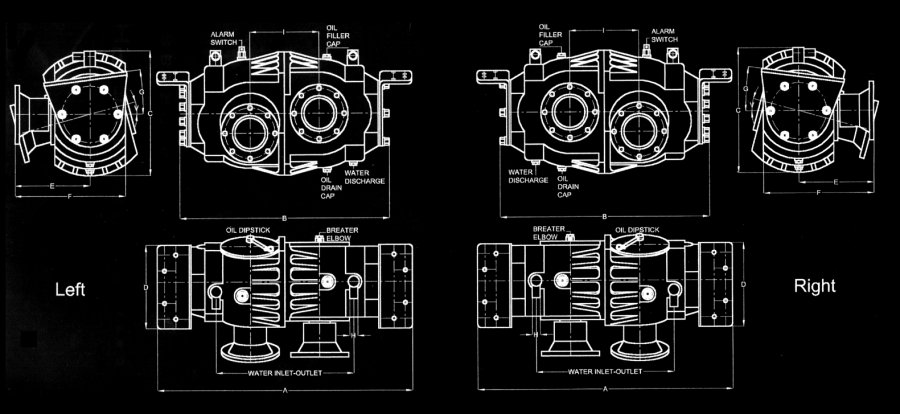
All I found on BPM website is the drawing below.
As I understand it, the point where that third hose is attached in your pic is the one labelled as "oil filler cap"... :confused:
Besides, interestingly, the raw water inlet/outlet are not labelled separately, as if the direction would not matter.
Which stands to reason, for cooling purposes only, and confirms that there isn't an internal pump inside the box.
Anyway, I for one am indeed curious to hear from Jez after his further investigations!
dim_vdrive.jpg
 
You'll reduce the force needed to push a certain volume water in, by generating suction in the other end ... sort of had the thought that the combined effect (pressure at entry and suction at outlet) would be enough to obtain greater flow rate than what the speed would equate to with inlet pressure alone....
Yeah, as I said I do understand the principle.
I'm just not sure of how relevant the suction effect can be, and I suppose it ain't trivial to make a proper size/shape of the opening, considering also that it should work in a very wide speed range...
Anyhow, only some tests could tell. Maybe you're right, and it could well be that nobody thought about that before! :encouragement:
 
Top