
Using a VSR with a 1-both-2 off switch..... PART 2

Sneaky Pete

Well-Known Member
Joined
26 Nov 2009
Messages
919
Location
In the shadows of Faslane.
Visit site
Following on from my post on this recently. I think the boat has been wired in the dark using scraps of cable left in a bin. What a mess.
I am looking for some direction due to my limited knowledge of electrics. Picture 1 is the present set-up where would I fit into the circuit a VSR allowing me to still use the1-both-2 off switch.

Picture 2. Is this the correct circuit set-up when the 1-both-2 off switch is removed and replaced with manual on/off power switches, a VSR and an emergency crossover switch.
Advice greatly appreciated.
Hopefully this doesn’t turn into a trilogy.
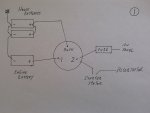
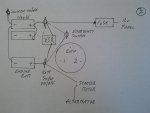
Switch 1both2.jpg VSR.jpg
 
Picture 1 isn't drawn quite right, but that doesn't matter. You connect the VSR between the positive connection on the engine battery and the positive connection of the house bank. There needs to be a fuse between one battery and the VSR, to protect the VSR from overload. If the other cable is in no danger of chafing you can leave it un-fused, fit a fuse if a risk of short circuit exists. Any fuses should be fitted as close to the batteries as possible.

Pic 2 is correct as far as the switch cabling goes, but the VSR should be connected as above. All cables from the batteries to the switches and the cables to the emergency switch should be rated for the starter motor and fused as appropriate.
 
It does but for the risk of cable damage or a terminal shorting out, etc when the system is linked but I wouldn’t want to be explaining why I didn’t fit the <£5 fuse if my boat caught fire.

As Paul mentions, it is sometimes a good idea. But actually, it’s always a good idea. Worst case is that you’ve wasted a fuse holder if it never blows??

Sterling show their VSR with 2 fuses for example. I’d expect Victron to do so, and I rate their products highly, but they don’t!

Why on earth? The circuit between the 2 batteries/banks only needs one fuse to protect it.
 
Last edited:
As Paul mentions, it is sometimes a good idea. But actually, it’s always a good idea.

He mentioned having a second fuse if there's a risk of the cable chafing - surely it's easy to install a cable so that it isn't in danger of chafing? Or isn't this how the professionals work?
 
I thought i was clear with what i meant, apparently not :)

At least one fuse must be fitted to protect the VSR from overload.

If the VSR is mounted, for instance, in a wooden box, on a plastic boat, with nothing in a position to short circuit the cable between the battery that does not have a fuse and the VSR, then it is pointless fitting a second fuse. What is it protecting ?

Victron clearly agree with me, they stipulate a single fuse. Other manufacturers may disagree, i don't care as i only fit Victron VSRs so i'm following the manufacturers instructions and those of common sense, IMO.

I'm all for fitting fuses and/or circuit breakers, i've just installed nearly 40 on one boat, but they are there for circuit and/or wiring protection, no point fitting them for the sake of it.
 
OP hasn’t mentioned his brand that he wishes to use.

I’d hate to advise 1 fuse on 1 leg only to be told he was fitting a Sterling :eek: ‘orrible things that they are.

Horses for corses but a risk that can be removed for the cost of a fuse holder is worth it in my opinion. No boat leaves me without each leg protected with a fuse unless it forms part of a solid bus in which case it has a resettable Blue Sea breaker.


Would be like asking for a brand new car with only a drivers airbag because you do t carry passengers very often and wanted to save a few quid. But, each to their own.
 
OP hasn’t mentioned his brand that he wishes to use.

I’d hate to advise 1 fuse on 1 leg only to be told he was fitting a Sterling :eek: ‘orrible things that they are.

Horses for corses but a risk that can be removed for the cost of a fuse holder is worth it in my opinion. No boat leaves me without each leg protected with a fuse unless it forms part of a solid bus in which case it has a resettable Blue Sea breaker.


Would be like asking for a brand new car with only a drivers airbag because you do t carry passengers very often and wanted to save a few quid. But, each to their own.

You have a length of cable, a few inches long, in a wooden box, on a plastic boat, with no metal in it, there is nothing that can possibly cause a short circuit, even if the cable was badly fitted and chafed against "something" (which by virtue of the previous description would have to be non-conductive). What is the second fuse protecting ? What is it protecting against ?
 
Wooden box? Is that the battery box?

You have a length of cable, a few inches long, in a wooden box, on a plastic boat, with no metal in it, there is nothing that can possibly cause a short circuit, even if the cable was badly fitted and chafed against "something" (which by virtue of the previous description would have to be non-conductive). What is the second fuse protecting ? What is it protecting against ?
 
It is there for the day matey drives a wood screw though the other side of the box whilst mounting a new fuel filter or remote oil filter, etc...

I changed a whole sub loom on a Oyster because someone drove a 3 inch stainless screw into a 1 inch bulkhead and punctured only 1 core that believe it or not.... kept tripping the fuse by shorting the filter housing, though the engine.

I can't see why it needed further discussion as it is horses for courses. Some specify 2 fuses, Victron only specify 1. Pay your money, take your choice. I'd be going with the 2nd fuse. If the relay is closed, you have 1 theoretical cable, if the relay opens, you have 2. Fuses protect the cable. I'm not saying that you must fit 2 fuses or god forbid you are wrong, I'm saying that I do fit 2.

FTR: the reason I was asking as to whether it was a battery box or not was because mounting any switching devices, relays, contactors, etc in a battery box is not a good idea otherwise something could go bang one day.
 
Top