Use of DSC alerts?

The graphic WAS funny

  • I DISAGREE

    Votes: 0 0.0%
  • I agree

    Votes: 0 0.0%

  • Total voters
    0
Solitaire,

What I want is a DSC course on MY SPECIFIC VHF. I regard VHF & DSC as vital safety equipment so when refitting last year splashed out on the dog's whatsit's Icom 601 set with Command mic for quick access at the helm station. Great kit yes, but the accompanying manual is rubbish. It doesn't explain a lot of what the set does - the instructions on the set screen(s) do not correspond with the manual. I tackled Icom at LIBS this year and frankly they were hopeless and really couldn't be bothered with my problem - which as you can tell brassed me off big style. I wouldn't buy Icom again for that reason. So - if you're running an Icom 601 DSC course - I'm interested.

rob
 
[ QUOTE ]
The problem is Brendan that there is no theory which gives it advantage, certainly not on angle modulated systems, (Phase and Frequency Modulation).
On amplitude modulated derivatives like SSB if you shout louder into the mike you can get a higher output. The same is not true for F3E or G3E. The carrier amplitude of the signal always remains the same. It is the "deviation" which changes ie the frequency or phase shifts, so it can not have any bearing whatsoever on range persee.
You have to put in sufficient signal to open the squelch of the reciever and that is dependent on how many microvolts are being received at the antenna ie how great the electomagnetic field being recieved.
That is a function of the carrier power, nothing to do with whatever signal that carrier is being modulated with, whether digital, voice, Pulse Code Modulation or the bonzo dog do dah band playing the into and outro into your mike..it will always be the same.


[/ QUOTE ]
I rest my case! 99.9% of people who come on an SRC course would now be lying on the floor bleeding to death! It would be very educational for you to go and sit in on few courses and see the attendees. You are living in a very small world and I'm afraid you are not seeing reality! I would say that 50% of peep who come on the SRC course are women, they are there because they want to know how to use the radio in an emergency and feel confident in the procedures. Only last week I had was doing a 1:1 Day Skipper theory course for a lady who specifically asked me to cover DSC alerting. Her partner was in his 60's and she wanted an update on how to use send DSC alerts in case something happened to him. In fact a very high proportion of women do the course for that very reason. They don't want to know what goes on inside the box!!

The wider market are looking to understand how to correctly make use of the equipment, the procedure! As Dogwatch has said, you don't have to strip down your car engine to to take your driving test - a very good analogy in my opinion.

There might well be a need for a further course, after all there are extra courses on sea survival and diesel engine - but these are MCA based. But those who go onto to do such courses do so for different reasons than leisure boating.
 
To slighty defend the RYA course, it is run purly to equip the operator with a 'how to make correct calls' what has that got to do with what goes on behind the scene's. Any person can buy and install a radio with all the problems that you mention. That's not the RYA's fault if you want to have a go at someone make it the MCA and Ofcom they say what the RYA course is to teach and Ofcom liscence your set. If you feel it needs a degree in radio technology to install a set thats great but it is not going to happen.
 
[ QUOTE ]

What I want is a DSC course on MY SPECIFIC VHF. So - if you're running an Icom 601 DSC course - I'm interested.

rob

[/ QUOTE ]

I'm running a course this Saturday and the next one is on 22nd April. I use the 601 simulator so you can take your choice on dates. If you go to the web site you can see the other dates available. We are currently operating from Universal Marina, but if you do the April date then we will be in our new offices/classroom in Deacons Boatyard just up from Aladdin's Cave at Swanick.
 
[ QUOTE ]
Back to the question -


The bits the instructor got a little confused on (but recovered well) were DSC urgency calls and Mayday relays.


[/ QUOTE ]

The key here is to remember that you'd send such calls using the urgency call setting on the menu. To be honest, if push came to shove, you could use the security alert as well - after all both get all DSC enabled sets to change to Ch16. The only difference is that the receiving screens will "announce" either and urgency or a safety incoming call. The voice call would confirm the actual nature - Mayday Relay or Pan Pan.

The major difference between using the "red button" and making other calls is that the menu you will ask you if you want to send the call or not.

I also suggest to people that they think carefully about where they mount there sets. Some screens are very small and the practicalities of seeing what is on the screen is not helped by poor positioning. I find this is an issue when, like me, people have to wear glasses to read!! I could see the screen if it was on the bow no worries - up close a slightly different matter. /forums/images/graemlins/cool.gif
 
Of course what I had in mind would be nowhere near that level of technicality.
I was just answering Brendans post in a technical fashion, because presumably
he is able to understand to that degree.
I have well over 100 RAE candidate passes under my belt, and I didnt bore any of them to death.
You wont change my mind on this, and I daresay I wont change yours.
I firmly beleive that procedures are fine, but the whole system becomes useless
if it doesnt work properly when needed in an emergency.
Lets take a car analagy...you wouldnt go on a long journey without knowing how to check the oil level, check the tyre pressures, check fuel level, know where to put the water, or washer water would you?
It is this sort of very basic level that I feel should be added to the radio course.
Too much on radio systems is taken for granted and many of them dont perform to anywhere near their potential because of dodgy install.

And what has being a woman got anything to do with anything.
I find that on the whole they are at least equal to or better at learning than men, because they generally dont arrive with any preconceived attitude.

Regards

Steve.
 
I did the DSC SRC course last year. I found it very basic, especially the bit about how to press the red button ... but then I deal with computers and their (ab)users every day so if I couldn't work a VHF I'd be worried. I can't remember if I actually learnt anything "new" or if it was all just revision of bits'n'pieces I'd pickedup over the years....
For me, learning more about the y's and wherefor's of installation and background power would be interesting, but in no way essential to the operation of the set, some ppl find it hard enough to grasp the concept of DSC (Do I have to switch to Chl 70 to send a DSC? Does it transmit on Ch16 for an emergency? type questions) without having to understand how the thing connects and works too ...
For those that want to know more there are plenty of resources out there for them ... but for those that just need to be able to operate the radio the current SRC/DSC is (just) adequate IMO.

You comparison to checking oil levels, washer water & tyre pressure is (IMO) the equivalent of making sure the radio is turned on and the antenna is still there (found ours in the cockpit last year!).

I believe it would be better for pleasure users to be able to gauge the effectiveness of their sets in a radio check, having done this myself with a friend (I assume he still is!) I know our radio works effectively at around 12Nm with land interference ... so not much problem there! All I've heard from the CG is "Your loud and clear" or "Your weak and unreadable" ... usually nothing inbetween... certainly nothing to give an indication of the effectivness of the radio, but then you'd need to know the distance between the antenna ....
 
Ah now there lies the problem!

Sorry but why do Hams always try to make all radio course like the RAE?
Please don't tell me they don't.
I have been teaching radio for nearly 20 year's.
Not just marine but land based radio too.
Everytime a Ham gets involved they try to make us all radio ham's!
Sorry not having a go at the hobby because it is a good hobby but well don't all need to be trained as ham's.
There is other ways that radio can be use, correctly.

You can not compare the RAE with the SRC course.

They are very different for very good reasons.

The SRC is an operators course the RAE is not, it is a course designed to teach how to make, how to understand radio.
There is very little content on operation on the RAE.

Both Jon and Solitare are very well reppected instructors.
Solitare has, rightly, found there is a short coming and was trying to fix it.

The SRC course is a very full course.
IMHO it could do with being longer but then the average boaty would not do it!
The content we have to include in the course is huge and can be a tight sqeeze.

Now the RYA are insisting those teaching the SRC course use real radio simulators this will help the students to understand it much better.
The students get to use real radio's and feel more confident in the use of voice and DSC.

The last course I ran, two weeks ago, none of the stdents had seen or used a marine radio before.
All left feeling 110% confident on what they had learnt.

You average boaty does not need to know how to instal a radio, how the wave carry throught the air, how to do a VSWR, propergation etc.
It is very clear from a number of post in this thread and on other that deal with radio the people only want the basics.

The SRC is a requiement under International Maritime Law.
The requirement is a course on how to use the radio not how to instal or repair it.
It is an operators.

Please do not think this is a knock at the Ham's its not, it just what I have seen and had to deal with over the years IMHO.

Solitare, great idea keep it up.

Regards
 
Perhaps, like driving ... there is a requirement for Advanced SRC course ?? In the course you'll learn how to control a skid, cadence brake and ... oh bum ... thats driving ... erm ...
 
I can understand where you are coming from with this poll - I do the VHF courses and the way that we are required to teach them, there is more forgettable eye glazing technicalities than there is real practise.

I suspect that the real learning how to use the sets will only come from doing it over a period of time. And it will still probably desert people when it comes to the crunch. Plus, of course, you cant practise Maydays on your real set.

Maybe the solution would be to make the DSC course 8 hours on the practise radio sets and just a handout covering all the legalistic crap so beloved of Offcom. As it is, its a bit (now repeat after me) T tango, U uniform, R romeo, G golf, I india, D delta ! /forums/images/graemlins/grin.gif
 
Back to the debate about useable distances for Digital versus Voice (Analogue)...

I'm interested in this.... (and trying to ignore the above bits about over complicating..... I know this isn't neccessary for a certificate, or probably of interest to many users....)

I appreciate Steve's point about there needing to be enough carrier to overcome the squelch, but I understood that the better distance acheived by digital was (accepting that there is enough carrier signal to start with) the fact that the receiver needs to recognise a high state or low state for an accurate reception, and providing the voltage needed to achieve this state is greater than the background noise then a 100% replication of the transmission is acheived.... whereas with analogue, the varying voltages present under AM system allow parts of the frequency band of the transmission to be 'lost' meaning that as the receiveable frequency range reduces, a gradual deterioration is observed...... and eventually as enough of the range are lost it becomes unintelligable...

So technically, the same distances... but practically, a bit further useable distance for digital.....

Although perhaps largely irellevant given the need to follow up a DSC call with a voice call..../forums/images/graemlins/grin.gif

PS..... I'm assuming that VHF uses Amplitude mod not any other mod such as FM or PCM...?
 
Thats where i came in, with my SILLY question.
Thanks Solitaire i did'nt dream it would create
such flak for you, still you got above it.
Cheers Tony
 
VHF uses frequency modulation.

Remember back to physics when they got out the slinky and held it at both ends. One pupil then pushes the spring so a pulse of energy travels along the spring, but the spring stays in a straight line between the pupils.

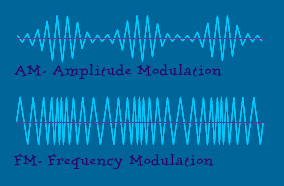
AM is when the student swings the spring side to side and you get a sine wave shape in the whole spring.

AM can travel further, the more power you push in the further you can expect the signal to travel, AM SW enjoys the phenonima of skip off the Stratosphere (I actually can't remember which layer, one of them) and so can travel around the earth rather than straight lines, hence why it is popular with HAMs.

The problems with AM is clarity caused by static More here from PBS web page

FM vs AM: What's the difference?

fmamcompare.gif


FM radio works the same way that AM radio works. The difference is in how the carrier wave is modulated, or altered. With AM radio, the amplitude, or overall strength, of the signal is varied to incorporate the sound information. With FM, the frequency (the number of times each second that the current changes direction) of the carrier signal is varied.

FM signals have a great advantage over AM signals. Both signals are susceptible to slight changes in amplitude. With an AM broadcast, these changes result in static. With an FM broadcast, slight changes in amplitude don't matter -- since the audio signal is conveyed through changes in frequency, the FM receiver can just ignore changes in amplitude. The result: no static at all. more


helps?
 
Flak, I thought we were having a discussion, no one has flamed nor got irate, I think it has been quite interesting. So far even Solitaire has respected Steve's views and understands where he was coming from with regards a better understanding.

And Steve understands Solitaire's point of view with the level of students attending courses.

You, ironically are the only one giving flak by suggesting that everyone has given flak to poor Solitaire. Please do not troll!
 
Sorry Woofy, I know the difference... just couldn't be arsed to look it up to see what modulation it uses /forums/images/graemlins/grin.gif.... in fact I know quite a bit about it..... have a masters in communication engineering, and spent many a happy hour investigating AM, FM, PCM, DPCM, ADPCM etc etc although haven't used diddly squat of it since.... /forums/images/graemlins/wink.gif

My post was more about trying to bring the thread back on track.... and I do appreciate that its technically innacurate, eg input dBm not neccessarily affecting frequency response directly under an AM system etc etc.... but it seemed to me that there was a risk that people (who are interested!) might go away with a misunderstanding of the merits and disadvantages of analogue and digital...

Regardless.... thanks for the efffort anyway!
 
Re: Further with digital??

Ive been doing a bit of digging about this today, been on the phone to a former colleague at Marconi and been looking at "geeky" books since I got home.
The answer is that there is no answer...as far as I can tell.
In theory, if the carrier breaks the squelch there should be enough modulation for any mode to operate, provided that the modulation is of equal value.
One possibility, is that because DSC is applied closer to the Phase modulator then the modulation index may be higher and the signal cleaner.
However, conversely if we take the parallel of digital TV it is widely known that much more signal is required to get acceptable results.
What may be a noisy but acceptable signal on analogue will result in chronic pixellation on digital.
What was also pointed out to me was that the human ear/brain is predictive, and is quite good at filling missing bits of mesages in poor condx.
A digital system has to have the whole packet cleanly for it to be of any use.

Obviously for end to end communication systems which use smart methods of digital modulation such as GMSK (gaussian minimum shift keying) and with handshaking, compression and rolling error checking, with these systems on a dodgy link, they can automatically force the far end to re-send over and over again until the packet is received correctly. Even on old low speed links using a protocol like X25 that was always the case.
However DSC isnt that smart, and is basically built around what was a one shot ID system.
It's quite old, having been around in PMR since the late seventies.
But that is not to knock it...it's tried and tested and reasonably bomb proof which is exactly what is needed for an emergency communications system.
So I'm sorry I cant give a definitive answer, but I err on the side of caution and would say that with an FM or Phase Mod system only rely on it as far as you would with voice comms.
Maybe someone else can find a definitive answer?

Steve.
 
Re: Further with digital??

Interesting..... nver looked at DSC properly with a technical hat on.... so its a fire and forget system with no error correction?

Interestingly i've been quite involved in VOIP systems in recent years and the telco guys use an very simple index for voice quality that is based upon human interpreters rather than any fixed electronic measurement system.... their justification being that the human can interpret far more accurately a 'good' signal from a 'bad' one... and its not just the frequency response range of the signal, its a whole load more complicated than that.... for example signals with low ranges removed are better interpreted by the ear than signals with high ranges removed... but remove either entirely and it becomes unintelligable...

Still think that an FM system retrieving very basic digital streams is likely to be better than one trying to recover complex analogue signals.... after all it only really has two states to identify rather than an infinite variation..... but only guess work... and based on gut feel and I guess without an error correction system the difference is one lost bit screws the whole system unlike analogue...

I can understand Digital TV being power demanding, after all the rates must be quite high given what is being transmitted..... but surely DSC is very low rate and hence less prone to error?

Maybe I'm just chasing my tail here!

Regardless.... an interesting subject....
 
[ QUOTE ]
You wont change my mind on this, and I daresay I wont change yours.

[/ QUOTE ]

Nope!

[ QUOTE ]
And what has being a woman got anything to do with anything.
I find that on the whole they are at least equal to or better at learning than men, because they generally dont arrive with any preconceived attitude.

[/ QUOTE ]

Good lord! We agree on something!

My reference to women was their reason for doing the course - nothing more. Oddly enough they make up over 50% of the population. Would you have commented if I said men?
 
Top