Use DSC position request to alert shipping

nick.hawkes

New Member
Joined
26 Jan 2014
Messages
2
Visit site
I'm wondering about buying an AIS class B transceiver for crossing shipping lanes to make sure that we are seen by the shipping. However, finding a good location for the aerial (so as not to clash with the VHF aerial and yet be high enough for a decent range) has me wondering if there is another solution, can anyone comment on the following idea. If we spot a ship on a near collision course, using our AIS receiver, we can obtain it's MMSI number. Then, using this number we can send a DSC 'position request' to the ship, which I imagine will present out position on the ship's chart plotter (since, I believe, the position request message contains our own position in the transmission). Not as satisfactory as continually sending updated positions via AIS, but good enough to reassure us that we have probably been seen. Am I correct in my thinking about how the DSC position request works, and any thoughts about whether this is a legitimate use of the facility or likely to be an annoyance to the ship's crew. I imagine it to be less intrusive than a ship-to-ship 'have you spotted us on your radar' message.
 
I don't think a "position request" message sends your own position.

I believe there is a "position report" message which sends your position and is closer to what you're trying to achieve.

I would not be confident that ships' VHF is necessarily connected to the ECDIS (if they even have ECDIS).

My gut feeling is that if you must contact them, most watchkeepers would prefer voice to DSC data.

Don't forget about channel 13.

Pete
 
I would suggest that you just buy an AIS transceiver splitter (such as Raymarine AIS100) and use your masthead VHF antenna with the AIS.

I fitted a splitter this season, having previously had a separate AIS antenna which had very poor performance. It has been very noticeable this year that big ships don't come anywhere closer than about a mile - I can see them making a small adjustment to their course a good ten or fifteen miles away to avoid coming anywhere close to me. I guess they prefer to make a small course change early than a big one late.

Last year I had a small antenna low down and I would sometimes see ships before they appeared on the AIS. Also, they would have to be even closer before the ship's name would be picked up. I never tried what you are proposing, but I think it would not have been very practical.
 
I was hoping that NASA would bring out a (new) standalone transceiver engine that would interface with their AIS Radar, so that it could be programmed from the AIS Radar, rather than what they have now that works with modern navigation equipment or computer. Many of us have older equipment that does not interface with anything new. I have an old Raytheon radar and a Navman plotter that would not work with the NASA transceiver engine they produce now.

I contacted them on this, and they replied that they have no plans at present.

Perhaps, if enough of us asked, they may produce something.
 
I'm wondering about buying an AIS class B transceiver for crossing shipping lanes to make sure that we are seen by the shipping. However, finding a good location for the aerial (so as not to clash with the VHF aerial and yet be high enough for a decent range) has me wondering if there is another solution, can anyone comment on the following idea. If we spot a ship on a near collision course, using our AIS receiver, we can obtain it's MMSI number. Then, using this number we can send a DSC 'position request' to the ship, which I imagine will present out position on the ship's chart plotter (since, I believe, the position request message contains our own position in the transmission). Not as satisfactory as continually sending updated positions via AIS, but good enough to reassure us that we have probably been seen. Am I correct in my thinking about how the DSC position request works, and any thoughts about whether this is a legitimate use of the facility or likely to be an annoyance to the ship's crew. I imagine it to be less intrusive than a ship-to-ship 'have you spotted us on your radar' message.
We use the Mk I eyeball and stay clear of the big stuff.
 
We use the Mk I eyeball and stay clear of the big stuff.

Ditto, but as I mentioned in another thread, in rain or less good vis, it is useful to know that blip 10 miles away is coming nowhere near you, even if it's doing 22Kts.

I was on the bridge of a car ferry about a year ago, and asked the guys on watch about AIS / Chan 16 / Radar / eyeball use. They do have Chan 16 up, but v.quiet.. They tend to use eyeballs and radar, largely ignore AIS- though they transmit position. That tends to concur with what I thought, that small boat users have more actual use for AIS than the big boys. Having said that, the "spy in the bridge aspect" - recording their movements in busy areas probably modifies the behaviour in some cases.
I think the bulk of bridge officer training still favours radar. One of our dinghy sailing club members take charge of a huge cruise boat on watch and tends to agree.
Do you have a radar reflector up your mast?
 
I think the bulk of bridge officer training still favours radar.

That matches everything I've seen and heard as well. AIS is slowly becoming more of a presence as new ships (and bridge refits) incorporate it into ECDIS, but radar is still king. Some of the watchkeepers I used to see on square riggers spent far more time looking at the radar than out the window, even on clear days.

Pete
 
We use the Mk I eyeball and stay clear of the big stuff.

That's just about right.

To get the best out of AIS, you need a good receiver which will warn you of collision. On the basis of what it tells you, up the helm and get out of the way.

I doubt a Class B AIS transmitter adds much, if anything, to your safety.
 
I'm wondering about buying an AIS class B transceiver for crossing shipping lanes to make sure that we are seen by the shipping.

It won't make sure you're seen. You'll be one of hundreds of Class B boats whose signals are received on the ship's AIS receiver. But few watchkeepers look at that, they look at their radar. Buying an active radar transponder is a much better way to spend your money.
 
That's just about right.

To get the best out of AIS, you need a good receiver which will warn you of collision. On the basis of what it tells you, up the helm and get out of the way.

I doubt a Class B AIS transmitter adds much, if anything, to your safety.

I think you and others are very wrong! Having spent the season doing some long offshore trips with my Class B transceiver it was very noticeable how fewer close encounters with large ships I had. MY AIS starts picking up ships about 50-60nm away and out of curiosity I like to look up the name, destination etc, but also note the CPA and TCPA, especially if the CPA is small. I noticed on several occasions that I might initially have a small CPA with a target - say 0.25nm in 2-3 hours, but by the time the ship had come into view the CPA had always increased to usually about 1nm - sometimes I could even see them adjusting course by a degree or so about 20-30 miles away, which is when they probably first picked up my own AIS signal.

Last year I has the AIS transceiver but transmitting only via a low-mounted stub antenna and I could sometimes see ships before they appeared on my AIS and I thus doubt they were picking up my signal at all - certainly I had a number of ships coming fairly close particularly at night.

I feel very substantially safer single-handing with my AIS transceiver - particularly now that the antenna is at the masthead via a splitter. Indeed, I have realised now that with AIS as first line of defence, then a decent gimballed radar with guard-zone as second line of defence, I am not at risk of running into anything. I generally set the AIS alarm to sound if a target has a CPA of 0.5nm in a TCPA of 12min, and the radar guard ring at about 1nm depending on sea-state. I never once managed to spot a single target with the "Mk1 eyeball" before it had been detected by the AIS or the radar, even at night and indeed would often have a hard job making a visual confirmation on a radar target.

Previously when single-handing I used to kip during the day and stay awake at night - I now do the opposite as there is no point in staying on deck all night peering into the dark as the AIS and radar alert me way before I see anything myself. At least if I am looking out during the day, I have a chance to spot flotsam that would get through the AIS and radar lookout and could be a danger. I thus kip mostly at night which is far more pleasant too!
 
I'm using an active splitter to my masthead antenna which gives me a minimum 50 mile range and a maximum 550 mile. (there's a separate thread on this night-time phenomenon!)

The AIS software also has a signal strength meter which is supposed to show any degradation of the VHF setup. Mine shows no degradation of signal through the splitter.

Richard
 
Don't think using DSC is a good way of doing it, would not expect the VHF's on the big ships to be configured to do automatic/manual response, probably just ignoring a position request.

My AIS class B transponder send my position/COG/SOG but I'm not assuming that that I'm seen but it might help...

On my chart plotter I use the COG/SOG predictor arrows (5 min inshore / 30 min offshore), the arrow heads show the predicted positions in x min for me and my AIS targets.
The big ship (class A) also transmit their ROT (Rate Of Turn) as part of the dynamic data, on my chart plotter a ship turning is shoen with a clearly visible curly arrow.
Any changes to course/speed will be visible much earlier on AIS than on both RADAR and visual plotting can do.

By using AIS I can understand the other vessels path earlier and I have better understanding of what their intentions are at an early stage.
Less guessing on what the big ships are doing - less need to hail on VHF - but if I need to I can use Name or do an DSC/MMSI call.

I turn my AIS of in harbor and anchorages + I can put the AIS on silent mode if necessary.

I found this interesting thread http://www.gcaptain.com/forum/professional-mariner-forum/12345-ais-small-vessles.html a bit long but worth the read
 
I think you and others are very wrong!

In the middle of the ocean, where there are few Class B transponders, I'd expect ships to show them on their radar screens. Anywhere near land, which is where most Class B transponders will be, and they'll almost certainly be filtered out from the radar screens - the clutter would be ridiculous otherwise.
 
Don't think using DSC is a good way of doing it, would not expect the VHF's on the big ships to be configured to do automatic/manual response, probably just ignoring a position request.

My AIS class B transponder send my position/COG/SOG but I'm not assuming that that I'm seen but it might help...

On my chart plotter I use the COG/SOG predictor arrows (5 min inshore / 30 min offshore), the arrow heads show the predicted positions in x min for me and my AIS targets.
The big ship (class A) also transmit their ROT (Rate Of Turn) as part of the dynamic data, on my chart plotter a ship turning is shoen with a clearly visible curly arrow.
Any changes to course/speed will be visible much earlier on AIS than on both RADAR and visual plotting can do.

By using AIS I can understand the other vessels path earlier and I have better understanding of what their intentions are at an early stage.
Less guessing on what the big ships are doing - less need to hail on VHF - but if I need to I can use Name or do an DSC/MMSI call.

I turn my AIS of in harbor and anchorages + I can put the AIS on silent mode if necessary.

I found this interesting thread http://www.gcaptain.com/forum/professional-mariner-forum/12345-ais-small-vessles.html a bit long but worth the read

That thread is very informative, particularly post 13. It exactly confirms my observations that ships start changing course about ten miles out to avoid a CPA of less than 1nm. Before I had AIS transceiver I would often have ships coming much closer than even 0.5nm - presumably because they didn't see me until I showed up on their radar.

Also, earlier this summer a French fisherman was able to call me up on VHF by my vessel name to warn me that was standing on to his drift nets - I picked it up immediately. In previous years when called "la navire a position blah blah boa" I would have to leave whatever I was doing in the cockpit, wait for the vessel to call again, write down the position, and check it against my chart plotter, all of which would take some time.

For me and my sort of sailing, my AIS transceiver, with masthead antenna, has been one of the most important safety additions to my boat.
 
I did not go down the splitter route.
I bought a dedicated aerial & then I cut down a fairly long sailboard boom -extending type- so I had the straight part with a slight bend at the end to turn the wire sligtly so it aligned with the deck gland better.. The aluminium in a sailboard boom is good quality & nicely anodised
I fixed it to the pushpit with the aerial on the extending part. To fix it i used a couple of u bolts. The end comes right near the deck gland to prevent exposed wires getting caught.
the aerial gets enough range but if I wanted more I can pull the extension out of the boom & get an extra 2 feet height.
My reasoning for the separate aerial is as a backup in case of dismasting
On the opposite side of the boat i have used the other half of the boom with an Echomax active radar reflector
The AIS picks up ships well before I see them. The only problem is that if I switch on CPA TCPA etc the da...med chart pilot keeps bleeping to warn me & I have to turn it off every 30 seconds plus a little text box block the chart plotter. Hence I turn that part of the system off. then it is awkward seeing on the plotter where the targets are
 
The AIS picks up ships well before I see them. The only problem is that if I switch on CPA TCPA etc the da...med chart pilot keeps bleeping to warn me & I have to turn it off every 30 seconds plus a little text box block the chart plotter. Hence I turn that part of the system off. then it is awkward seeing on the plotter where the targets are

Yes - sadly the AIS functions in most plotters are quite basic, with limited control over filters and alarms and very little thought given to overall usability.

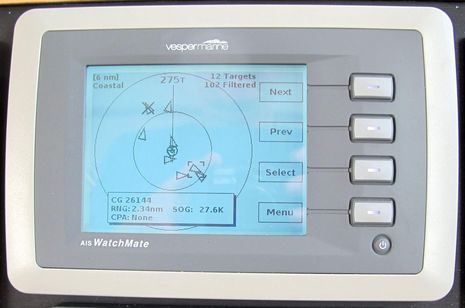
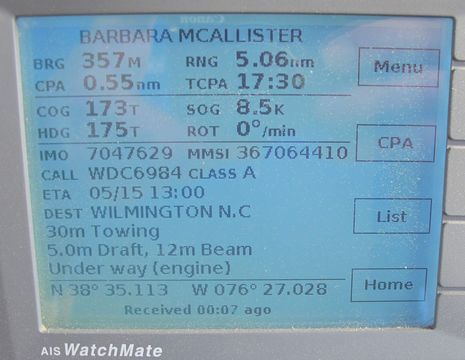
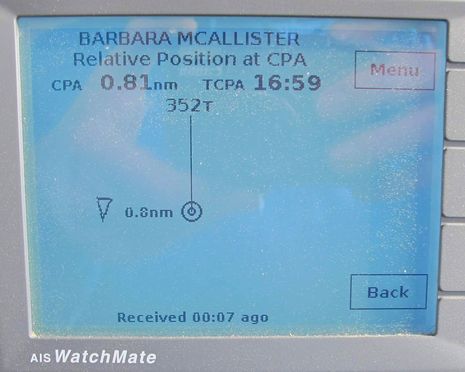
For this reason, on Ariam I opted for a separate screen:

Vesper_on_Gizmo_New_York_Harbor_cPanbo-thumb-465x308-7466.jpg
Vesper_Watchmate_alarm_screen-thumb-465x360-7478.jpg
Vesper_WatchMate_CPA_graphic_cPanbo-thumb-465x372-7481.jpg
(Pictures from Panbo, not my own)

It's not perfect, but it's far better than the inscrutable blobs and single fixed CPA alarm on Kindred Spirit's plotter.

Pete
 
I have a friend whose son is an officer on one of the large cruise ships operating out of Southampton. He tells me that on the older AIS sets it was not possible to filter out Class B transmissions but it is on the newer equipment. Whether this is done or not is determined by company policy and in his company the filter is not used. I think it would put a watch officer in a very difficult legal position if Class B transmissions were filtered out and the ship subsequently hit and AIS transponder equiped yacht.
 
MY AIS starts picking up ships about 50-60nm away and out of curiosity I like to look up the name, destination etc, but also note the CPA and TCPA, especially if the CPA is small. I noticed on several occasions that I might initially have a small CPA with a target - say 0.25nm in 2-3 hours, but by the time the ship had come into view the CPA had always increased to usually about 1nm - sometimes I could even see them adjusting course by a degree or so about 20-30 miles away

That might be because they've seen you on their radar.
 
That might be because they've seen you on their radar.

Exactly. I've also seen such course adjustments, and the one time I've called a ship he instantly gave a CPA figure (which matched mine) and we agreed we were both happy with it. We don't have an AIS transmitter, so that will have come out of his ARPA (or manually plotted, but I doubt that). We just have a passive reflector, at the masthead, but if I was buying something to improve our visibility to ships I would go with an active radar transponder rather than an AIS transmitter.

Pete
 
I have a friend whose son is an officer on one of the large cruise ships operating out of Southampton. He tells me that on the older AIS sets it was not possible to filter out Class B transmissions but it is on the newer equipment. Whether this is done or not is determined by company policy and in his company the filter is not used. I think it would put a watch officer in a very difficult legal position if Class B transmissions were filtered out and the ship subsequently hit and AIS transponder equiped yacht.

But ships with newer radar displays are able to filter what's shown on the screen in order to reduce visual clutter in congested waters. No prizes for guessing which boats are likely to be filtered out.
 
Top