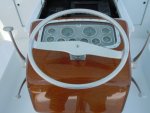
US gear/throttle levers?

No, my OP was not about electronic throttles, you seem to have hijacked the thread along that line.
Mmm... Talk about being touchy! Your OP didn't specify mechanical throttles either, did it?
Feel free to argue that I hijacked your thread if you wish, but the fact is that most throttle levers nowadays are single lever, and this is true also in the US.
Which is the reason why I answered your question "why do they..." along the lines of "actually they don't".
The fact that most single lever throttles are electronic, and drive electronic engines, is just incidental - though it's a key reason for the shift towards single levers during the last 20 years or so.
But you can forget this part of my reasoning altogether, and the answer to the sweeping generalization of your OP still stands.
 
when manoeuvring I set the throttles at 700 and just us the gears
Yup, good point. This is a trick not allowed by single levers - though to be honest I prefer to engage/disengage at idle anyway. G/boxes are rather expensive bits! :)
 
Yup, good point. This is a trick not allowed by single levers - though to be honest I prefer to engage/disengage at idle anyway. G/boxes are rather expensive bits! :)

Agreed. Each year when I change the gearbox oils I remove the metal strainer to see if there are any tell tale 'bits', but to date there's been none. I suspect the 700 rpm is a somewhat dumbed down limit given the toughness of TwinDisc. Well, at least I hope so...

But i dread the day when (if) I change Play d'eau and end up with electronic throttles. I really love the way separates work.
 
No, my OP was not about electronic throttles, you seem to have hijacked the thread along that line. On most european boats, the gear/throttle (even sail boats) is a single combined lever, but on US boats (including some sail boats) the system is 1 for gear + 1 for throttle.

That just reflects product developments. Many sailboats used two levers in the past, simply because the single lever had not been invented! started to become the norm in the 1970s as new style gearboxes allowed the use of the then new single levers. The US stuck with twin levers for all the reasons discussed by others, particularly for power boats. When I was involved in building power boats in the 1980's many of our customers specified twin levers, even though single were available because that is what they preferred.

There is nothing unusual about people having different preferences and this is reflected in builders also making different choices to satisfy their customers.
 
But i dread the day when (if) I change Play d'eau and end up with electronic throttles. I really love the way separates work.
Seconded 100% :)

I also would think that 700rpm ain't a problem for your g/boxes - but that requires a bit of care in throttling at no more than 700, to start with.
For me, it's more a matter of "automatic" habit, so to speak: the first thing I do when maneuvering is pull down the throttle levers completely, using only the gear levers from that point onward.
If and when I need a bit of extra thrust, I find a short throttle burst more effective than leaving the engines constantly at a slightly higher rpm.
 
Seconded 100% :)

I also would think that 700rpm ain't a problem for your g/boxes - but that requires a bit of care in throttling at no more than 700, to start with.
For me, it's more a matter of "automatic" habit, so to speak: the first thing I do when maneuvering is pull down the throttle levers completely, using only the gear levers from that point onward.
If and when I need a bit of extra thrust, I find a short throttle burst more effective than leaving the engines constantly at a slightly higher rpm.

Makes sense.
 
The Cummins engines on Play d'eau (Fleming 55) use Twin Disc gearboxes and the max revs for engaging gear is 700 rpm. This is about 100rpm more than tickover. So when manoeuvring I set the throttles at 700 and just us the gears. Simples!
I'm also curious about this. Changing gear from forward to reverse while under load sounds like a bad idea. Do you think it's possible that the 700 rpm is specified because that is within the range of what idle could be? I have no knowledge on this and am prepared to be educated
 
Makes sense.
Yup Piers, but it's 'orses for courses. My engines idle at 600 rpm with a switch I can flick to reduce it to 500. In marinas I usually flick that switch because manoeuvring at 600 is a bit punchy so far as the sideways kick of the props is concerned. Depends on the boat, coarseness of props, etc - 'orses for courses
 
I'm also curious about this. Changing gear from forward to reverse while under load sounds like a bad idea. Do you think it's possible that the 700 rpm is specified because that is within the range of what idle could be? I have no knowledge on this and am prepared to be educated

I have a pair Twin Discs and like them .keep this link on my iPad
Go to page 26
http://www.marind.ca/medias/pdf/produits_marins/twindisc/td_operators_manual.pdf

Although we have single morse tele flex I just flick into F or R from N while at tick over 600 rpm -first click .
Via micro switches they prevent any movement out of N unless tick over ,same micro switches also prevent starting in F /R .The only phaff is synchronising ,I miss that having come from VP EDC ,but I don,t miss the EDC woes with damp contacts and duff relays ,fuses ,etc
A lot of older Italian and French 90 ,s boats have twin levers , they seem perfectly controllable when turning and backing in when Med mooring .
 
Via micro switches they prevent any movement out of N unless tick over
The Uflex separate levers that I have on my boat came standard with a similar "fool proof" prevention:
a mechanical pin lock on the gearbox lever, activated whenever the throttle lever is in any position other than idle.
It took me just a few months of usage to decide to disassemble that lock and chuck it overboard.
First of all, it's just another thing that can go wrong, leaving you with a locked lever in the worst possible moment.
But secondly, and most important, I actually LIKE to be able to trash my gearbox, if I really want to (which btw is impossible with electronic controls).
The reason is rather obvious, and funnily enough, it's even suggested in the "NOTE" at page 26 of the manual you posted... :encouragement:
 
Just to confuse the issue a bit more, I've skippered US sportfishing boats where the controls are either side of the helm. Often you steer on the throttles going astern while facing backwards.

It works a treat!!
controls.jpg
 
Just to make sure I'm speaking accurately, the specs of the Cummins 6CTA 8.3 idle is at 600+/-50. The TwinDisc manual shows max for shift is 1,000 rpm (MG5075A). This agrees with portofino's link which is the same manual as the one on board. My gearbox log shows 700 was given to me by MIT in 2016 when the idle pressure was adjusted to give the correct shift timing. If this is so, I'm well within the limits.
 
Well I've been educated. Although the manual does not specifically say change while the engine is under load, the fact that some models allow upto 1000rpm or even 50% means it's obvious. The changing I can understand, there is obviously some kind of clutch mechanism, what amazes me is you can be instantly at 50% power in reverse, that's got to hurt something
 
When my father was his boats built in Sweden with Volvo Penta engines had two levers per engine the red one gears and the black one throttle I think.

My boats always had single lever per engine.

Current boat has EC controls with a built in delay between switching from ahead to astern two seconds from memory?

The EC controls are very light with a definite click and feel when going into slow astern to neutral to slow ahead.

I found the risk with two levers per engine was to have the rpm too high on the throttle lever and bang it quickly from ahead to astern or VV.

Give me single lever EC or EDC controls every time its much easier to feel.
 
Well I've been educated. Although the manual does not specifically say change while the engine is under load, the fact that some models allow upto 1000rpm or even 50% means it's obvious. The changing I can understand, there is obviously some kind of clutch mechanism, what amazes me is you can be instantly at 50% power in reverse, that's got to hurt something

" Twin disc " refers to one disc for F and another R -they are immersed in oil .Not dry like a car g box clutch .
When you swop from one disc to the other you are not actually moving gear gogs like a car manual gbox ,just releasing one disc and pressing on the other which changes the direction .
There's no movement or grunching of gogs /gear teeth ,no lay shafts sliding about
Obviously as the driving floating disc contacts ( huge pressure required ) the direction chosen disc ,theres a bit of heat /friction generated .
They have G -box oil coolers fed from the main engine water pump .
They have there own oil pump-to pressure up , and it's high .We have a guage to see .
So if you get an oil leak or burst pipe the pressure drops and the discs come apart -losing drive - default position is N .
So @ 700 rpm as opposed to tick over 600 ,the oil pressure has increased ,handy to press two discs spinning 100 rpm faster and the water pump on the engine s circulating a bit more water to help cool it ,if there's any more friction over what friction there would have been 100 rpm lower ?

Important point is no gogs /gears are being slid about and mated like a conventional car g-box .
So it's ideally designed to go from F to R in rapid succession ,if you do that then naturally you notice as expected a rise in Gbox temp from the multiple friction generating episodes of the discs contacting .

Not a great deal to "hurt "
 
Very nice boat that, shame the broker can't count, I'm sure I see 3 engines and 3 sets of controls

As that is advertising a 2017 boat the photo's are library photo's and that actual boat did have 3 engines hence 3 sets of controls,
It was the only RS43 every built with triples. All other 43's were twins
 
Which ever way you look at it, moving a shaft say 2 to 3 inch diameter and a prop of say 35 in Dia turning at 700 rpm ahead and then directly to 700 rpm astern creates a huge load on a clutch plate and a gearbox.

Stopping for a few seconds between ahead and astern to allow the prop and shaft to slow down or stop is a good move and one stick goes a long way towards achieving this by ramping down the rpm.

Twin sticks which in the excitement of the moment allow you to move directly from 1200rpm ahead to 1200 rpm astern is not good.
 
Twin sticks, which in the excitement of the moment, allow you to move directly from 1200rpm ahead to 1200 rpm astern is not good.

Hi Bandit. One comment and one question. Comment - Play d'eau's TwinDiscs have a reduction of 2.53:1. Question - cannot a single lever 'in the excitement of the moment allow you to move directly from....ahead to astern?'
 
Piers

With single lever when you move from ahead to neutral to astern the throttle ramps down to idle and then up again as you pass slow ahead to neutral to astern, where as with twin levers per engine you could leave the throttle at say 1500 and go quickly from ahead to astern at that rpm.

My current controls are EC so very light, and its easy to "feel the click into slow ahead then neutral then slow astern. You can set the delay at between 0 and 5 seconds on the EC controls, I think mine are set at 2 and I assume that is 2 secs from ahead to neutral and then another 2 to astern so 4 secs total ahead to astern.

On my Fairline with the twin station single stick per engine Volvo Penta controls and the 20 year old engines and controls which were very stiff to operate there was a risk that the force required to move the throttles when you intended to move from ahead to neutral it was easy to push it past neutral to astern directly.

With the new engines in the Fairline and new Volvo Penta cable controls it was much better but not perfect and you could crash fast from ahead to astern. I did sit once with the floor boards up trying to time how long it took from ahead to neutral before the shaft slowed to stop turning and it took quite some time especially if the boat had some way on it. The fairline had no bow or stern thrusters and no keel so was a bit of a handful going astern and everything was done on the engine controls going astern.
 
Top