
Updating a Bradley-type Spring Damped Coupling on Trailer

Joined
28 Apr 2021
Messages
351
Location
Solitary Confinement
Visit site
Probably more of a question for a caravan forum but still applies to old boaties.

Is it possible to update a Bradley-type spring damped coupling of a trailer, to something safer without having to update the entire lot, e.g. coupling, axles, hubs & backplates, meaning wheels etc? Probably a nigh on £1,000 job if paid for.

Useful background, legally braked trailers manufactured pre Oct. 1982 may be fitted with a new replacement spring damped coupling, such as a Bradley, although for new trailers they are illegal in the UK & EU. Generally, farm or yard only is advised.

As I understand it, spring damped couplings don't have the auto reverse brakes that also came in at that time, meaning that breakaway cable systems can't be added without, I am told, replacing everything.

Ditto legally, I read that a secondary coupling must be fitted to a braked trailer manufactured before 1982 that has a manual handbrake arrangement.

Personally, I'd like more than a chain or chain mounting points welded on as I imagine they can do a fair bit of damage ramming the back of one's vehicle if the hitch came off. (On the other hand, I'll admit that they do some good purpose if you're in the habit of driving off bridges). It's a simple, 1960s set up. Coupling, hand brake, rod, linkage, two cables to the hubs. Coupling's pretty siezed up though brakes work & bearings spin.

I see hand brake spring kits, are they of any assistance?

Sorry, it's Saturday now & the trade's closed to ask.
 
Basically no; if you change from a spring coupling to a hydraulic the brakes need changed to auto-reversing, although it could be bodged by adapting a hydraulic coupling with a reversing lock of some kind. I don't understand how you can't fit a breakaway cable, it should work just as well; the lever may need modifying though as most have the ratchet pawl just held by gravity rather than sprung.
 
Yes, just gravity. Primary problem I'm having is that it's all in Imperial and it seems that all just dried up about 8 years ago. Is it too political to ask if Boris has any intention of bring inches back now? If so, I might hold on ... otherwise, it all needs replaced. Jockey wheel too. If the holes don't line for mm replacements, I'll be cursing.

The other option is to go for a towing eye coupling, are there pros and cons to them?

IMG_0154 copy.JPG
 
Probably more of a question for a caravan forum but still applies to old boaties.

Is it possible to update a Bradley-type spring damped coupling of a trailer, to something safer without having to update the entire lot, e.g. coupling, axles, hubs & backplates, meaning wheels etc? Probably a nigh on £1,000 job if paid for.

Useful background, legally braked trailers manufactured pre Oct. 1982 may be fitted with a new replacement spring damped coupling, such as a Bradley, although for new trailers they are illegal in the UK & EU. Generally, farm or yard only is advised.

As I understand it, spring damped couplings don't have the auto reverse brakes that also came in at that time, meaning that breakaway cable systems can't be added without, I am told, replacing everything.

Ditto legally, I read that a secondary coupling must be fitted to a braked trailer manufactured before 1982 that has a manual handbrake arrangement.

Personally, I'd like more than a chain or chain mounting points welded on as I imagine they can do a fair bit of damage ramming the back of one's vehicle if the hitch came off. (On the other hand, I'll admit that they do some good purpose if you're in the habit of driving off bridges). It's a simple, 1960s set up. Coupling, hand brake, rod, linkage, two cables to the hubs. Coupling's pretty siezed up though brakes work & bearings spin.

I see hand brake spring kits, are they of any assistance?

Sorry, it's Saturday now & the trade's closed to ask.
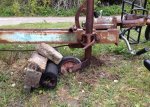
First thing what axle / brakes do you have ? what capacity is it ?

I would think they are Girling or Lockheed, depending trailer capacity you should be able to find a younger coupling from a caravan. These were hydraulic damped, post 1974 ish, they were to the same EU spec as today, but non auto reverse, you may get new ones non auto reverse, but with break-away chain. But it all depends on what brakes and capacity you have.

Brian
 
I remember Watford being on the hubs, no idea about the axles. They've been long bought out by Indespension with very limited supply of sizes left. Shoes not disk brakes. No hydraulics. Single axle. Leaf springs. Needs to be 1800kg+. Probably 2k on the safe side.
 
When I was designing light trailer under gear Indespension was one man working in a shed in the backyard.

Are you just after a break-a-way brake function ?

Brian
 
That was the aim.

I hire a towing vehicle so I don't want to risk it slamming into the rear with a chain in a worst case scenario.

I'd rather it just ran down the road itself then I can drive off and pretend I don't know anything about it ... Oops, just joking.

At the very least, to be legal though, I would need the latter.
 
Is this the same trailer which needs new hubs and wheels?
Buy a redundant caravan chassis and swap all the moving parts?

The worst case with coupling failure is far worse than creasing the rear of the towing vehicle.
How much towing do you intend to do?
Trailers are grief, Much to be said for hiring one. Maybe a flat bed which takes the yacht on a cradle.
Better still, keep the yacht right next to the sea.
 
Yes, same one. It's for a triple keeler, so hiring a flat bed was another option but this chassis is custom designed to fit.

From pricing up paid for shipping, the general rule appears to be buying your own second hand pays for itself in one trip, & makes selling the boat easier at the other end. But, otherwise, I agree with you. If you can find the boat you want, where you want, & in maintained condition.
 
Is this still for a friend?
Not mine. Asking for an aquaintance.

There comes a point at which updating a very old trailer becomes a lost cause. This is the one with unknown wheels and new tyres required is it?
By the time it is all done you will have spent hundreds of pounds and will probably be in the zone of needing it certifying (which requires a paper trail of compliance). Your objection to replacing parts because they are now metric points to you not having the facilities to re-drill the mounting holes or replacing the mounting brackets.
Is it really more cost effective compared to having it transported? Will the upgraded trailer add much to the boat's value? It is, after all a very old trailer on leaf springs.
In your shoes I would settle for making the trailer safe and legal at minimum cost. Put a massive breakaway chain on it and take a gentle trip to the new location. I think a trailer banging up the back of your tow vehicle is the least of your worries if it becomes decoupled. How many trailers decouple themselves anyway?
 
Last edited:
Trailer failure happens
Facebook

In my late teens I was overtaken by a dinghy I was supposed to be towing.
Filed under 'things I got away with!'.
 
Trailer failure happens
Facebook

In my late teens I was overtaken by a dinghy I was supposed to be towing.
Filed under 'things I got away with!'.

Years ago I had to go down to Strensham services on M5 to look at a 6 ton twin axle boat trailer, traveling south it crossed to north bound lane ( pre crash barriers ) and carried on for half a mile. Question was why the break-a-way brake system had failed, reason was the handbrake and coupling were still hanging on the ball on the back of the Landrover. In passing, the trailer had electric brakes operated by the cars brake hydraulics, no overrun, no reversing problems, never caught on though.

Brian
 
That was the aim.

I hire a towing vehicle so I don't want to risk it slamming into the rear with a chain in a worst case scenario.

I'd rather it just ran down the road itself then I can drive off and pretend I don't know anything about it ... Oops, just joking.

At the very least, to be legal though, I would need the latter.

We used to fit a separate handbrake on the side of the towbar with a arm that went behind the existing brake lever, operate handbrake or break-a-way chain, pulled leaver putting brakes on.

The main problem may be brake size, 10 inch were okay for around 25 cwt, may be pushed to 30 cwt depending on tyre size, above that you need 11 inch.

To be honest looking at the photo, it should not be on a public road.

Brian
 
Is it really more cost effective compared to having it transported? Will the upgraded trailer add much to the boat's value? It is, after all a very old trailer on leaf springs ... In your shoes I would settle for making the trailer safe and legal at minimum cost.
Apologies for my radio silence. I got banned again and am just back from a week in solitary detention.

And thank you very much for your kind suggestions.

I've continued to dig in and document my findings as they may be useful for others reading this way.

Firstly, for the most part, parts suppliers are largely clueless. Fair enough, the lads on the phone weren't even born when this was made but it's rare to find anyone who knows anything about arcane interchangeability. Someone might but they're probably retired by now.

With older trailers there's an additional issue that imperial couplings use 2" balls, whereas metric ones use 50mm balls, and both use different sized/incompatible threaded studs. Now 2" and 50mm might not seem as different as to matter, but seemingly the shape of them is different as well and, hence, they are not entire compatible.

You will get away with it, but you may not in extremis. Reasonably, no one wants to commit to suggesting you do.

Therefore, unless you have a contemporaneous towing hitch, presumably attached to a Ford Zephyr or something, you're sort of forced to upgrade the coupling even if it could be refurbed.

Legally, if you have a pre-1982 trailer, you can still use the original, or swop an old spring loaded coupling out for a new one, but you do need to attach a safety chain. (Ditto for off-road use). Post-1982, you have to go for a full breakaway cable type set up.

The issue I've got to now is attempting to find out whether a modern pole coupling with a breakaway cable is compatible with non-auto-reverse brakes. As I understanding it, the old spring loaded coupling has a latch you flip over the shaft to disable the brake so you can reverse. Modern ones don't but deal with it using auto-reverse brake plates. No one so far has been able to tell me if I can combine the two or need to upgrade to auto-reverse brakes too.

Yes, costs still stack up well against paying to have it moved. It's basically equivalent to one or at the very most two moves. It's a handy trailer because it's very minimal & easier to store than a new Ifor flat bed.

Watch this space (unless they drag me and my posts off again).
 
Apologies for my radio silence. I got banned again and am just back from a week in solitary detention.

And thank you very much for your kind suggestions.

I've continued to dig in and document my findings as they may be useful for others reading this way.

Firstly, for the most part, parts suppliers are largely clueless. Fair enough, the lads on the phone weren't even born when this was made but it's rare to find anyone who knows anything about arcane interchangeability. Someone might but they're probably retired by now.

With older trailers there's an additional issue that imperial couplings use 2" balls, whereas metric ones use 50mm balls, and both use different sized/incompatible threaded studs. Now 2" and 50mm might not seem as different as to matter, but seemingly the shape of them is different as well and, hence, they are not entire compatible.

You will get away with it, but you may not in extremis. Reasonably, no one wants to commit to suggesting you do.

Therefore, unless you have a contemporaneous towing hitch, presumably attached to a Ford Zephyr or something, you're sort of forced to upgrade the coupling even if it could be refurbed.

Legally, if you have a pre-1982 trailer, you can still use the original, or swop an old spring loaded coupling out for a new one, but you do need to attach a safety chain. (Ditto for off-road use). Post-1982, you have to go for a full breakaway cable type set up.

The issue I've got to now is attempting to find out whether a modern pole coupling with a breakaway cable is compatible with non-auto-reverse brakes. As I understanding it, the old spring loaded coupling has a latch you flip over the shaft to disable the brake so you can reverse. Modern ones don't but deal with it using auto-reverse brake plates. No one so far has been able to tell me if I can combine the two or need to upgrade to auto-reverse brakes too.

Yes, costs still stack up well against paying to have it moved. It's basically equivalent to one or at the very most two moves. It's a handy trailer because it's very minimal & easier to store than a new Ifor flat bed.

Watch this space (unless they drag me and my posts off again).

see #14

You need to start with brake size / gross trailer weight, is it safe

Brian
 
Top