Unstepping mast problem

LONG_KEELER

Well-Known Member
Joined
21 Jul 2009
Messages
3,720
Location
East Coast
Visit site
The boat

Micro 18 footer . Tall tapered fractional ali mast with swept back spreaders.
One cap shroud each side and one lower each side.
Adjustable backstay . Has proper tabernacle for lowering and stepping.

The Problem

We turned the boat into the wind on the trailer.
I helped my pal by being in the cockpit with a ladder to support the mast coming down. He was well forward with an extended halyard lowering the mast.

It was a bit gusty to be fair , but aborted when the mast started swaying from side to side despite leaving the rigging on . Although we slackened the stays, I am wondering if we should have left the caps fairly tight and just slackened the lowers or perhaps some other set up.

I know there seems to be a 100 different ways to step and unstep masts but would welcome any thoughts or experiences.

Thanks in advance.
 
Its all under the most control when the point at which the shrouds pivot is in line with the pivot point of the mast base. On some boats this is slightly tricky to achieve, but you can manage it with some imagination.

Why not use a spinnaker pole as a gin pole? You can do the whole thing single handed and I've put a 45 foot radio mast up single handed using this technique.

View attachment 69764
 
I used to do it in a very similar way (apart from using a ladder) and it never caused any major issues.

Now I do it all by myself on a 20' and also on a 22'

*Release (replace) forestay by mainsheet. Pull it in as much as you can to regain tension (an adjustable backstay should help).
*Rigging slightly loose but still connected to contain any undesired or unexpected lateral movement.
*Take mainsheet with you back to the cockpit and -slowly- start lowering the mast until you can grab it (that mast should be fairly light)
*don't do it on a windy (especially gusty) day :)

That's it...
See here, very similar: https://www.youtube.com/watch?v=C5WdqdlB8Nc

Reverse method for stepping as well.
 
I used to have a Micro 18 and can empathise, but it's not a unique problem - the deck chainplates are too low (with respect to the mast step) and there's no side to side restraint until the mast is almost all the way up.

I used to do it on my own mostly, but never on a windy day, and I was resigned to inevitably bending a bottle screw when I didn't notice that it was not articulating properly as the mast went up. On a windy day you need two helpers with lines attached to the main halyard shackle which is hauled to the mast head. Their job is to stop the sideways movement. There are other ways using fixed points abeam of the boat, which can be on other boats, but you get the idea.

The other 'hard' bit which you may not have got to yet is the unfortunate Physics of yacht design. Once you've got the mast level and it's still engaged with the pivot pin at the step, you standing in the cockpit aren't far enough back to be holding the mast at its centre of gravity. That means that you're holding more than the total weight of the mast. You can't put it down because it will buckle if you leave it supported on the back edge of the coachroof, so you need a plan... And obviously the reverse is true - it's a bit of a strain getting it hooked to the pivot, but it gets easier once it's on its way up.
 
I sympathise with OP problem. Here masts are routinely lowered to transit under low bridges and of course many are fractional rig where the chain plates are aft of abeam the mast so shrouds go loose immediately mast goes back. My 21fter is just like that. I use the gin pole arrangement (actually 2 spin poles) and a tackle on the forestay which makes it easy to manage the lowering from the cockpit. However I also need a person on the cabin roof to manage the side sway. I also have a peculiar base pivot in that rather than legs of the pivot being about 10cms apart they are only about 1cm apart with lots of free play so able to cope with some swinging. The 10cm apart type are very susceptible to damage with a swing.
One very useful trick (essential part) is to fit a post at the transom to support the mast. Make the post quite high in my case 2 metres. Low enough for bridge transit but also just low enough for me to reach while standing on the cockpit seats. Mast is lowered to the post then disconnected from mast pivot and slid forward until mast base is under the bow rail. Then top of mast can be lowered from the post to a suitable support for road travel. I have a separate hook on the side of this post for low level support. Post sits on top of rudder pintle and is clamped to the stern rail. You can use crossed pieces of wood for stern support but it is not so easy to lower mast to lower level.
Your mast should be small enough to man handle but if you use the gear used for bigger masts it becomes very easy and safe even single handed. I never loosen rigging just the forestay which is attached by high field lever so very quick to tension.
Now on a bigger mast there are several ways to solve the problem. One type I think the McGregor 26 has additional intermediate side stays attached to chain plates precisely in line both fore and aft and vertically with the mast pivot. Such that this stay stays tight all the way to horizontal.
I have used a method where I attach cable clamps to cap shrouds about 50 cms above the chain plates. Onto these on each side I attach a line which goes forward through a block on the gunwhale well forward of mast then back to cleats or winches. As the mast goes down the cap shrouds can be tightened to keep the mast centralised.
Lastly a few boats at our club have system where there is a specially made car that runs up the main sail track. 2 Spinacker poles are used attached at one end to this car on the mast and the other end to specially fitted and located attachments about mid way down cockpit and at the gunwhale. The geometry is such that as the car is pulled up the mast and forestay released the mast goes back so that eventually it is sitting at about 45 degrees but supported by 2 poles from mid mast out to gunwhale. So very well supported sideways. Of course fine for bridges but still difficult to get the mast right down and off the boat. For OP just go carefully the first time and get some practice with lots of helpers. olewill
 
When we do my 20 ft Squib we disconnect the shrouds whilst holding the mast upright. 2 people lift it vertically onto the ground at the side of the trailer. One holds it from on deck & the other goes down the ladder & takes hold keeping it against the boat. Then the second person comes down & one person puts foot at base whilst the other walks it down. I suspect that an 18 ft boat mast is no heavier than a 20 ft boat mast & we do them several times a season
 
Last edited:
If there is not a straight line through the cap shroud chain plates and the tabernacle pivot the you need to replace the fixed length shrouds with something you can tweak for stability as the mast comes down. Lower a bit, tighten or loosen new stays, repeat until pub time.
As said before, a gin pole and a still day are very desirable./.
 
Why not use a spinnaker pole as a gin pole?
View attachment 69764

Has anyone ever actually used one of these lash-ups to raise a boat's mast, or are they Dick Everitt style theories, alongside "100 Things a Boy Can Do With Bungee".

Presuming that you didn't do that diagram, so this ain't personal ...

(1) What keeps the gin pole upright?

(2) The suggested 1" Schedule 40 pipe has a second moment of area of 36350mm4 and therefore a 3m length (estimated) will have a buckling load of about 8kN and, from the geometry given, a maximum load in the line to the winch of 7kN. Assuming the mast is 12m long, that would allow a maximum mast weight of 2.5kN, or (roughly) 250kg. Allow a modest safety factor of two, and it's down to 125kg. That sounds a bit light for a mast.

I'd still be more worried by the gin pivoting, though.
 
Has anyone ever actually used one of these lash-ups to raise a boat's mast, or are they Dick Everitt style theories, alongside "100 Things a Boy Can Do With Bungee".

Presuming that you didn't do that diagram, so this ain't personal ...

(1) What keeps the gin pole upright?

(2) The suggested 1" Schedule 40 pipe has a second moment of area of 36350mm4 and therefore a 3m length (estimated) will have a buckling load of about 8kN and, from the geometry given, a maximum load in the line to the winch of 7kN. Assuming the mast is 12m long, that would allow a maximum mast weight of 2.5kN, or (roughly) 250kg. Allow a modest safety factor of two, and it's down to 125kg. That sounds a bit light for a mast.

I'd still be more worried by the gin pivoting, though.

Yes, I've used a gin pole several times to put a radio mast up. You stay the gin pole either side to the pickets (you've put in with your friendly sledge hammer) and which also have the mast stays fixed to them.

You pace (or measure out) the base and lay everything out flat on the ground. You can pre-determine (approx) the length of the various stays by checking them against the ones to either side, flat on the ground. So long as you've paced it out reasonably accurately, the whole thing shouldn't be too far off.

Its a bit of work, but with a suitable block and tackle you can easily put a forty or fifty foot radio mast up single handed. If You've got multiple stays to the mast (from the gin pole) make sure that the mast DOESN'T get anywhere near inverted. It should have a slight bow in it as it's raised, with the tip of the mast going up first.

The nice thing is that you can do the whole thing very slowly and you've got a chance to adjust all the stays (except the ones to the top of the gin pole that are out of reach) while you are lifting the thing vertically.
 
Yes, I've used a gin pole several times to put a radio mast up. You stay the gin pole either side to the pickets (you've put in with your friendly sledge hammer) and which also have the mast stays fixed to them.

Thanks. How does a radio mast compare to a boat mast in weight?

I'm lucky - there is an 8' high earth bank beside the place where I rig my Hunter 490, and some one standing on that can easily raise the mast from the angle (about 30o) to which I can easily lift it while standing in the cockpit.
 
As said using a single gin pole does require it to be stayed to stop it flopping to either side. A problem when the mast is near horizontal. I and most in our club find it easier to use 2 spin poles one from each side so in effect self staying. It is desirable that the single gin pole be the right length from mast to forestay connection (bow when the mast is up). This makes attachment of the forestay easier when it is up. However many use a jibb or spin halyard as this leaves the forestay free to be easily attached while halyard with tackle enable the mast to be pulled forward. Using spin poles I have a deck attachment ring back from abeam the mast to accommodate longer poles but still the ends are at the bow.
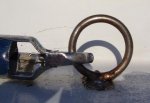
I have a dinky little attachment on the bottom of my forestay which is a bit of 4mm ss rod clamped parallel to the wire just above the swage. On the bottom a loop is formed while the top is bent over so it won't slip out. I shackle the tackle to this lop with a ss ring about 5cm in diameter. The ring accepts the fittings of the spin poles while the whole fitting enables me to use the forestay to pull up the mast but still leaves the thimble eye clear for attachment when it is up. I think it takes longer for me to attach the clamp on the stern pole than to actually disconnect and lower or raise the mast.
100_6759scaled.jpg (83.8 KB)
mastbase.jpg (24.1 KB)
Poleringscropped.jpg (20.8 KB)
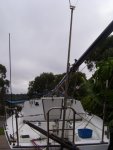
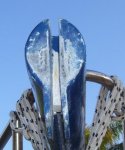
First is obviously the very tall stern support post. It looks a lot taller than it is photographed from below but you can see the mast is in the low support for road transport or storage. Also can be seen (with difficulty) on the far right is my home made VHF antenna. (works well) The tall antenna on the left was 27mhz now gone (redundant). Second picture is one of the rings on side deck that take the spin pole lower end, third is a close up of the mast base mentioned in my previous post which is fairly resistant to damage by side sway.
Lastly as a matter of interest Lakesailor of this forum advocated fro a small boat a system of 2 poles very long ie longer than half the mast height making a A frame with bases on side deck and stayed to bow and stern. This A frame enabled the mast to be lifted from a a point above balance point to vertical and then the base manoeuvred into place. This system almost essential for a keel stepped mast. (Not common on small boats ) Also useful if you don't have a tabernacle or base that can hinge. olewill
 

Attachments

  • 100_6759scaled.jpg
    100_6759scaled.jpg
    83.8 KB · Views: 0
  • mastbase.jpg
    mastbase.jpg
    24.1 KB · Views: 0
  • Poleringscropped.jpg
    Poleringscropped.jpg
    20.8 KB · Views: 0
Last edited:
Just one last suggestion to OP. I assume has has a base of 2 parts where the bottom has lugs widely spaced with a 10mm bolt or shaft through the lugs. This tight fit will not allow any side sway but the base lugs in themselves will not be strong enough to resist side sway. (as mast goes up or down) So suggestion is to fit a 6mm shaft or bolt temporarily. This will have lots of slop so allow some side swing without damage, but be strong enough to take the (forward) pressure of the mast as you pull it up. olewill
 
Has anyone ever actually used one of these lash-ups to raise a boat's mast, or are they Dick Everitt style theories, alongside "100 Things a Boy Can Do With Bungee".

Presuming that you didn't do that diagram, so this ain't personal ...

(1) What keeps the gin pole upright?

(2) The suggested 1" Schedule 40 pipe has a second moment of area of 36350mm4 and therefore a 3m length (estimated) will have a buckling load of about 8kN and, from the geometry given, a maximum load in the line to the winch of 7kN. Assuming the mast is 12m long, that would allow a maximum mast weight of 2.5kN, or (roughly) 250kg. Allow a modest safety factor of two, and it's down to 125kg. That sounds a bit light for a mast.

I'd still be more worried by the gin pivoting, though.

Are you forgetting that the gin pole is either pivoted separately, or pivoted to the mast?
With a theoretical weightless gin pole and frictionless pivots, the only force on it is directly along its length.
 
Thanks. How does a radio mast compare to a boat mast in weight?

I'm lucky - there is an 8' high earth bank beside the place where I rig my Hunter 490, and some one standing on that can easily raise the mast from the angle (about 30o) to which I can easily lift it while standing in the cockpit.

The weight question is a bit of “How long is a piece of string?” The masts I put up were comparable in weight to a Contessa 32 mast I estimate. I.e. 250 kg?
 
Has anyone ever actually used one of these lash-ups to raise a boat's mast, or are they Dick Everitt style theories, alongside "100 Things a Boy Can Do With Bungee".

Presuming that you didn't do that diagram, so this ain't personal ...

(1) What keeps the gin pole upright?

(2) The suggested 1" Schedule 40 pipe has a second moment of area of 36350mm4 and therefore a 3m length (estimated) will have a buckling load of about 8kN and, from the geometry given, a maximum load in the line to the winch of 7kN. Assuming the mast is 12m long, that would allow a maximum mast weight of 2.5kN, or (roughly) 250kg. Allow a modest safety factor of two, and it's down to 125kg. That sounds a bit light for a mast.

I'd still be more worried by the gin pivoting, though.
We used the bottom section of an old two part windsurfer mast as a gin pole. This was on a Trapper 240 fractional rib. I could not carry the mast on my own. I would estimate a total weight of 175kgs with RR gear and furled jib. If there was no wind we just clipped the jib halyard to the top of the ginpole and the mainsheet tackle to the bottom. The pole was shaped to fit the leading edge of the mast and clamped to the mast with a ratchet strap run internally around a through bolt then around the mast. This set up keeps the gun pole upright once under a bit of tension. I found the hardest part was lifting mast onto high rear crutch roller and sliding mast back ready for pivot pin to be put in prior to using him pole. The balance of the mast was such that the weight over the back of the crutch was top heavy.
If there was any chance of a cross wind or if raising or lowering on the water we always attached additional Dyneema stays to the front sides of the pole which lead back to stainless rings that were mounted outboard off the toe rail but in line with the mast pivot point. Two additional dyneema stays were taken up from these rings by the spinnaker pole uphaul to create constantly tensioned temporary rigging preventing any lateral movement of mast and gin pole during lifting or lowering. It also meant that mast stepping or unstepping required no physical manhandling and could be done single handed. It all sounds very complicated but once set up it made trailer sailing a trailable yacht more practical making for a much quicker turnaround on launch or recovery.
 
Nope.


I know. That's how I did the calculation.

I looked at Johns diagram again, it says he would use 1 1/2 inch for the gin pole. It looks like the one inch is for the "triangles" I suppose you could stop the pole pole swinging too much with a second line running down to the bow and through the anchor bow roller.
On our 18 footer we were fortunate enough to have only to take off the forestay/furler. It was a simple matter to "walk" the mast while karen gently pulled the furler to keep it from fouling the roof and deck. It was heavy work, and not a job for a gusty day, but once it was halfway up it became stable as the shrouds became tighter. I did it many times, and the only big problem we had was a shroud catching on something occasionally. Just to add, we always did it on the trailer not in the water
 
Many years ago a friend of mine had a vivacity that had a fairly heavy mast, we knew nothing about boats at the time but he was an engineer and I was experienced with lifting, climbing, ropes etc so we had to figure out things ourselves.

we manouvered the base of the mast into the tabernacle and propped it on a "horse" in the cockpit. attached the side stays and back stay. We devised a method of using 2lengths of 4x2 timbers bolted together at one end and propped against the stantion bases? on either sides,then using the winch on the trailer attached to the mast about 7 feet up, with our pair of timbers almost vertical, and the winch strap jammed between the them, we hoisted.

Our method was very safe as no one was under the mast once hoisting was started and when it was vertical the forestay was fixed with the hoisting strap still in place. being on thr trailer it was easy to pause and untangle or release anything that was getting snagged.

I am considering a trailer sailer again and will likely use a similar method but with a 12v winch allowing easy one man operation....
 
Top