Unexpected Mull of Kintyre currents

leepen

New Member
Joined
13 Aug 2018
Messages
1
Visit site
Hello all,

I am trying to explain and unexpectedly difficult passage from Gigha to the Clyde round the Mull of Kintyre on Friday 10th August.

The forecast was good: NW 3/4 decreasing 2. Dover HW was 1056 and 2320 BST. In line with the CCC Sailing Directions recommendations we left Gigha at 1655 (Dover -0600) and made good time. We arrived abeam the lighthouse at 2050 carrying a fair current. However, as soon as we got to the next headland (with the small white box on it) we were met with a significant adverse current such that we were virtually stationary in large waves that we beginning to break.

Initially I headed inshore hoping to find the reputed relatively calm inshore channel, however conditions got worse and we ended up heading offshore. Even further offshore the current was still against us. So it appeared that even the offshore current (which is supposed to change an hour later) had changed and was against us.

According to the tidal atlas the inshore stream goes westerly 1 hour before HW Dover (between 2150 to 2250). According to the CCC pilot the N going stream at the Mull starts HW Dover -0130 (also 2150) and in Sanda Sound at HW Dover -0110 (2210).

I cannot explain why we should have adverse current over an hour earlier than expected. I go round the Mull in both directions most years, and although it can be rougher than expected, I have never experienced such variation from the predicted tides. Has anybody else come across something similar or do they have any suggestions?

Thanks.

Leepen
 
The forecast was good: NW 3/4 decreasing 2. Dover HW was 1056 and 2320 BST. In line with the CCC Sailing Directions recommendations we left Gigha at 1655 (Dover -0600) and made good time.

That CCC advice is mince and they should stop punting it. Basically their timing for Sanda is way out and that knocks everything else out.

Having consulted the Admiralty Tidal Stream Atlas, we left Gigha at HWD+4 (ie 2 1/2 hours earlier than you) a few weeks back and after a good fast trip made it through the Sound of Sanda with 45 minutes to spare. Going outside Sanda would have given us an extra half hour or so ... but we could not possibly have done it on the CCC timing.

From memory (I'm not on the boat) it's 21nm from Ardminish to the Mull light, then another 10nm to Sanda, where the tide turns at HWD-2. The CCC Gigha departure time therefore works - only just - if you can keep up 7.5kt.

The tides from Gigha down towards the Mull are not too strong and turned for us about Machrihanish, so I reckon that HWD+3 would have been an even better departure time.

We had a similar experience to you coming up from Glenarm a couple of years ago. It was a time since I had been in the area and I forgot how far out the CCC tidal timings are.
 
Going from Gigha to Campbeltown aim to be at the lighthouse for LW Greenock. It's simple to remember and it works.
Donald
 
Going from Gigha to Campbeltown aim to be at the lighthouse for LW Greenock. It's simple to remember and it works.
Donald

That's interesting. Today, LW Greenock was 1249 so on that basis I'd have left Gigha at 0849 which was HW Dover +3 ,,, just as I concluded would have suited me best. Phew. Thanks.
 
Welcome. It's an easy way to remember and you just change your leaving time to suit your speed/conditions and doesn't rely on someone working out an average speed on your behalf.
Donald
 
Welcome. It's an easy way to remember and you just change your leaving time to suit your speed/conditions and doesn't rely on someone working out an average speed on your behalf.
Donald

I'll be writing it in my CCC book next time I'm on board. Many thanks.
 
I have also found the (previous?) CCC guidance of leaving Gigha at -0600 Dover to be wrong, and hitting adverse currents round the Mull even after a fast motor down from Gigha.
Hence like JumbleDuck my own notes remind me to leave a good couple of hours or more before then.
So interesting to see Aja’s simple aide memoire.

My CCC books are on the boat. Anybody know if this has been corrected in latest versions?
 
Going from Gigha to Campbeltown aim to be at the lighthouse for LW Greenock. It's simple to remember and it works.
Donald
If you fix a lighter chain to your anchor you probably need to run with HW Broomielaw otherwise ye'l be there too soon because of yer increased boatspeed....
 
I always prefer to use local times of HW for passages like that, rather than basing on far away places like Dover. I find that it gives me a better feeling of what is actually happening, rather than blindly following "Directions".
 
I always prefer to use local times of HW for passages like that, rather than basing on far away places like Dover. I find that it gives me a better feeling of what is actually happening, rather than blindly following "Directions".

Yes, it's very odd that the CCC book suddenly slips into HWD speak there when everywhere else is either very local or one of the standard ports (Greenock, Oban, Belfast, Liverpool, Ullapool). I wonder if that;s how they came to get it wrong?

Mind you, I love my tidal stream atlases, and they are all HWD.
 
Yes, it's very odd that the CCC book suddenly slips into HWD speak there when everywhere else is either very local or one of the standard ports (Greenock, Oban, Belfast, Liverpool, Ullapool). I wonder if that;s how they came to get it wrong?

Mind you, I love my tidal stream atlases, and they are all HWD.

Yes, I make good use of my Tidal Stream Atlas, but the first thing I did was to head each page with its relationship to HW Oban. I use Oban tide tables.
 
Yes, I make good use of my Tidal Stream Atlas, but the first thing I did was to head each page with its relationship to HW Oban. I use Oban tide tables.

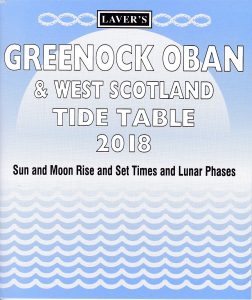
I use the Laver's combined Greenock and Oban ones. After the Embarrassment At Stranraer I always check very carefully which page I am reading from ...
 
I use the Laver's combined Greenock and Oban ones. ...

Can you share a link or advise where they can be obtained. An internet search gives Professor John Laver and Tidal Wave Review at the Royal Society of Edinburgh but nothing on tide tables.
 
I came across this in my search for Laver's tide data as mentioned by Jumbleduck: -

"Three Georges and one Richard Holden: The Liverpool tide table makers"

https://www.hslc.org.uk/wp-content/uploads/2017/10/151-3-Woodworth.pdf

Starting in 1770, the brothers Richard and George Holden published some of the first high-quality, publicly-accessible tide tables in the UK. Their Liverpool tables continued to be produced by family members for almost 100 years, and the ‘Holden Almanack and Tide Table’ was published by different owners for a further century. These tide prediction tables were so much of an improvement on what was available before that they have a small but important place in the history of UK tidal science.1
 
Can you share a link or advise where they can be obtained. An internet search gives Professor John Laver and Tidal Wave Review at the Royal Society of Edinburgh but nothing on tide tables.

First hit I got on "laver tide table" was http://www.laverpublishing.com/

They're wee blue-and-white covered books and many/most chandlers seem to have them. I bought mine this year at Largs.

green-oban.jpg
 
Thanks, I don't recall seeing Laver's at Craobh Marina.
 
Yes, I make good use of my Tidal Stream Atlas, but the first thing I did was to head each page with its relationship to HW Oban. I use Oban tide tables.

I just write the times of HW Dover and the hour increments, before and after, along the top of the pages, for the weekend or week ahead. I then can forget all about Dover, or any other port. The simplicity of this method means I can immediately establish what the tide flow is by flipping to that day / time page. It also reduces the probability of a mistake by making a calculation when tired.

I prefer the Admiralty Tidal Atlas over those in Almanacs because the A4 pages are just easier to use, especially if you have to interpolate speeds between the arrows.
 
Top