
petem
Well-Known Member
P, how do you get that track info onto your PC? I guess you created all your WP's etc offline too?



It's actually the opposite, sort of: I use Garmin SW on the PC for planning (either Mapsource or Homeport), and after making up my mind, I key into the Raymarine plotter the actual leg of the day.P, how do you get that track info onto your PC? I guess you created all your WP's etc offline too?
LOL, 'course I did.I think you mean 7 litres per Nm


It's actually the opposite, sort of: I use Garmin SW on the PC for planning (either Mapsource or Homeport), and after making up my mind, I key into the Raymarine plotter the actual leg of the day.
So, yes, there is a double input, but I'm not aware of any easy/efficient way to transfer routes between the PC and the Raymarine plotter - at least not with the oldish components that I've got.
And it's no big deal, really. On top of being fast and easy, using the PC for route planning also allows you to organize a routes database very efficiently.
Which btw comes in handy when you change the boat, as it was the case for me now... :encouragement:


That's a very good question indeed, worth a thread in itself.I wonder how you feel about, 'the old girl', now that you have a good few miles and half a season under your belt, in your new mistress - are you happy with the transition and how much do you miss her?
For the records, my very first Coppercoat experience so far has been great, with the hull which is practically still as clean as when we started.Bum etc not bad but not just done

I just reviewed the detailed log which I kept during the trip.
Practically, we made the whole trip at cruise speeds anywhere from 20 to 24kts.
It's a bit tricky to check exactly the fuel burn difference within this speed range, because between refills we made some legs a bit slower and some others a bit faster. But surely the difference is neither here nor there, in terms of Nm per liter.
Obviously, single digit speed is what would have made a big difference, but we never made more than very short hops at D speed, for all the reasons previously explained. So, I still have no clue about how large the exact difference could be, in a long passage.
That's a bit academic anyway, 'cause I would have made a completely wrong boat choice, if I had long distance cruising in mind - this delivery trip being pretty much an exception.
So, in a nutshell, we made 1170Nm overall, burning 8300 liters of fuel, which means an average of 7.1 Nm per liter.
That's inclusive of about 50 hours of genset usage, and actually also the engines clocked more hours than those spent at cruising speed - almost 80, overall.
Obviously, the average speed calculated on engine hours basis is much lower (14.6 kts), with a hourly fuel burn of "just" 104 liters.
But that includes lead times upon maneuvering and very short hops at D speed, which are meaningless.
Actual mile crunching was never done at less than 20kts solid, with most of the longer legs in the 22kts ballpark - which btw is also a technical sweet spot for the engines, a hair under 1800rpm, right at the peak of torque curve, according to MAN specs.
Therefore, assuming an average cruising speed of 22kts (hence 53 of the 80 hours spent at or around that speed), the actual fuel burn has been 156 lph (calculated in excess, as if the rest of the hours and the genset would have burned nothing).
And by sheer coincidence, that's exactly the value reported in the builder's specs, at 1800rpm/23 kts.
In other words, my first estimate of post #182 proved to be spot on, eventually (actual fuel burn=builder's specs minus 1 knot).
In the future, after some time of our more typical cruising around CF, with short day trips which make D speed much more acceptable also in a boat not designed for that, I will possibly be able to update the above numbers including slower cruising, but don't hold your breath: I expect/hope that it will take me years to burn another 8k liters, from now on!
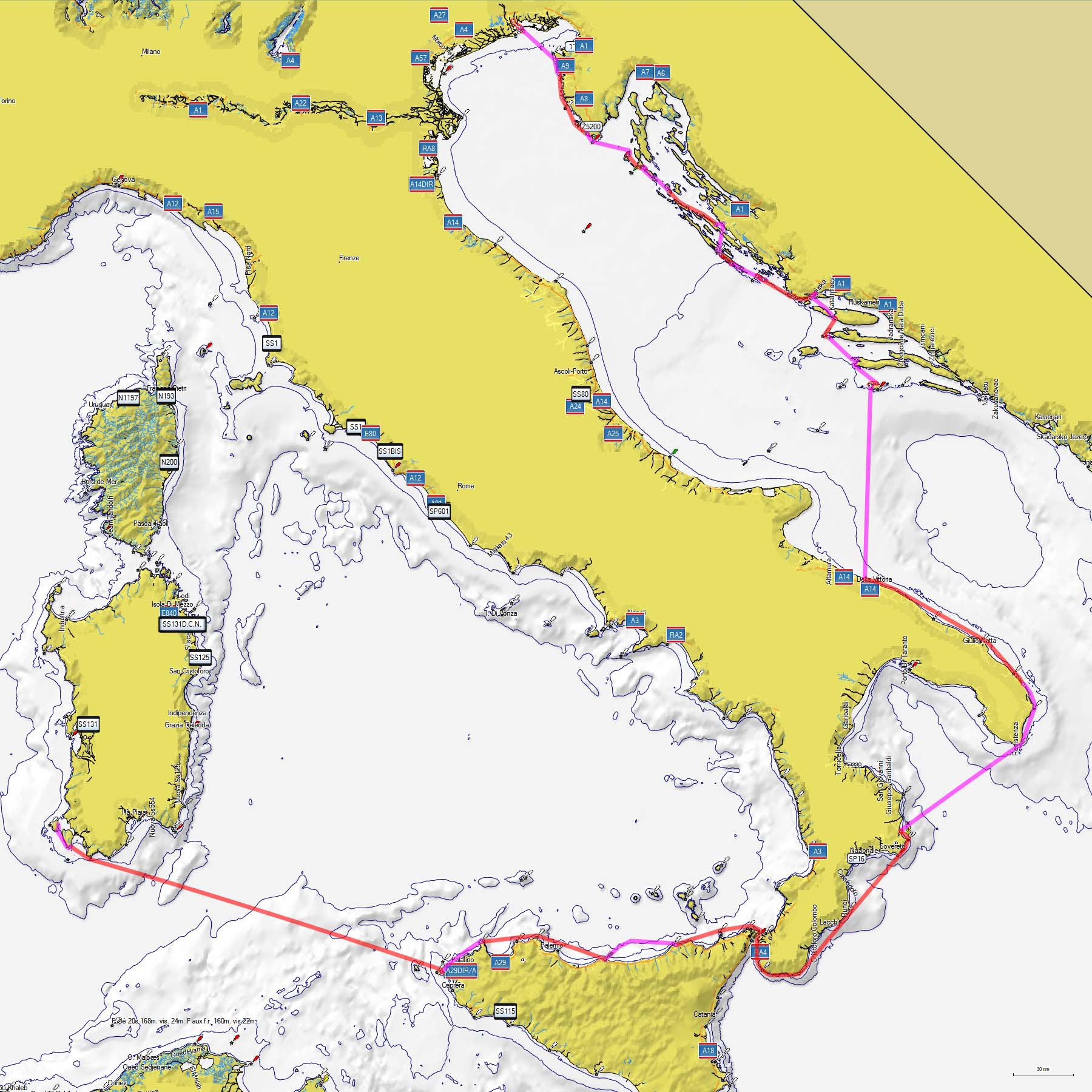
For the records, I'm also attaching an overview of the actual route, which was eventually a bit different and shorter from what we originally planned, for several contingent reasons.
I made each cruising day/leg in alternated colors, for my planning convenience.
We never made any night passages, because I don't fancy the idea of being unable to see and avoid floating stuff at 20+ kts…
 ..
..
I suppose you are referring to the video which I actually posted in this other thread.Also the longer crossings must have been quite demanding, especially in the conditions you posted the vid of earlier. Must have felt good to tie up at the other end and enjoy a cold drink.


...are you sure to have a motor for the washer? I can't remember to have seen any boat with such setup.Must get our washer motor repaired before next cruise.
Happy to hear that you enjoyed the thread! :encouragement:
Ref...
...are you sure to have a motor for the washer? I can't remember to have seen any boat with such setup.
The typical installation is with an electrical valve opening/closing a pipe connected to the boat fresh water circuit, which is kept pressurized by the fresh water pump. Maybe you just have a stuck valve?

No bizarrely, just like a car there is a separate 4 litre windscreen washer bottle with an integrated motor pump in one of the cockpit lockers, piped to the windscreen wipers. Presume this was to enable wash additive to be mixed with the water. Agree it would have made more sense to have had it piped to the boats domestic fresh water system.
 tech eh?