
jim.howes
Well-Known Member
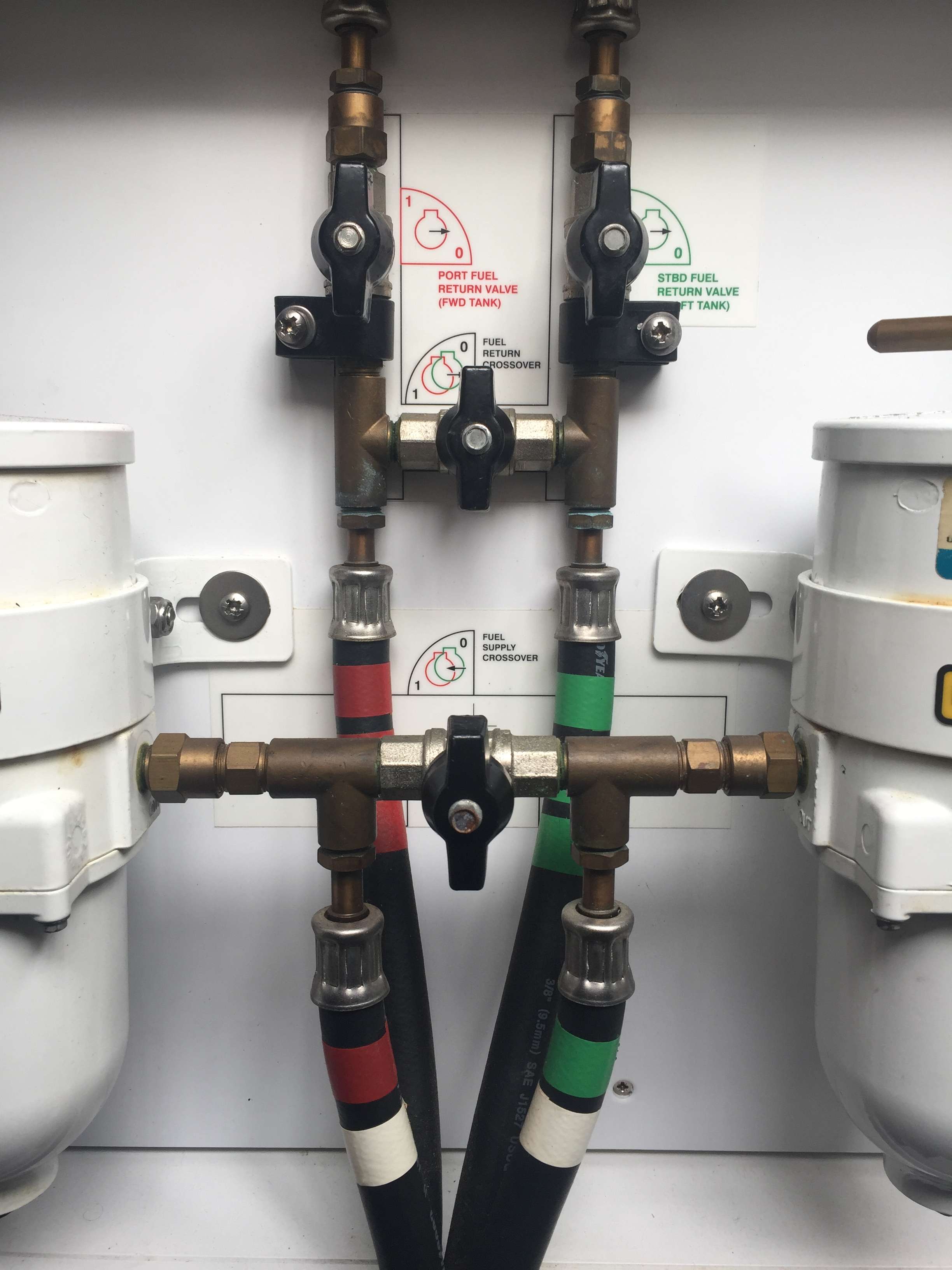
Hi your photo is as your schematic drawing. A really clean and tidy layout, well done. Jim

Hi just to make sure I understand. If the valve at the bottom is horizontal then the fuel coming from tank 1 can go to engines 1 and 2 and the fuel coming from tank 2 can go to engines 1 and 2. Does that rebalance the tanks’ fuel levels? Imagine I have tank 1 at 10% and tank 2 at 90%. Question 1. Do they eventually both go to 50% if that valve is horizontal? Then above that valve we see the return system. Fuel is going up in this case. So coming from engines 1 and 2 it hits the return crossover valve first. If that’s horizontal then return fuel from engine 1 can go to both tanks 1 and 2 and return fuel from engine 2 can go to both tanks 1 and 2. After that, return fuel goes up to the other 2 valves at the top. If one of them is horizontal then the return fuel cannot go to that tank. In that case, if the crossover valve is horizontal then fuel can still go to the other tank. If the crossover valve is vertical then you can have pressure build up and a big issue. Correct? I have an SC35 and last weekend I saw one tank level going from 50% to 10% and the other from 50% to 80% but I am suspecting there is an issue with the sensors reading the fuel levels rather than the flow of the return fuel. Because such imbalance could only happen if the return crossover valve is horizontal and one of the return valves above is also horizontal, which would mean return fuel from both engines would go to one tank, which then gets filled up over time while the other gets depleted. Am I correct? Thanks in advance.So this is what's on the bulkhead.
The fuel supply shutoff valves are elsewhere in the cockpit.
The original poster will have something similar.

Hi just to make sure I understand. If the valve at the bottom is horizontal then the fuel coming from tank 1 can go to engines 1 and 2 and the fuel coming from tank 2 can go to engines 1 and 2. Does that rebalance the tanks’ fuel levels? Imagine I have tank 1 at 10% and tank 2 at 90%. Question 1. Do they eventually both go to 50% if that valve is horizontal? Then above that valve we see the return system. Fuel is going up in this case. So coming from engines 1 and 2 it hits the return crossover valve first. If that’s horizontal then return fuel from engine 1 can go to both tanks 1 and 2 and return fuel from engine 2 can go to both tanks 1 and 2. After that, return fuel goes up to the other 2 valves at the top. If one of them is horizontal then the return fuel cannot go to that tank. In that case, if the crossover valve is horizontal then fuel can still go to the other tank. If the crossover valve is vertical then you can have pressure build up and a big issue. Correct? I have an SC35 and last weekend I saw one tank level going from 50% to 10% and the other from 50% to 80% but I am suspecting there is an issue with the sensors reading the fuel levels rather than the flow of the return fuel. Because such imbalance could only happen if the return crossover valve is horizontal and one of the return valves above is also horizontal, which would mean return fuel from both engines would go to one tank, which then gets filled up over time while the other gets depleted. Am I correct? Thanks in advance.

Couldn't agree more. I'd also recommend doing it with Sea Start as it's much more of a practical real world course rather than blindly following the RYA syallabus.re: leaving engines etc to the experts - if you plan on going out to sea, it's definitely worth doing an engine maintenance training course. Boats usually break down because of a fuel issue or a cooling issue. Its well worth your while learning how to deal with it, and will make your boating life much easier and happier (and cheaper ;-))