UK Shore-Power Facilities Compendium

I am indeed familiar with the area and the facilities - or lack of them! I haven't visited since 2004, though...:(
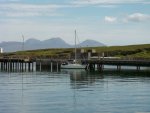
Scalasaig.jpg
A pontoon on the north side of the pier would be good - but it might not survive the winter! I'm afraid I'm drifting the thread to wonder where you are going to berth longterm and there's no need to reply unless you really want to. I have an EV with a range of 100 miles, 50 miles from home and back, which is fine. A range of 50 miles, or 25 miles from Colonsay and back, might be impractical.
 
I must say I rather admire the vessel - it is not within my present budget, but makes me excited for the possibilities of retirement.

Perhaps the below view of the San Francisco Bay will be more useful - it shows a 50nm distance from Benicia Marina in the north, all the way down to the Don Edwards park in the south. I note that Mountain View is nearby - perhaps Tim Apple might purchase a Candela for commuting.

I agree this is not a long range for "serious" cruising, but I think it's an adequate range for a day or weekend boat, and it should be a memorable delivery trip.

Interestingly, the manufacturers emailed this morning saying that they are already anticipating that by the time the boat is ready, it will come with a larger battery. The technology is moving on so fast these days (thanks to the arrival of EVs, of course - not to mention the loosening of the strangle-hold Big Oil has on everything). When you compare the energy content of modern batteries to that of diesel the former is about 1/30th on a volumetric basis. However, introduce the hugely more efficient energy conversion of the electric drivetrain and that changes to about 1/4. So we have only to improve energy density/specific energy by a factor of 2 to make an electric boats really quite practical, particularly combined with much improved charging facilities - both in terms of coastal boating as well as on the rivers/canals. And then there's the cost savings... Candela estimate the C-8 has about 1/10th the running costs of an equivalent fossil-fueled vessel. From my 10 years of EV experience, I'd say that isn't far off.
 
I am indeed familiar with the area and the facilities - or lack of them! I haven't visited since 2004, though...:(
A pontoon on the north side of the pier would be good - but it might not survive the winter! I'm afraid I'm drifting the thread to wonder where you are going to berth longterm and there's no need to reply unless you really want to. I have an EV with a range of 100 miles, 50 miles from home and back, which is fine. A range of 50 miles, or 25 miles from Colonsay and back, might be impractical.
(See my last reply to KompetentKrew re range...)
Sorry, I meant a pontoon attached to a re-jigged south side of the actual harbour - we have broached the subject with Calmac only tentatively, thus far. There seems to be plenty of room for it... and it would then be only a short distance to mains power at the estate's small boathouse.
 
As the C-8 has only just (last week) enetered the water for the first time, it's a bit early to tell. I can't get a straight answer out of them about *maximum* range but, given the nature of the effect of hydrofoils on drag, maybe 50Nm at 22kts *is* the optimum conditions for range (but not possible with waves higher than about a metre, I gather).

Yes, sandwiches only, I fear - It does have options for a wee fridge, a marine toilet (with tank) and hot shower ( Candela C-8).
So I was going to ask
(a) what wave height can that boat cope with? Which you say above is only about a metre; and
(b) what is the range when off the hydrofoils butting into wind and waves? Do you know, as likely to be massively less?
so let me add a couple more
(c) how often have you taken a boat round the UK coast - say from Portland ish, round Lands End and up the Irish Sea to Colonsay?
(d) what do you think the typical swell and wave heights are for these coasts (open to Atlantic swell and short steep wind vs tide waves)?

PS. Many on here have done these routes, up to and including Colonsay, but in boats designed for much bigger waves and with massively longer range between safe harbours.
 
When you compare the energy content of modern batteries to that of diesel the former is about 1/30th on a volumetric basis. However, introduce the hugely more efficient energy conversion of the electric drivetrain and that changes to about 1/4.
Are you sure?

This article gives figures of 47.5 MJ/kg and 34.6 MJ/liter for gasoline and 0.3 MJ/kg and about 0.4 MJ/liter for the lithium-ion batteries in a Chevy VOLT.

On those figures, petrol is about 158x more energy dense than batteries by weight, or 86.5x by volume. (I think?)

The article is admittedly a few years old, and the Chevy a car that launched 10 years ago, but I'm surprised if batteries have increased their energy density by so much over only a decade - I would think that quite a remarkable achievement.
 
So I was going to ask
(a) what wave height can that boat cope with? Which you say above is only about a metre; and
(b) what is the range when off the hydrofoils butting into wind and waves? Do you know, as likely to be massively less?
so let me add a couple more
(c) how often have you taken a boat round the UK coast - say from Portland ish, round Lands End and up the Irish Sea to Colonsay?
(d) what do you think the typical swell and wave heights are for these coasts (open to Atlantic swell and short steep wind vs tide waves)?

PS. Many on here have done these routes, up to and including Colonsay, but in boats designed for much bigger waves and with massively longer range between safe harbours.
That is the way my thinking was going. While it is possible to harbour hop from say Dover to Poole with plenty of choice of marinas - and even mid summer get 2*50 mile legs in 24 hours, once you get past there your options shrink rapidly. Add to that, even in the summer you are lucky if you get more than 5 consecutive benign days when 50 mile hops are achievable. I suspect the biggest constraint will not be recharging facilities but time. If you achieve 1 day in 3 that will be good going, so the 1500 miles from the south coast to the destination could be 90 days, not 30. even the easy legs along the N coast of Europe will take far longer than planned, and doubt even if everything goes well this can be done in under 6 months - a whole summer with the worst bit weatherwise at the end!
 
That is the way my thinking was going. While it is possible to harbour hop from say Dover to Poole with plenty of choice of marinas - and even mid summer get 2*50 mile legs in 24 hours, once you get past there your options shrink rapidly. Add to that, even in the summer you are lucky if you get more than 5 consecutive benign days when 50 mile hops are achievable. I suspect the biggest constraint will not be recharging facilities but time. If you achieve 1 day in 3 that will be good going, so the 1500 miles from the south coast to the destination could be 90 days, not 30. even the easy legs along the N coast of Europe will take far longer than planned, and doubt even if everything goes well this can be done in under 6 months - a whole summer with the worst bit weatherwise at the end!

I pretty much thought the same thing when I mentioned the OP having a very slow trip. I would be extremely difficult with a displacement boat and combination of tides and weather. A fast boat makes it a lot easier but still very challenging.

I remember cruising from the Clyde in 2010 with the intention of heading around the top to the East coast. We were taking our time but I still remember most of the summer consisting of a few decent days followed by a week of stormy weather. We were stuck in Kinlochbervie for almost 2 weeks as the remnants of a US hurricane blew through. The wind got close to 90mph and we had to change our shore lines to keep the bows into the wind. We finally gave up on going around the top when the weather improved as the forecast was for a 36 hour lull before it became windy again.

It was towards the end of the season at that point and we had not been in a great hurry. A fast planing boat could have come up the West coast in the gaps between gales but would still have spent a lot of time waiting around in harbour. Fog might also be an issue further South. A poor summer could throw a huge spanner in the works. Luckily, I haven't seen much summer rain since 2012.

Perhaps the OP should follow my route and keep going to the med. instead of turning right after the channel. Biscay would be a the main problem. The coastal route isn't great as Gironde to Arcachon and then to Biarritz must be about 75nm each leg.

On the bright side, it becomes easier after that and at least he can outrun an Orca.:D:D
 
Last edited:
I'm planning a rather long electric-powered motor-boat trip next year (originating in Sweden) around the south and west coasts of the UK and wondered if anyone knows of a list of available shore-power facilities at harbours/marinas in those regions of the UK. It is going to be quite a task contacting them all to ask (I'm at 50+ charging stops for the whole 2350 miles so far... What else would I be doing in my retirement? ).

Your trip around the North Cornish and North Devon coast is going to be all but impossible with a 50 mile range. How are you going to get between Padstow and Ilfracombe? Make a dash for Lundy?
 
Perhaps the OP should follow my route and keep going to the med. instead of turning right after the channel. Biscay would be a the main problem. The coastal route isn't great as Gironde to Arcachon and then to Biarritz must be about 75nm each leg.

The boat would certainly be a lot more at home in the Med!
 
Your trip around the North Cornish and North Devon coast is going to be all but impossible with a 50 mile range. How are you going to get between Padstow and Ilfracombe? Make a dash for Lundy?

See the list of stops I posted earlier which were quickly derived based entirely on the apparent facilities available from a satellite image and what was found online. Feel free to comment with local knowledge... Push come to shove, I could always commission a tow... or rendezvous with a boat that has 3 phase power...
 
Stayed on Colonsay summer 2020 (our post-lockdown escape) - via ferry not own boat! - and there was a large (maybe 7m) RIB with us on the ferry which launched/recovered most days behind the landy which towed it. The slipway seems ‘okay’. The OP will know best!

There was also talk of sinking visitor moorings in the next bay south of the harbour.
 
See the list of stops I posted earlier which were quickly derived based entirely on the apparent facilities available from a satellite image and what was found online. Feel free to comment with local knowledge... Push come to shove, I could always commission a tow... or rendezvous with a boat that has 3 phase power...
Again, what boating experience do you have of going round the UK coast?
(Many of us have sailed these waters many times - including to Colonsay many times.)

And would you be able to get any insurance cover for a brand new €300k inshore waters foiler with limited range doing a long coastal passage.
(I know my insurance costs for a proven 8 ton sailing yacht with experienced skipper, for waters from Stockholm to Scotland - do you?)
 
Are you sure? (OP: *No*!! But I cant be bothered to do the maths again right now!)

The article is admittedly a few years old, and the Chevy a car that launched 10 years ago, but I'm surprised if batteries have increased their energy density by so much over only a decade - I would think that quite a remarkable achievement.

Well, if you take the somewhat more common Nissan LEAF as an example, it was originally launched in the UK in 2011 with a 24kWh battery and by 2019 that had gone up to 62kWh which weighs a bit more but is almost the same volume. This rapid pace of improvement will only accelerate (IMO - see here for more including the equally dramatic reduction in cost).
 
See the list of stops I posted earlier which were quickly derived based entirely on the apparent facilities available from a satellite image and what was found online. Feel free to comment with local knowledge... Push come to shove, I could always commission a tow... or rendezvous with a boat that has 3 phase power...

Can your boat dry out? If not, it’s going to be pretty much impossible as there are virtually no marinas.

Assuming you can somehow make it to Padstow, your next options after that are

Clovelly: absolutely zero facilities, dries out, can’t imagine they would let you run a generator for 24 hours either. No easy petrol station either.

Bideford: zero facilities, dries out, not really practical to run a generator.

Ilfracombe: dries out, minimal facilities. You may be able to get a shore power connection if your lucky, but it might only be 13A

Watchet: Marina, stay afloat (if it’s been dredged). Should be able to get 16A charge

Lundy: like landing on the moon, they don’t have electricity. No where to run a generator.

Your bigger problem is I don’t think any of these places are even remotely achievable with your boats range.

I really wish you the best of luck but your plan is totally ridiculous.

As for charging from a generator, Honda EU2000i about 2kw, two of them 4kw. So we’ll over 10 hours with both running at full chat to recharge your boat.
Each will use about a litre an hour, say 12 hours to charge. That’s 25 litres of petrol. Refilling the generator tanks 4 times each… where are you going to get the petrol from?

Finally 100m of 2.5mm cable won’t work, you will need more like 10mm to keep the voltage drop under control…
 
There are a number of electric charging points on the Norfolk Broads , the first being at Great Yarmouth Yacht station about a mile inland from the river mouth..
if you can get under the bridge at low tide..
anyway this link has all the sites listed..
Electric boat charging points
 
Can your boat dry out? If not, it’s going to be pretty much impossible as there are virtually no marinas.

Assuming you can somehow make it to Padstow, your next options after that are

Clovelly: absolutely zero facilities, dries out, can’t imagine they would let you run a generator for 24 hours either. No easy petrol station either.

Bideford: zero facilities, dries out, not really practical to run a generator.

Ilfracombe: dries out, minimal facilities. You may be able to get a shore power connection if your lucky, but it might only be 13A

Watchet: Marina, stay afloat (if it’s been dredged). Should be able to get 16A charge

Lundy: like landing on the moon, they don’t have electricity. No where to run a generator.

Your bigger problem is I don’t think any of these places are even remotely achievable with your boats range.

I really wish you the best of luck but your plan is totally ridiculous.

As for charging from a generator, Honda EU2000i about 2kw, two of them 4kw. So we’ll over 10 hours with both running at full chat to recharge your boat.
Each will use about a litre an hour, say 12 hours to charge. That’s 25 litres of petrol. Refilling the generator tanks 4 times each… where are you going to get the petrol from?

Finally 100m of 2.5mm cable won’t work, you will need more like 10mm to keep the voltage drop under control…

Hi 'jakew009', I sense you are a bit of a 'glass half empty' kind'a guy...! But you raise some important points so let's look at them...

In turn, then:
Q: Can your boat dry out? A; Yes.

Q: Clovelly is the option on my list (with Port Issac 42 statute miles before and Burry Port Marina a slightly more challenging 52Sm after). Not sure what 'facilities' you think I need (but to be fair I haven't said) but it's basically shelter/secure mooring and at least single phase mains electricity (and ideally somewhere to eat/shower etc). I see there is the Red Lion no more than 50m from the centre of the (dry) harbour at Clovelly and half a dozen or so private residences even closer. It would not be the first time I have knocked on a complete strangers door, extension lead in hand and obtained a charge for an EV (albeit only after the occupant had pick themselves up off the floor from shock/hysterics - on both occasions they would not even accept any payment). I do not intend for my visit(s) to go down this route, however. I'll get around to contacting the more 'basic' potential pit stops in due course but I am fairly hopeful that most, if not all, will be able to provide what I need. (Just got off the phone to the Red Lion and charging is certainly practically possible either from the hotel itself which is currently under refurb with plans for outside sockets anyway) or the Lime Kiln building just south and in the middle of the harbour. So, it's just a question of persuading the owner (nothing like free publicity!).

Q: Gennys... Their use would be intended only for dire emergencies (the boat has a built-in 'limp-home' mode at 4kts) so charging for hour after hour would not be needed. Perhaps a small detachable outboard motor (my original emergency option) would be more sensible/practical/affordable?

Q: Extension voltage drop: Voltage drop for a 2.5mm2 cable over 50m at 10A from a standard mains socket (full charge from 20% in about 14 hours - if I can get a 16A charge that drops to about 10 hours) is 8V - well within acceptable limits but perhaps I should make 2 of the 25m extensions in 4mm2 instead...?

I expect you still think I bonkers but if we never push the envelope...?
 
There are a number of electric charging points on the Norfolk Broads , the first being at Great Yarmouth Yacht station about a mile inland from the river mouth..
if you can get under the bridge at low tide..
anyway this link has all the sites listed..
Electric boat charging points

Thanks for the interesting link but I'm going the other way (clockwise) but electrification makes even more sense for canal boats than it does for cars...
 
Again, what boating experience do you have of going round the UK coast?
(Many of us have sailed these waters many times - including to Colonsay many times.)

And would you be able to get any insurance cover for a brand new €300k inshore waters foiler with limited range doing a long coastal passage.
(I know my insurance costs for a proven 8 ton sailing yacht with experienced skipper, for waters from Stockholm to Scotland - do you?)

Well, I've done some racing in the Solent and spent a few weeks sailing a 60' yacht around these parts (albeit some time ago). I've researched insurance and it isn't insanely expensive. If it turns out to be I'll just have to hope my Tesla shares do a bit better than they have done in the last couple of weeks!
 
Stayed on Colonsay summer 2020 (our post-lockdown escape) - via ferry not own boat! - and there was a large (maybe 7m) RIB with us on the ferry which launched/recovered most days behind the landy which towed it. The slipway seems ‘okay’. The OP will know best!

There was also talk of sinking visitor moorings in the next bay south of the harbour.

There is the main slipway next to the ferry RORO ramp but there is the old original in the harbour too.

There are 6 moorings being deployed in the bay to the south of Scalasaig (organised by the Colonsay Community Development Company) which were due to be deployed in 2020... This year, now, apparently. Coincidentally, I'm planning to build a house just in from the bay 'soon'...
 
Top