U J's in prop shaft

wolves88

New Member
Joined
31 May 2017
Messages
6
Location
Plymouth
Visit site
Hi all, new member here, I am in the process of fitting a reconed 1.8 BMCwith a hurth ZF 10m box and I have a 1 ¼” shaft and coupling into my semi restored Colvic 20, my problem is because the angle of the shaft where it meets the gear box flange is not flush” I have dropped the engine as low as poss to meet it” but to get it in line would need to raise the front of the engine some 3+ inches higher creating what looks like too much slope for the engine to run at i.e. oil in sump. So being a car man I managed to find a small 16” 4x4 pro haft with a U J and a flange each end that match my box and shaft flanges, my worry is how do I null the thrust will a heavy duty pillar bearing just before the stern tube do or is this idea a no no? I am way over budget and don’t want to go down the aqua or python drives route, any advice please thanks Barry
 
Highly unlikely the shaft is in the boat at too steep an angle, so raise the engine to meet the shaft. 10 degrees is quite common and even up to 15. The previous enginee may have had a 7 degree down angle box if the bearers are too low and at a shallow angle.
 
Can you add a picture please ?

It sounds as if the engine bearers (rails and/or mounts) are too tall for the new engine. Perhaps not possible to put smaller ones in, as the sump might hit the hull ?


IIRC, pillow bearings ( =? pillar) are not for taking thrust (i.e. along the length of the shaft) but to contain a drive shaft parallel to the length of the shaft.
 
...creating what looks like too much slope for the engine to run at i.e. oil in sump.

The engines of untold thousands of small craft run at a significant angle. The limits are usually specified in the owner's handbook (but even with a 'home' marinisation, the same engine has often been marinised commercially by someone, who will have published the spec.) On our Kubota-based Beta, for instance, the permitted longitudinal angle is 15 degrees either way from horizontal. This is a fairly commonplace industry figure and probably somewhat conservative.

Such angles can, of course, have a bearing on dipstick readings. Beta recommends filling the installed engine with the prescribed amount of oil from empty, marking where that is on the dipstick, and using that mark as your new datum.
 
You still have to get your angles right and get good quality cardan shafts as in a boat they work far harder than in a car.

A boat works with the drive under load pretty much the whole time it's driving, so it's like driving uphill the whole time. In a truck/car they get a rest as you take your foot off.

Get the angles right and they can work but you will need a thrust bearing attached to the hull. Another point worth considering is if the spiders fail at the prop end the flailing shaft could easily put a hole in the hull, so a plate underneath might be an idea.

217699d1315484821-knocking-rear-high-revs-pinion-angle.jpg
 
Last edited:
What you describe is pretty much what we have in our boat, although I used a pair of Mini cv joints with the shafts cut down and welded together. The thrust is taken by a 1 1/4" plain ball bearing mounted in a square housing with a bolt at each corner. This is well up to the job for our BMC 1.5. It works well. The shaft has no vibration at all.
Have a chat with your local bearing stockist about axial loads. If you want to spend more money you could go for a double taper roller bearing.
 
You still have to get your angles right and get good quality cardan shafts as in a boat they work far harder than in a car.

A boat works with the drive under load pretty much the whole time it's driving, so it's like driving uphill the whole time. In a truck/car they get a rest as you take your foot off.

Get the angles right and they can work but you will need a thrust bearing attached to the hull. Another point worth considering is if the spiders fail at the prop end the flailing shaft could easily put a hole in the hull, so a plate underneath might be an idea.

217699d1315484821-knocking-rear-high-revs-pinion-angle.jpg

I see this comes from 'hotrodders'. It would be true in the case of a hot rod.
It's less true in the case of a boat.
A lot of it is about the fact that a uj running at an angle is not a CV joint. So if the road speed is constant, the engine has to vary its speed as the joint rotates. It's less of a worry with a boat as the prop speed is not firmly locked to hull speed.
 
thanks SBS It would be real easy to use the small 4X4 prop as it has 2 flanges the same size as my gearbox and would just bolt straight in, would your set up for thrust work do you have a photo of it in situ thanks Barry
 
thanks SBS It would be real easy to use the small 4X4 prop as it has 2 flanges the same size as my gearbox and would just bolt straight in, would your set up for thrust work do you have a photo of it in situ thanks Barry

You really are making it overcomplicated trying to fit UJs. They are not necessary.

As already advised the engine will run at more than 10 degrees to the waterline, so reworking the bearers to mate the output coupling to the shaft is the first thing to do. You are overimagining the problem of oil pickup. Just think of the angles engines run at in sailing yachts without any problems.
 
I have (for sale) a Colvic 20 too.

I calculated the side thrust on a pillow block bearing, and ran the numbers according to a sensible usage, I forget exactly what, but the answer was in years (like 6) before replacement would be required. Yes, it's bearing abuse, but at a tenner, who cares.

I'm an ex aerospace design engineer.

Ymmv

Guy
 
I see this comes from 'hotrodders'. It would be true in the case of a hot rod.
It's less true in the case of a boat.
A lot of it is about the fact that a uj running at an angle is not a CV joint. So if the road speed is constant, the engine has to vary its speed as the joint rotates. It's less of a worry with a boat as the prop speed is not firmly locked to hull speed.

Even with everything south of the first UJ speeding up and slowing twice every revolution?* While props and shafts arent as heavy as a car, they arent featherweight either.

* unless you have ideal set up like Neil_Y's second configuration, in which case its just the intermediate shaft that varies speed.
 
Hi all, new member here, I am in the process of fitting a reconed 1.8 BMCwith a hurth ZF 10m box and I have a 1 ¼” shaft and coupling into my semi restored Colvic 20, my problem is because the angle of the shaft where it meets the gear box flange is not flush” I have dropped the engine as low as poss to meet it” but to get it in line would need to raise the front of the engine some 3+ inches higher creating what looks like too much slope for the engine to run at i.e. oil in sump. So being a car man I managed to find a small 16” 4x4 pro haft with a U J and a flange each end that match my box and shaft flanges, my worry is how do I null the thrust will a heavy duty pillar bearing just before the stern tube do or is this idea a no no? I am way over budget and don’t want to go down the aqua or python drives route, any advice please thanks Barry

By "looks like" are you comparing it to the hull? Which might not be horizontal under the engine?

neil sorry to sound a real dummy but i am trying to load photos and when i click the image thing its asking for url ? "not a clue!

URL is what you type in the address bar to go to a web page without using links or bookmarks. So the image would need to be on the web somewhere... popular image hosting sites include photobucket and postimage. You can upload images to the YBW forum site but you run out of space pretty quickly.
 
We have the set up you describe but I suspect we have a lot more space to achieve this succefully than you do.
Where our s/s prop shaft enters the hull we have deep sea seal then the s/s prop terminates with a bolt on flange to match thr lorry UJ. The inboard end of the s/s prop shaft is grooved to allow the fitting of a matched split collar. This collar is held in place by and supported by an industrial plumber block housing a 50mm bearing. The plumber block acts a thrust block and the grooved collar locates the s/s prop shaft to stop any longitudinal movement. The lack of longitudinal movement is essential to ensure the deep sea seal functions without any leaks. It does this perfectly but I suspect you would need to have this collar made and it might all get a little expensive.
Having the abilty to remove the lorry propshaft whilst afloat without upsetting the s/s shaft exciting the boat is nice. Not needing perfect engine alignment is also good and the sliding spider joint on the lorry propshaft all helps to make a vibration free installation. Our installation was designed like this from day one and works very well. All the parts except the grooved collar are available off the shelf at none marine prices
 
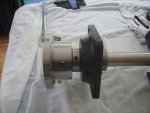
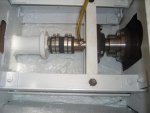
Setup of our thrust bearing. There is a collar behind the bearing which is located on the shaft by two allen screws to take forward thrust. Reverse thrust is taken by the half coupling.
 

Attachments

  • IMGP1735Comp.jpg
    IMGP1735Comp.jpg
    71.9 KB · Views: 1
  • IMGP1750Comp.jpg
    IMGP1750Comp.jpg
    74.9 KB · Views: 1
thanks for everyone's input guys really helpful for a learner boat builder on his first big nautical project, I am going to give it one more go at aligning the engine to shaft before going down the UJ route, I have got an 1" or so that can be removed from the bearer under the gearbox to allow me to drop the rear slightly, and the new stern tube isn't fixed in yet so can ream the keel slightly to straighten the angle that end, will try and get some photos loaded they are on my laptop but not on a website so cant load them, or dont know how to, I T not a strong point of mine, thats a job for this evening.
 
Even with everything south of the first UJ speeding up and slowing twice every revolution?* While props and shafts arent as heavy as a car, they arent featherweight either.

* unless you have ideal set up like Neil_Y's second configuration, in which case its just the intermediate shaft that varies speed.

I guess you'd have to do the maths to work out what load that put on the bearing in the UJs. There are plenty of vehicles running UJs at angles.
There are more than a few powerboats with angled UJs I believe.

A better approach might be to use rubber couplings.
This can give a quieter installation than a rigid shaft.

Also isn't running the intermediate shaft at half the angle of the propshaft (the absolutley not picture) OK if the UJs are phased correctly?
But I don't disagree that it's simplest to just line up the engine.
 
You still have to get your angles right and get good quality cardan shafts as in a boat they work far harder than in a car.

A boat works with the drive under load pretty much the whole time it's driving, so it's like driving uphill the whole time. In a truck/car they get a rest as you take your foot off.

Get the angles right and they can work but you will need a thrust bearing attached to the hull. Another point worth considering is if the spiders fail at the prop end the flailing shaft could easily put a hole in the hull, so a plate underneath might be an idea.

217699d1315484821-knocking-rear-high-revs-pinion-angle.jpg

This is not entirely correct, and I'm not talking about the moronic spelling...
 
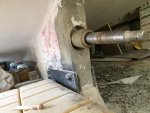
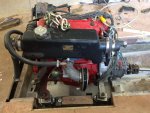
Ok to update think I'm back to a R&D coupling I have removed 1 1/2” off the gearbox bearing allowing the engine to drop as low as poss, if also reamed the rear stern tube opening which has allowed the shaft to level itself and its the best I have had it, I would ideally like to raise the rear cutlass bearing another ½” to make it sweet but in doing so my prop touches the hull, the prop is a 17” that came on the shaft I picked up locally off a Romany, I’ve been told it’s too big for the Colvic and a 15”would be more suited, so I think I will raise it a tad, ready for a 15” prop, can mine be taken down to size or is a replacement prop required? only let me load 2 load 2 photos
engine a 001.jpg
engine a 004.jpg
 

Other threads that may be of interest

Top