Two-stroke outboard engine seized - water in cylinder? How bad is this?

KompetentKrew

Well-Known Member
Joined
27 May 2018
Messages
2,631
Visit site
Hello,

My outboard engine was working perfectly last time I used it, but I must admit to my shame that it has been sitting neglected in the boatyard for the last year.

A couple of years ago I suffered from the clamps seizing from lack of use over the winter, so I have taken care to wind them a turn or two occasionally when passing. How I now wish I had thought to give the starter cord an occasional pull too.

I noticed recently that there wasn't much movement in the throttle and intended to lubricate it, removed the cowl and realised that the starter cord would not move.

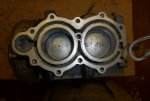
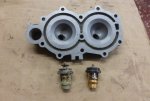
In the photos, the crud in the cylinder looks like bird shit, but isn't - the engine was simply removed from the dinghy and not used for some time. I only removed the head after finding it seized. I was surprised to find the crud does not taste salty.

Google suggests my best bet to free the cylinder is either 2-stroke oil or a mix of ATF and acetone. Possibly kettles of hot water over the cylinders (careful not to get it inside them) to try and break the seal. If I get it moving, I guess I need to inspect the piston rings? I've never done anything like this before.

Engine is a Tohatsu 9.8 two-stroke.

I appreciate any thoughts you might have.

7OatmjC.jpg

D4sMoTA.jpg

5o3O6fZ.jpg

Ya3V2O5.jpg

2pDsWhN.jpg

Mc8OqWG.jpg

axCDgIA.jpg
 
Gosh. Looking at the corrosion where the gasket would be sitting, it does seem that it's not going to be possible to get compression.
I can only suggest further cleaning to see it with the crud removed, but it doesn't look hopeful to my untrained eye.
 
Strip down and clean. Make sure piston ring grooves are crud free. Use a drill mounted ‘honing’ tool on bores Smear of not setting hylomar or Curil-T on gasket. While you’re at it give all the cooling passages a clear out. And send those pictures to Torqeedo for their marketing department.
 
Two options.
Bin it - or risk spending a lot of time fruitlessly rebuilding it.
Freds post above is spot on, you'll have to take the pistons out which may not be easy as the rings on the bad cylinder are almost certainly rusted into the bore. If the cylinder isn't too pitted you might get away with it but may well need one new piston. Also clean up the mating faces of the head and block with fine (wet) wet n dry on a sheet of plate glass to assess whether the corrosion has damaged them too much. If you can't get an unbroken ring of bright metal for the gasket to seal that's probably a stopper.
In any case a gasket set, new rings and a piston (if you can even get them) won't come cheap.

Good luck, it'll be very satisfying if you succeed.
 
Strip it down and clean up component parts.
i.e. Head, barrel. drive leg, prop , rotor, coils, cowl,etc.
Clean then and bag and label them.
Sell parts on line and use the money to buy a new reliable engine.
It will turn out much cheaper in the long run.

Outboard parts are EXPENSIVE, so why not cash in.

gary
 
Two options.
Bin it - or risk spending a lot of time fruitlessly rebuilding it.................In any case a gasket set, new rings and a piston (if you can even get them) won't come cheap.
Good luck, it'll be very satisfying if you succeed.

All parts are available for the T9.8 2 strokes and rebuilding is far cheaper than cost of a new engine, which can't be purchased anyway for leisure use.
 
Well I wouldn’t write it off just yet , not before scraping and cleaning the mating face of the block( which does look bad?)
If that comes back then a bit of patience and magic lubricant mix of choice may unseize the piston and rings..
Or just clean it out a bit and offer it for sale as suggested.
Good motors those but quite old now?

I am going to guess that lying on its back the salt water has eaten its way through at the head joint faces and seeped into the cylinder to rot it - so in the long term , where else too by now but out of sight ?
 
I'm with Graham! Sought after engines, these. Parts still widely available (not that expensive direct from Japan either, even after tax). At least got to be worth trying to clean it up and free that piston with ATF/acetone/diesel etc.
 
Some years back a friend of mine dunked his Honda 2.3 and it became seized.

He took it to the Honda dealer, Seamark Nunn, and they couldn't free it.

He gave it to me, and guess what, I couldn't free it either. It's been an excellent source of parts for my existing 20 year old Honda 2.0 .

Just to add to add to the suggestions already made, you could buy a nice used outboard of the same make and model that you seem to be happy with, and use your existing one for parts.
 
Last edited:
Thanks very much for all the replies.

As some have said, it would be neither cheap nor easy to replace this engine, so I don't know what I'll do if it can't be freed.

You can't actually see the faces of the block in these pics, as the gasket is still in place - you can just about see this if you look closely at the second pic. I think what you're seeing, above the rim of the cylinder, is crud that fell out of the cylinder when I removed the head - the camera is looking vertically downwards in these pics. I'll have to try a different lens next time and see if that's clearer.

I didn't have time to look at it today, but this guy and this guy on YouTube make it look relatively easy and painless, so I'm feeling more optimistic having watched those. I'll no doubt have more questions if and when I can free it, but I appreciate all your help so far.
 
That piston's going to need braying with a wooden drift and a gert big 'ammer before it moves. Lotions and potions are not going to free an engine rusted up as badly as that.
The rings must be rusted solid into the bore which will be far too pitted and eroded to use as is . It may well require the piston to come out in pieces.
Oversize pistons do seem to be available and surprisingly reasonably priced. Smashing it out and a rebore would work as long as the corrosion there hasn't gone too deep.
 
Last edited:
A while back I freed a little two cylinder Johnson which looked a bit like that. Carefully cleaned out the crud, soaked the pistons for a day in releasing oil, then gently tapped them to free. Carefully cleaned any remaining crud as they moved and 'honed' the bores (bit rusty at the top) with W&D fine sand paper. I was in rural Virginia and no gaskets available, so used some sealant and the old gasket. The engine had been out of use for years, as it gave HT belts as the throttle opened. That was due to bad earthing of the rotating ignition plate. Worked for years after.
 
Your realistically going to need a new powerhead. Oversized pistons and rings, rebore your looking at hundreds. Then youre gonna need new main bearings your crank will need splitting....new seals and gaskets well into the hundreds again.
 
Your realistically going to need a new powerhead. Oversized pistons and rings, rebore your looking at hundreds. Then youre gonna need new main bearings your crank will need splitting....new seals and gaskets well into the hundreds again.
That depends what the bores look like when cleaned up.
 
That depends what the bores look like when cleaned up.
If the pistons will come out...and yiu can bet if they do the rings will be stuck and rusted and will need replacing, main bearings 99% of the time will be shot...to replace the crank will need splitting. Costs soon mount up
 
Top