Two questions about replacing wet deck core…

steve yates

Well-Known Member
Joined
16 Oct 2014
Messages
4,115
Location
Benfleet, Essex/Keswick, Cumbria
Visit site
I have several sections of coachroof with very high moisture readings and a couple that are definitely spongy and delaminated. I have a good idea of what I am going to do, ie cut open the deck from the top, remove the cut fibreglass panel, get out al the old rotted balsa, clean off the in er skin, and underside of the removed top skin, coat them and the balsa with epoxy, add a layer of thickend epoxy over and into the balsa, replace the top skin over it and weight it down until cured.

My questions are about the edges of the sections, what is the best way to finish these? I’m think grind back about an inch either side, lay some glassfibre tape over the joins, wet it out and then add a final layer of epoxy thickened with an easily sandable filler so i can fair the edges.
Does that sound right? Any other ways?
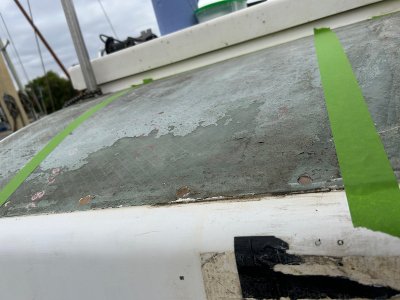
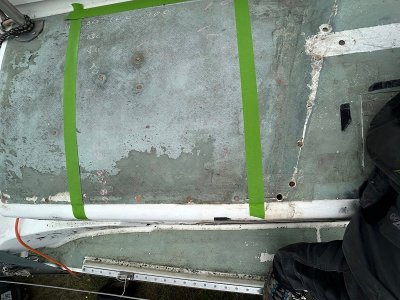
The second part of the question, bearing in mind the bit above is, where on the photo should i make the bottom cut? (The gree tape is where i will make the other three cuts, and then i’ll do the next section and soon) Along the edge of the nonslip? About an inch inside? This section of coachroof has a distinct camber. Its the worst affected area of deck.
The holes are where the doghouse will be bolted in ( they will be filled first) and the hatch garage, the doghouse was originally bolted directly through the balsa, hence the rot.)

Any other tips and clever suggestions from those who have done this job will be much appreciated.
IMG_2025-08-17-121133.jpeg
IMG_1583.jpeg
 
I’m think grind back about an inch either side, lay some glassfibre tape over the joins, wet it out and then add a final layer of epoxy thickened with an easily sandable filler so i can fair the edges.
Does that sound right?
Sounds right to me and is what I did on a similar though not identical cored deck repair.
The second part of the question, bearing in mind the bit above is, where on the photo should i make the bottom cut? (The gree tape is where i will make the other three cuts, and then i’ll do the next section and soon) Along the edge of the nonslip? About an inch inside? This section of coachroof has a distinct camber. Its the worst affected area of deck.
Presumably only the coachroof is cored, not the sides? If so, I would try to establish exactly where the coring starts and then make the cut at such a distance that the rotting balsa can be comfortably dug out sideways and the skins be made good for new coring. Probably no more than 50 mm.
 
Last edited:
Does the underside have a head lining? When a friend had a similar though perhaps more extensive problem, he chose to remove the inner skin and do much the same job but from the underside, in that way the repaired edges of the cut/refitted grp panels were hidden behind his head lining panels. You do of course end up with more dust/crap inside the boat, but it saved a lot of fairing and in his case, matching the moulded-in non-slip deck pattern.
 
Does the underside have a head lining? When a friend had a similar though perhaps more extensive problem, he chose to remove the inner skin and do much the same job but from the underside, in that way the repaired edges of the cut/refitted grp panels were hidden behind his head lining panels. You do of course end up with more dust/crap inside the boat, but it saved a lot of fairing and in his case, matching the moulded-in non-slip deck pattern.
I’ve made a definite decision to go in from the top, I find working with epoxy upside down to be a disaster for me every time :) Besides, I’m going to put faux teak down on the deck later so doesn’t have to be a perfect finish.
 
When I did the same job on a Coronet fore-deck I used ply instead of balsa and cut through the top of the ply, stopping before going right through. This allowed it to drape into the curve of the deck. I finished the joint with epoxy and bi-axial cloth followed by thickened epoxy and laid faux teak over the top, If you PM me your email address I can send you the PBO article that my mate Tony produced on the complete project.
 
I have several sections of coachroof with very high moisture readings and a couple that are definitely spongy and delaminated. I have a good idea of what I am going to do, ie cut open the deck from the top, remove the cut fibreglass panel, get out al the old rotted balsa, clean off the in er skin, and underside of the removed top skin, coat them and the balsa with epoxy, add a layer of thickend epoxy over and into the balsa, replace the top skin over it and weight it down until cured.

My questions are about the edges of the sections, what is the best way to finish these? I’m think grind back about an inch either side, lay some glassfibre tape over the joins, wet it out and then add a final layer of epoxy thickened with an easily sandable filler so i can fair the edges.
Does that sound right? Any other ways?
The second part of the question, bearing in mind the bit above is, where on the photo should i make the bottom cut? (The gree tape is where i will make the other three cuts, and then i’ll do the next section and soon) Along the edge of the nonslip? About an inch inside? This section of coachroof has a distinct camber. Its the worst affected area of deck.
The holes are where the doghouse will be bolted in ( they will be filled first) and the hatch garage, the doghouse was originally bolted directly through the balsa, hence the rot.)

Any other tips and clever suggestions from those who have done this job will be much appreciated.
View attachment 197911
View attachment 197912
Could you not just drill a series of holes from above, de-core with a bent nail in a drill, re-core with spray foam, then plug the holes with thickened epoxy. I’ve done this with smaller sections. And only on old boats where the upper skin was mighty thick to start with. But it’s been relatively successful. You can go in small sections this way, and only remove “sponge” where it exists. The only iffy part is drying out the in-between - dry days, sunshine, eat guns, and vacuums help.

Removing all of the upper layer seems dramatic.
 
  • Like
Reactions: dsw
Its a few feet of delaminated core. While I think it could do as a stopgap for small areas, I doubt the hole drilling and epoxy injection idea thats get repeated a lot is a long term fix. Balsa wicks moisture, and since your not removing the moisture, it will wick along the deck and continue to slowly rot the balsa all around the little pillars of epoxy.
It actually feels like less effort to open the deck up, remove the rot and moisture and rebond new core in then seal and fair the joints. With the added security that at least that section is good for another 50 years.
I’ll come back and tell you in a couple of weeks if I wished I had drilled a load of holes instead :)
 
Wide area epoxy injection is a really bad idea. Epoxy is a good thermal conductor and will cause condensation inside where it’s used.

Expanding foam in a can is an excellent replacement for balsa, with surprising adhesion qualities, especially (specifically) when moisture is present. It will seal off the wet balsa from air and prevent any further rot. The biggest concern is that it’s expansion is quite powerful and will blow your top and bottom ‘glass layers apart if there aren’t plenty of holes for it to escape from.

The only place you need epoxy injection is at thru-deck penetrations. It’s not actually needed to seal the foam, but to provide a stiff compression column for the fastenings.
 
If you are going to do it then IMHO do it properly. If you are going to lay a faux teak deck then going from above is a good idea. If the panel you cut out is in good condition then you could reuse. Personally I would grind scarfs when refitting to avoid any hard stress points. You could use balsa as a core but proper foam won’t rot in the future. I would steer clear of any use of expanding foam, you won’t be able to control how much pressure it puts on the skins. Your question about how far to cut will only be answered when you open it up!
 
If you have not seen them already, there are multiple threads on core replacement on Sailing Anarchy. Some of them very knowledgeable. Google will find them.
 
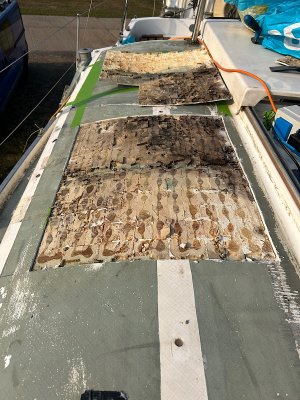
The rotten core in question, need to keep cutting open aftwards but could have been worse I reckon.
I admire your efforts and I'm interested to follow as I could do with doing a bit myself, but given how thick that top layer of glass is and the age of the boat, I reckon you could just as easily not bother.
It doesn't look that bad at all, I fitted a new swan neck last year and the core around it was actually sodden and mush. I epoxied around the new fitting and have been doing a good job of not thinking about it since. My boat is 40 years old and I come to see it as like having a bit of rust on a car...to be expected at that age.
 
I’ve probably gone further than I had to now I’ve opened it and seen whats u der there, but I definitely want the black stuff replaced. It was completely delaminated , and gave when you walked on it. I have a hard doghouse that screws into the deck there, I really want it screwing into something secure :) I have a section further forward I made the cuts on but am struggling to make any progress lifting off the skin, its so well bonded. That was overkill and I think I will probably just grind back the cuts, fill them with epoxy, glass tape them and fair.
 
Top