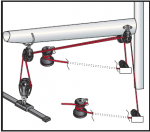
Twin mainsheets

zoidberg

Well-Known Member
Joined
12 Nov 2016
Messages
6,949
Visit site
I'm doing a 'refurb' and planning to relocate the existing mainsheet track, which is close to the companion-hatch, to a position about 20" further aft.
However, I am reminded that Jean-Jacques Van Den Heede used a 'twin mainsheet' arrangement, and that it worked Right Round for him.

I like to ask for others' views, for usually I learn something I hadn't sussed out for myself, so I invite opinion on the relative merits of retro-fitting a twin mainsheet system on a 27' sailboat of similar shape to J-J's boat.

49753016611_12551c6367_w.jpg
 
Attaching the mainsheet(s) at the end of the boom gives the advantage of much better leverage and no need of a track. Sail shape might be controlled by using an additional boom vang
 
I can see the advantages. Save the money and complexity and clutter and drillings and labour associated with a track. Assuming sufficient purchase, you still get all the flexibility of being able to trim the boom to the Centreline which many single-point cruising set-ups lack.

If your mainsheet tackles go to each quarter, which I think is what you suggest, the load (if you want to trim the leech hard) will be considerable.

What it seems you lose is the ability to trim dynamically i.e. in gust response, with accuracy. But if you're short-handing and offshore, how much time do you spend doing that? Probably not much. You wouldn't want this system round-the-cans racing, but that's probably not your concern.

Another solution, which I am surprised not to see more of now that we are so good with Dyneema, is a split strop as used on most high-performance dinghies.
 
I can see the advantages. Save the money and complexity and clutter and drillings and labour associated with a track. Assuming sufficient purchase, you still get all the flexibility of being able to trim the boom to the Centreline which many single-point cruising set-ups lack.

If your mainsheet tackles go to each quarter, which I think is what you suggest, the load (if you want to trim the leech hard) will be considerable.

What it seems you lose is the ability to trim dynamically i.e. in gust response, with accuracy. But if you're short-handing and offshore, how much time do you spend doing that? Probably not much. You wouldn't want this system round-the-cans racing, but that's probably not your concern.

Another solution, which I am surprised not to see more of now that we are so good with Dyneema, is a split strop as used on most high-performance dinghies.
Split strop as per most (many?) high performance dinghies is generally reliant on a strong boom and powerful kicker.
A second high quality mainsheet purchase may be no cheaper than a track. A track is good for spreading the loads into the deck.
What you actually want from a mainsheet system in terms of letting the boom up or out or a bit of both varies from boat to boat.
How much roach? How bendy a mast? Size of genoa? Wind conditons? Trying to sail high or fast?

Most boats you have 3 controls, kicker, sheet, traveller. Mostly you only need to ease one of those in response to a gust. With a twin sheet system you might need to ease both sheets.
I can see it can work and might offer great control in some circumstances, but I reckon the subtleties on making it work as well as a conventional system might take a lot of working out. It is after all, nothing new, similar things were used before ww2.
 
I've spent a lot of hours on a twin mainsheets boat - they were up on the coachroof either side of the main hatch. As RJJ said, there's a slight problem with accuracy if you're asking someone inexperienced to trim. My basic windward trim would be to use the leeward one as the 'sheet' and the wward one as the traveller. Other than that, I wouldn't want it on a boat which I raced a lot but on a cruising boat, no problem at all.
 
Jean-Jacques Van Den Heede's boat is Rustler 36 (I have one) - the mainsheet track bisects the cockpit. I can see the attraction of getting rid of the track, and attaching two mainsheets, one to either end of the track. Bearing in mind that with long distance sailing it is unlikely you will be hard on the wind for any length of time, I can see it might be advantageous in clearing the cockpit..
 
The extra rope of twin mainsheet might be OK on the coach roof, ahead of a sprayhood - or perhaps acceptable in the cockpit for a single hander crossing oceans (and hence only using occasionally).
But twin mainsheets in a busy cockpit sounds like a recipe for lethal results when gybing with lots of crew around.
 
Ignoring the user interaction for a moment, you should be wary of the structural loads imposed on the boom and the cockpit fixings as a result of changing the mainsheet position.

Presumably the area you are removing the existing track from is pretty stiff given the presence of the bridge deck etc. Where would you attach the ends and how strong are those locations? Remember there is a transverse compressive force as well as the upwards pull, and that snatch loads can be pretty high.

Will you have to move the attachment on the boom? Will this make the loads on the boom greater or less? If the main is loose footed and you are moving the attachment to the clew then this actually improves things. If the mainsheet will pull the boom aft when on the centreline then this will put a load on the gooseneck.
 
I have used a twin sheet main sheet set-up. On a close to thousand mile ocean voyage I had opportunity to see how it works in all conditions including a storm.
I think it is an excellent method and, with a bit of practice or retraining, it does allow careful control of main sail shape. The boat I sailed on, had a large spread between port and starboard sheets and as such it acted both as a vang and a preventer. The larger the base, the greater the control. I like it.
 
I already have a new track-section and controls. Moving the mainsheet 'attachment' to a new track about 20" further aft clears the companion-hatch where I spend much time on part-sheltered lookout when singlehanding. The plan is to extend the bridgedeck aft about 24" by fixing a 20mm marine ply/epoxy/poly-paint 'shelf' spanning the full space, giving a storage space beneath ( liferaft/dinghy ? ) and a 'lounging shelf' above where I could tuck myself into the corner under the sprayhood. I like the rearward extension to the normal 'rear-open' sprayhood that J-J and some others had, and would like to incorporate that.

Of course there will be large loads into this shelf, down into the cockpit seating. I've been mulling how to beef it up.

Should I go for a twin mainsheet set up, the 'chainplates' for the lower parts of the tackles would be secured into the outer sides of the substantial GRP coamings - which were strongly built in a Marcon boat 40 years old.

I'd need to look carefully at the 'swept area' of the sheet winch handles....

Cost differences are not of primary concern. Lengthy ropes can be tidied away. What is significant is relative freedom of movement without negotiating an arthritic body around a loaded mainsheet....
 
Last edited:
Have you thought about sitting looking aft. that might avoid major changes . I use this & can sleep in it because I get wedged by the sides. I have a sponge to rest my head. Normally my head is just below deck level but every 15 mins I can sit up & look round. One plus for me is that it helps my sea sickness as I can always see a wide horizon aft. I do not have a spray hood

Hammock 2 (600 x 403).jpg
 
It's a very interesting idea. On our centre cockpit it wouldn't be too hard to set up, simply placing a strongpoint at either end of the existing track. Presumably I could reuse my kicker blocks for the second tackle, at least temporarily.
The ability to lock the boom rigidly in place when at anchor is probably higher up my list than the ability to play the traveller in gusts.
If I ever get to use the boat again, I think I will try this out (I'd only need to install a couple of beefy U-bolts) - I can always revert to the original setup if I don't like it.
 
There is a calculator on the Harken website for working out the loads on a main sheet for different wind strengths.

Pete
 
It all depends on where the sheets are relative to the cockpit and working area.
My current boat came with twin mainsheets attached to the end of the boom so they swept the cockpit forward of the wheel. At the end of the delivery trip, Plymouth to Orkney, I had decided to get rid of them. Bought a conventional track and fitted it where designed, on the bridge deck just aft of the hatch. Not the most convenient place, but a lot better than the twin mainsheets sweeping the cockpit and hanging up on the guardrails. Close hauled the sheet had to lead down inside the guardrail but once the boom was eased it led over the guardrail. Also once sheets were eased the lazy sheet draped across the cockpit.
The only other boat I have sailed with twin mainsheets has an in mast reefing system and twin mainsheets from around the middle of the boom so they are forward of the spray hood. The tails of the sheets are led to jammers and winches either side of the main hatch. They have to be adjusted after each tack, but otherwise are use-able and quite safe for a cruising boat. They allow quite good sail control until the boom attachment is outboard of the sheet attachment on the coachroof. There is a lot of rope out on a run giving great potential for snags and tangles in the event of an untended gybe.
 
I have a 36ft wooden centre cockpit yacht which had a double main sheet arrangement.
I re-rove to single configuration for my on convenience as the original required hefty cleats either side of the cockpit where the deck is most narrow. By leading the hauling part along the centre line of the aft cabin the sheet can be tended by the helm without involvement (or discomfort) of the crew. However - the previous owners broke the boom twice during their a 6 year circumnavigation.
The boom is 4" square laminated wood which you would think over engineered however, as already pointed out the load on the end of the boom is significant but manageable. When reefed the loading around the reef clew area puts the boom under a significantly different shear loading. It was in the reef clew area that the boom failed on both occasions.
We deploy a boom vang when reaching for a reasonable period mainly for sail shape and comfort. However given the boats history, when changing the main sheet lead I fitted a central deck eye plate to the aft cabin top at mid reef clew distance from the mast, and carry a temporary boom strop and block to rig if reaching in strong winds for an extended period.
No failures yet but the rigours of North Sea passages are not quite as demanding as those of an ocean voyaging.
 
I was watching MJ Sailing last night, their yacht 'Elements' has a twin mainsheet setup. I noticed that one sheet is black and the other is white, I quite like that idea for helping to sort out any tangles.
 
My Boat (Archambault 40) has the Twin Sheet 'German' system.
It's handy for adjusting the mainsheet, whatever tack you're on, lots of leverage but honestly, I find it to be a bit of a pain in the ****. Also, you need a pair of winches.
My mate has a superb double sheet, off one block system on his Elan 33 and I've looked at changing mine to his, but the cost is huge.
Me thinks I prefer the simpler system.

1586690835029.png
 
I've always hankered after twin mainsheets on my 10m cruiser. The track is a pain (literally sometimes as its at knee level just in front of the wheel, so has to be stepped over frequently).

I mocked up twin mainsheets last autumn and, n my boat at least, could find no position where the sheets could be secured that didn't foul badly the back end of the cabin, sprayhood, etc and/or didn't make movement in the cockpit more difficult. My wife also didn't like the way the windward sheet swept across the cockpit when going about or gybing, creating a hazard for crew tending to the foresail sheets.

You're boat is likely to have a quite different cockpit layout, but I'd advise mocking it up and moving the boom about before you spend money. I'm glad I did.
 
Top