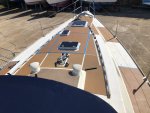
Treadmaster removal

That might be me!!

I've been using a Bosch power plane and then a belt sander and chisels and finally a palm sander or a detailing sander on a Makita multi tool.

Its been taking me a while because a) It keeps raining. b) I've been doing bits of deck with deck organisers in so have to remove lots of headlining to access fastenings...

I think I'll get much quicker when I'm working on straightforward sections with no deck fittings.

I tried the oscillating cutter on the multitool but it was quicker to power plane the bulk of it off and then use a chisel and sanding machine to clean up the last bits of epoxy.

PS Come and say hello if you see me down there. We are on A pontoon.


Then it was you, we are on A pontoon too.
I'll be interested to see how you are getting on next time I'm down.
 
Cannot offer any advice, but pleased I took some of my own. After reading many posts on the subject, and watching two club members trying to remove it, I swore no matter what, I would not buy a boat with treadmaster on the deck.
 
Cannot offer any advice, but pleased I took some of my own. After reading many posts on the subject, and watching two club members trying to remove it, I swore no matter what, I would not buy a boat with treadmaster on the deck.

I have a huge quantity of very old Treadmaster on my boat, and I had planned to change it slowly, piece by piece, and I have already bought some Treadmaster, so I will continue, although I have realized that doing it piece by piece will not possible because I have to also paint the deck between Treadmaster pieces. I will then try every method I am aware of to remove it. I already tried the grinder with sandpaper (a disaster!) and the multitool with a blade (doesn't work because it's just oscillating and this doesn't cut the Tread. Next try will be an electric planner and finishing with light sanding. The process is complicated by the fact that I don't have electricity, so I need either to use a generator or battery tools!

A photo of the first piece: Refit
 
I have a huge quantity of very old Treadmaster on my boat, and I had planned to change it slowly, piece by piece, and I have already bought some Treadmaster, so I will continue, although I have realized that doing it piece by piece will not possible because I have to also paint the deck between Treadmaster pieces. I will then try every method I am aware of to remove it. I already tried the grinder with sandpaper (a disaster!) and the multitool with a blade (doesn't work because it's just oscillating and this doesn't cut the Tread. Next try will be an electric planner and finishing with light sanding. The process is complicated by the fact that I don't have electricity, so I need either to use a generator or battery tools!

A photo of the first piece: Refit
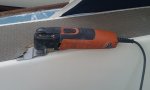
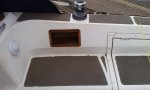
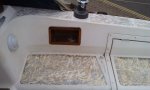
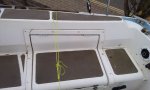
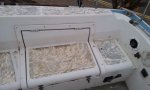
I am surprised a multitool did not work for you as I removed all the old TreadMaster from my cockpit and had no problems. I used a Fein with a 2" wide blade that was kept sharp. You need to be cutting through the glue layer rather than the TreadMaster.

IMAG0145.jpgIMAG0146.jpg
 
All depends on whether the Treadmaster has been laid by the original builder or is an owner-done job. Where original, it is likely to have been bedded down on an epoxy adhesive (if a reputable builder). Cheap and easy brigade use a contact adhesive which makes it easy to remove.
On our Colvic-moulded UFO31, as with the 27s and 34s, epoxy was ladelled on and after 43 years, there's more of that left than the ghastly diamonds! It's taken nearly five years to finally remove it, and we've tried all sorts of methods.
Where the material is still fairly thick, the Bosch/Ryobi tool with a curved flexblade was effective, but no good on the threadbare areas. The final solution turned out to be heat gun and scraper - not a Skarsten but a Stanley Max Finish 9-in-1 stainless jobby. Set yourself a target of about a 1m x .5m panel a day - that's about what you'll do. DON'T use an electric planer. Finish off with a rotary sander and 40 grit to remove the residual epoxy, and a straight orbital with 140 grit to get a fair finish to take a non-slip deck paint, such as Hempel's acrylic one - other makes are available, but acrylic is a good medium to work with.
Treadmaster sell contact adhesive too
 
I have used this bit of kit to remove paint and could be used to remove treadmaster.


An electric planer may also do the job

I have this jog to do on my boat some time when I stop procrastinating.

BTW I used grey sikaflex to glue my grey treadmaster down to my deck
 
I am surprised a multitool did not work for you as I removed all the old TreadMaster from my cockpit and had no problems. I used a Fein with a 2" wide blade that was kept sharp. You need to be cutting through the glue layer rather than the TreadMaster.

View attachment 94834View attachment 94835
What kind of glue is it? Mine is epoxy, and the multitool (a big Makita with a blade) doesn't do any good. It cuts the material (glue or Treadmaster), but with much difficulty. I wonder whether using a saw blade would work better. I am planning to try a saw blade with the multitool, as well as an electric planer and an electric hammer with an SDS wood chisel. I hope one of these solutions will eventually work.
 
What kind of glue is it? Mine is epoxy, and the multitool (a big Makita with a blade) doesn't do any good. It cuts the material (glue or Treadmaster), but with much difficulty. I wonder whether using a saw blade would work better. I am planning to try a saw blade with the multitool, as well as an electric planer and an electric hammer with an SDS wood chisel. I hope one of these solutions will eventually work.
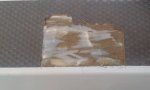
How sharp is your blade? If it is sharp then the blade should cut easily. Are you sure the glue is epoxy? Epoxy glue is now offered as the glue to use but I doubt this is the case 30 to 40 years ago. It definitely did not appear to be epoxy on my 1980 Westerly Fulmar. It made little difference whether I was cutting through the TreadMaster or adhesive. I am pretty sure they originally used a contact adesive and that was what my late father used on a new boat of a similar period. If you look at the photo I included in my last post thinned Treadmaster showing some cork flecks and the adhesive is grey in colour. This photo shows all the TreadMaster removed from the same section.

IMAG0149.jpg

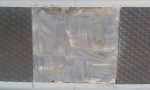
These next photos show the same sections of the cockpit before and after removal using the Fein Multitool with the 2" blade. From memory it only took a day and half to remove all the Treadmaster from the cockpit.

IMAG0865.jpgIMAG0870.jpgIMAG0866.jpgIMAG0871.jpg
 
I removed some Treadmaster from the project boat: truly a painful business but not impossible. I used a simple scraper and a hot air gun: heat the stuff, apply scraper and repeat. By heating the Treadmaster it was enough to soften the glue and remove the stuff. I’ve now replaced the old with new: someone will probably curse me in future years when it needs replacing again....
 
Our new to us boat is covered in the stuff and readaing up and contemplating removing it, a westerly of 1984 vintage so I am going to assume contact adhesive rather than epoxy.

Has anyone found anything suitable chemical/cleaning agent suitable for removing contact adhesive, all pointers gratefully received.
 
Our new to us boat is covered in the stuff and readaing up and contemplating removing it, a westerly of 1984 vintage so I am going to assume contact adhesive rather than epoxy.

Has anyone found anything suitable chemical/cleaning agent suitable for removing contact adhesive, all pointers gratefully received.
Our Westerly of similar vintage had treadmaster decks which we finished replacing this year.
998E6278-DED9-4A5F-98AF-9F87AE533674.jpeg
There’s still a bit of tidying up to do but I do know that the old tread master was definitely stuck down with epoxy glue. The epoxy had been thickened with a grey substance which I was told by an ex-westerly employee was ground slate. It certainly blunted tools quickly enough. We removed the old tread master by first planing off the majority with a power plane, then using a belt sander, and then finally a detail sander for the corners and fiddly bits.
 
PS. After lots of trial and error we used architects drawing paper to make patterns of the patches that we needed to stick down and then inverted the tracing paper onto the back of the tread master and carefully cut out the shape using a very sharp knife. The blade was changed many times.
 
That does look very smart I have to say.

Epoxy great that has really cheered me up.... :rolleyes: I do have a power plane with some TCT blades thankfully. The plan was to redo the decks with Kiwigrip and one of the very stippled rollers probably in grey or white.
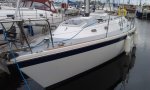
 
That does look very smart I have to say.

Epoxy great that has really cheered me up.... :rolleyes: I do have a power plane with some TCT blades thankfully. The plan was to redo the decks with Kiwigrip and one of the very stippled rollers probably in grey or white.
Chris, Concerto's decks are finished with grey Interdeck. This is an old photo as I do not have a recent one from this angle.

IMAG1008 1000pix.jpg
 
Chris, Concerto's decks are finished with grey Interdeck. This is an old photo as I do not have a recent one from this angle.

View attachment 125441

I take it you put the 'sprinkles' in the paint to give it some non slip, some seem to say it can be difficult to keep the kiwigrip clean which doesnt sound so great, so open to input feedback from others experience.
 
Top