Trapper 500/501 Fin vs. bilge keel

TomMc

New Member
Joined
12 Jan 2015
Messages
1
Visit site
Hi.

I'm new to the forum.
I have been looking at Trapper 500/501 as an option for my first boat. The Trappers have a good reputation and the majority of boats were built with fin keel. I am considering a 501 bilge keel and would appreciate any comments on performance when compared to the fin keel version. Is windward performance significantly effected?. Is heavy weather performance comparable with fin keel?. Are there any construction concerns?. Is it suitable for continuous mooring in shallow/drying locations. Any additional info is greatly appreciated

Thanks
TomMc
 
Fin keel will allow you to point slightly higher when sailing close hauled to windward but the versatility of bilge keels like being able to dry out, use cheaper drying moorings etc more than compensates IMO. If you are into racing, you'll get a better handicap with bilge keels so can compete on equal terms.
I've got three keels!
 
Hi.

I'm new to the forum.
I have been looking at Trapper 500/501 as an option for my first boat. The Trappers have a good reputation and the majority of boats were built with fin keel. I am considering a 501 bilge keel and would appreciate any comments on performance when compared to the fin keel version. Is windward performance significantly effected?. Is heavy weather performance comparable with fin keel?. Are there any construction concerns?. Is it suitable for continuous mooring in shallow/drying locations. Any additional info is greatly appreciated

Thanks
TomMc

I bought one of the first bilge keel versions as a kit and fitted it out at home - after demolishing the garage!

Sailed very well indeed especially to windward in strong winds, so no problems there - we sail in the Bristol Channel so a good recommendation for any boat. Tiller is very long and sweeps the cockpit but the boat did not have any vices, good space below and a good looking boat to boot.

Go for it
 
I used to keep my boat at the Trapper yard many years ago, and there were a few bilge keel 500/501s there, and the owners all really liked them.
 
Depends where you sail. My Trapper 500 is a fin keel and sails really well. Bilge keelers supposedly don't go so well to windward but as a previous post points out drying out is a benefit and makes some places accessoblt to a bilge keeler that a fin can't access.

I'm on the East Coast and we have lots of bilge keelers as creeks and swatchways are common round here. Must admit I've never really foiund a fin keel a disadvantage but what sort of sailing will you be doing? Trappers sail well so as far as bilge keelers go, a 500 will be one of the best bilge keelers to sail if you want a bilge keeler.
 
Tom - there is a big difference in the bilge keel versions of the 500 vs the 501. The 500 bilge keels had a curved forward edge and when taking the ground would tip onto their nose if too much weight (like a person going onto the foredeck!) was forward. The 501 keels had a straight angled forward edge and were stable when dried out. There may have been a few boats that have the 'wrong' keels that were built around the time of the change. Also be aware that the 501 bilge keel version was originally built with the fin keel rudder which hung below the depth of the keels (not helpful) Many owners cut the bottom 125mm of the rudder of and re-glassed (I did the same). In terms of construction - we had issues with the stanchion bases which were screwed into moulded in plates. They were always leaking so we had a wet bilge. I made up backing plates and re-fitted using through bolts which worked well. Be aware that not all boats were built by Trapper - both the 500 and the 501 were available as 'kits'. We had no problems with the performance (though we didn't race ours) and sailed many miles crossing the Channel each year for a family cruise. Still look back with fond memories of the boat.
 
We test sailed a twin keel 501, my father was thinking of one; it went well into a F5, pointed very reasonably and had a good turn of speed.

The partly exposed windward keel did thump a bit in the waves but that's no problem and any twin keeler will get that.

Well finished below, good quality woodwork.

Yes fine to keep on a soft mud drying mooring; avoid pounding on hard sand like any boat.

The Trappers seem a well kept secret, if a reasonable price - with an engine which won't require replacing soon - grab her !
 
Tom - there is a big difference in the bilge keel versions of the 500 vs the 501. The 500 bilge keels had a curved forward edge and when taking the ground would tip onto their nose if too much weight (like a person going onto the foredeck!) was forward. The 501 keels had a straight angled forward edge and were stable when dried out. There may have been a few boats that have the 'wrong' keels that were built around the time of the change. Also be aware that the 501 bilge keel version was originally built with the fin keel rudder which hung below the depth of the keels (not helpful) Many owners cut the bottom 125mm of the rudder of and re-glassed (I did the same). In terms of construction - we had issues with the stanchion bases which were screwed into moulded in plates. They were always leaking so we had a wet bilge. I made up backing plates and re-fitted using through bolts which worked well. Be aware that not all boats were built by Trapper - both the 500 and the 501 were available as 'kits'. We had no problems with the performance (though we didn't race ours) and sailed many miles crossing the Channel each year for a family cruise. Still look back with fond memories of the boat.

Someone who has had one - the 500 bilge keel in which I sailed went well to windward, apparently more handicapped by the masthead rig rather than keel configuration.
The 501 was a quite definite step forward - not only better shaped keels but better deck layout and room below.
Developed from the C&C27, early fin keel versions had a higher ballast ratio than later ones and some had lead keels.
Early ones were built in Poole by Ansteys, usually regarded as better finished than the ones built at Bursledon Bridge.
Good little boats, not leak-proof but IMHO definitely more sporty than the Westerly competition.
Early boats had a 2-stroke Dolphin petroil engine, then a YSM8 Yanmar diesel - the 501 was also fitted with a 2GM20 Yanmar.
So lots of variables, making the OPs original question slightly simplistic BUT little difference between apparent windward performance - just more leeway between 500 fin and twin keelers.
 
Tom - there is a big difference in the bilge keel versions of the 500 vs the 501. The 500 bilge keels had a curved forward edge and when taking the ground would tip onto their nose if too much weight (like a person going onto the foredeck!) was forward. The 501 keels had a straight angled forward edge and were stable when dried out. There may have been a few boats that have the 'wrong' keels that were built around the time of the change. Also be aware that the 501 bilge keel version was originally built with the fin keel rudder which hung below the depth of the keels (not helpful) Many owners cut the bottom 125mm of the rudder of and re-glassed (I did the same). In terms of construction - we had issues with the stanchion bases which were screwed into moulded in plates. They were always leaking so we had a wet bilge. I made up backing plates and re-fitted using through bolts which worked well. Be aware that not all boats were built by Trapper - both the 500 and the 501 were available as 'kits'. We had no problems with the performance (though we didn't race ours) and sailed many miles crossing the Channel each year for a family cruise. Still look back with fond memories of the boat.

Good point about the keel shape - I'd forgotten about that. I ordered my bilge keeler before they had made one and when I looked at the keel drawings I expressed concern that the boat would not stand up on them. Trapper people were very dismissive and asked me if I knew more abuot yacht design than C&C but I made them agree that if she did not stand properly, they would fix it. Later, before delivery I saw the prototype at SIBS and was still unconvinced. When mine arrived it was hull only and I could not test it empty but when fully fitted out 6 months later we craned it onto our slipway and she went down by the nose as I walked to the bow.........QED
That winter back she went to Trapper who, good to their word (after some pressure from my lawyer) replaced the keels with 501 keels and she was fine and dandy

I sold the boat in 1984 but saw it again last year, still in the same ownership. She looks good and the only problem he has had was the replacement of an engine mounting. No signs of osmosis - I put two coats on the bottom of whatever International were selling at the time and it worked well.

I stiffened the bow sections by glassing the liner to the hull half way along the forward bunk.

Great boats
 
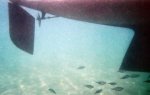
Strangely I don't think anyone has yet mentioned the rudder blade protruding aft; sometimes thought in theory to be a potential problem, but I think fine as long as one is aware.

I say again, I reckon the 501 a fine boat, and it must be said, a lot better looking than a Centaur even though I like them !
 
Strangely I don't think anyone has yet mentioned the rudder blade protruding aft; sometimes thought in theory to be a potential problem, but I think fine as long as one is aware.
It's mentioned clearly enough in the link I posted, together with its propensity to stall; it was only a problem with the 500 and is why it was changed in the 501. Anyway, not really a problem - sail upright to not induce weather-helm and when parked, rotate 180 degrees.

undrwtrudder.jpg
 
Please can you tell me in which year the 500 became the 501 with the modified twin keels .Thanks
I do not know when the bilge keels were modified - perhaps with the 501 phase-over during 1980. My 500 was a hybrid from 1980, a 500 rudder and cockpit but with a 501 cabin - however, it had a fin keel. The keel did not change with the 501 introduction, delayed for the January 1981 London boat show, although the rudder did, to a higher aspect ratio one. From the link I posted (#10):

"By the late 1970s a bilge keel version had appeared and around the time the 500th yacht was produced, the design had phased over to the Trapper 501 with modifications to the aft cockpit section and coamings, the cabin roofline and to the C&C trademark scimitar rudder with its sweeping swan-neck tiller. The interior was also redesigned and improved although the hull remained unchanged. Trapper 500s of 1980 from about build number 490 incorporated the internal layout and liners of the 501 before that model was introduced at the 1981 London boat show. The 501 remained in production until 1987."​
 
Last edited:
Hi, I was looking closely at a Trapper 501 when I was in the market a few years back. Nice boats but SWMBO didn't like the galley being so close to the main companion-way with sea boots passing close by :-) My preference would be a fin keel version any day but that's because i never seem to get fair winds and are forever going to windward to get anywhere! I also prefer the motion at sea of a fin over a bilge - personal taste.

One thing you should consider is the mooring. Bilge keels allow you the option of a cheaper drying mooring but this has a couple of down-sides - a friend of mine reports more fouling with a drying mooring,.. I would find it inconvenient not to able to get to my boat and leave or pick up my mooring at any time I want (ie when we are a bit late and tired on a Sunday evening and want to get home at a reasonable time!).
 
Tom - there is a big difference in the bilge keel versions of the 500 vs the 501. The 500 bilge keels had a curved forward edge and when taking the ground would tip onto their nose if too much weight (like a person going onto the foredeck!) was forward. The 501 keels had a straight angled forward edge and were stable when dried out. There may have been a few boats that have the 'wrong' keels that were built around the time of the change. Also be aware that the 501 bilge keel version was originally built with the fin keel rudder which hung below the depth of the keels (not helpful) Many owners cut the bottom 125mm of the rudder of and re-glassed (I did the same). In terms of construction - we had issues with the stanchion bases which were screwed into moulded in plates. They were always leaking so we had a wet bilge. I made up backing plates and re-fitted using through bolts which worked well. Be aware that not all boats were built by Trapper - both the 500 and the 501 were available as 'kits'. We had no problems with the performance (though we didn't race ours) and sailed many miles crossing the Channel each year for a family cruise. Still look back with fond memories of the boat.

The bilge keels pick up a lot more rubbish round the prop. but you tend to get good at have foredeck parties to clean it off!!
 
Top