traditional long-keeled yachts are the most intrinsically seaworthy.

Accounts of circumnavigations in long keeled narrow boats often mention pitchpoling and knockdowns leading to loss of the rig. Jimmy Cornell ended up sailing an Ovni.
 
We don’t circumnavigate very often, but a heavy, solid, comfy long-keel boat has enabled 15 years of happy and safe cruising for this family of four. I’ve not heard them complain too often that we’re not going as fast as an Open 60... but maybe we’re just not proper rufty-tufty sailors :)
 
Accounts of circumnavigations in long keeled narrow boats often mention pitchpoling and knockdowns leading to loss of the rig. Jimmy Cornell ended up sailing an Ovni.

The last thing an Island Packet is is narrow gutted.

Both of mine have been fat buggers-current one 13 foot beam. Shallow full keel, lots of ballast and weight kept low. A fair bit of form stability. They have small easily handled rigs and are designed for mature cruising couples. This philosophy appears to work.

First Mate and I are aware ALL boats have compromises. We accept the IP's compromises as a trade off of build quality and inherent comfort-especialy alongside or on the hook.
 
I think issue on this post is that people interpret it as my lightweight AWB is every bit as good a long keel boat for ocean sailing. I might be wrong. My view is that I dont think that it the case. I dont have a long keel boat but I have sailed on them. I dont have a lightweight fin keel boat but I have sailed on many. Given a full gale 1000nm from land I would choose the heavy long keel boat over the lightweight fin and spade rudder boat simply for comfort. A gale can be very uncomfortable but a kindly sea motion will see you better rested, better fed, less stressed amd better able to deal with issues as they arise. I sail a heavy displacement deep fin and skeg yacht that I beleive offers similar benefits in terms of sea motion to a longkeel design but also ensures we have good windward performance. Having our c of g lower than a full keel design means we carry a taller mast and we can stand up to our canvas better. Every boat is a compromise and people choose them for their own reasons and intended use. We chose ours and have never regreted it

One of the more sensible responses in this thread so far.

I've sailed long keeled boats and (lots of) fin keeled boats and the truth is that a moderate reasonably heavy displacement fin keeled boat can be just as comfortable as a long keeled boat. The bonus is that the fin keeler sails faster and handles easier than the long keeled boat. I know that none of the detriments of the long keeled boat can't be overcome (I've owned one and you can get used to the handling and the way that they sail) but people seem to equate fin keels with lightweight boats with fat rear ends that don't behave themselves because they were designed to get the maximum accommodation (including a rear cabin) into their designed waterline length. It's a poor comparison with the sort of design that's possible and desirable.

I started a thread on this very subject several years ago and exactly the same arguments were rehearsed.

We currently own and sail a Westerly Sealord. Moderate, long fin with impeccable sailing characteristics. Heaves to well and doesn't slam in a seaway. Yet steers beautifully when going astern and the only possible criticism is that she's got a spade rudder and no skeg. However I'll have to live with that unless we win the lottery.
 
I would want something like Nordkyn if I were to go off circumnavigating ....

http://nordkyndesign.com/nordkyn/design-overview/

http://nordkyndesign.com/heavy-weather-dynamics-yachts-in-following-seas/
http://nordkyndesign.com/heavy-weather-dynamics-too-fast-on-the-run/

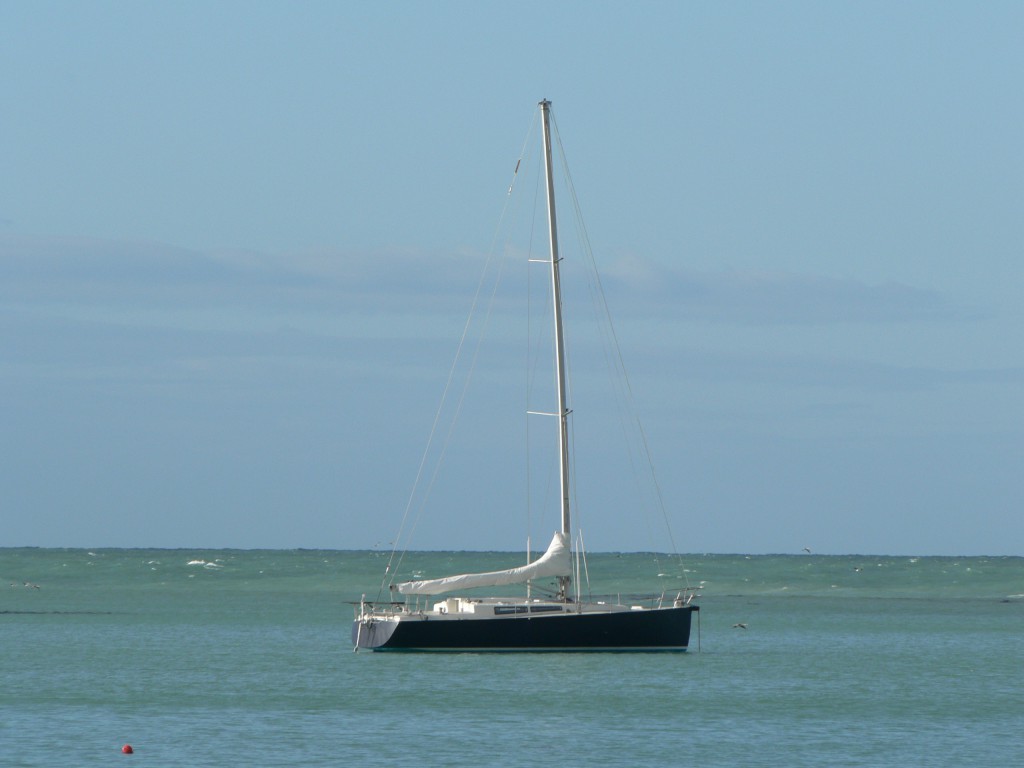
Anchored-inside-Oamaru-Harbour1-1024x768.jpg
 
Last edited:

Everyone to there own. Not for me. No sprayhood built in to the design. For me a large well designed sprayhood is essential. Dont want tiller steering or a mainsheet traveller that splits the cockpit. Ok boat for summer hols or weekends but long term comfort becomes an issue. Its a good job we all like different things :-)
 
Doesn’t it depend on the intended purpose of the yacht and the original design brief? In the past yachts tended to be commissioned for a singular purpose, even a particular voyage. It’s only recently with the onset of production yachts that a wide range of compromises been introduced to appeal to the masses.

Rosie was designed to take a couple around the world in comfort with an abandon of water and stores. She is very sea kindly, hoves-to better than any other yacht I’ve been on and has never slammed. She meets the design brief perfectly imho. She is not fast, but she is comfortable. On the downside she is a very awkward to sail in rivers/coastal cruising, poor at accommodating more than two, but that was not the intended purpose.

The same designer, with a very similar brief, came up Trekka for Guzwell. Fin keel, low displacement, fast, built to a tight budget.

Both very different yachts, both meeting, even surpassing, their intended briefs.
 
Last edited:
I think we are missing the purpose of owning a boat.

I would argue that 99% of all boats in new condition or cared for condition, are more or less equally seaworthy. When I kept my boat(s) in La Rochelle France the ´marina newsletter´ used to describe the boats parked there as 2nd homes. That is exactly what the vast majority of modern boats are. An apartment on the water which is capable of being taken to sea and sailed to mainly nearby places. (A water version of the mobile home or caravan). Modern legislation ensures that they are probably not going to sink in bad conditions except as a result of bad seamanship.

The long keel boats of the 70´s were designed to a traditional formula that suited the sailing demands of those days. The market evolved and couples or entire families started to demand more living comfort, space, bigger beds nice galleys and bathrooms so modern boats evolved. They are entirely seaworthy and comfortable 2nd homes.

Discussion of boats for extream conditions is somewhat academic. Hardly anyone on this forum has been out unknowingly in more than a F8 and sailing in those conditions is more to do with size than design. In a 22ft boat its hell on earth in a 43 ft boat its a bit unpleasant trying to go to windward.

The fact there are so many Contessa, Nic, Rival, Elizabethan, Halmatic long keelers around is due to the excellence of the construction when nobody really knew a lot about Fibreglass. As somebody pointed out earlier in this thread today they retail 2nd hand at modest prices and are a wonderful way to get on the water but perhaps not that comfortable internally.
 
>I would call that under canvassed.....

If the boat was under canvassed it wouldn't reach hull speed our ketch did.

You might not be under canvassed in a F6 but F3 is where lots of sailing is done or more likely engining if you are under canvassed...... you see so many stumpy masted yachts engining or motorsailing when well canvassed designs are still sailing along
 
You might not be under canvassed in a F6 but F3 is where lots of sailing is done or more likely engining if you are under canvassed...... you see so many stumpy masted yachts engining or motorsailing when well canvassed designs are still sailing along

But often in the wrong direction.

First Mate and I are travellers by water rather than purist sailors.

Which is why we have the boat we do, and we use it in the way we do.

If we have a destination in mind and it is safe to go, we go. Sail or iron jib, its all the same to us.

Unlike some club members we know quite well who spent 5 weeks in Lymington, Poole and Portland waiting for the wind to be dead right for a channel crossing.
 
But often in the wrong direction.

First Mate and I are travellers by water rather than purist sailors.

Which is why we have the boat we do, and we use it in the way we do.

If we have a destination in mind and it is safe to go, we go. Sail or iron jib, its all the same to us.

Unlike some club members we know quite well who spent 5 weeks in Lymington, Poole and Portland waiting for the wind to be dead right for a channel crossing.
Yep, we have friends who never use the engine. Not us. The engine is there to be used but if we can sail rather than engine then life is better. We often sail past yachts that are engining whilst we are sailing! We most often sail past catamarans here that are motorsailing. I have occationally thought, wow, this Lagoon is sailing well! We have slowy caught them up to discover they have their engine on! Always nice to sail past in those situations.
Last summer we did an anticlockwise cruise around the western Caribbean. We left the ABCs for Haiti, Cuba, Bahamas, Panama, Columbia and back to ABCs. Our friends sat in a marina for four months and said wow, you have done a lot of motoring! Panama and Colombia winds are very light that time of year. We are not sailing purists which is why we got to visit lots of great places in the light wind summer months. Better than siting in a marina paying fees in my opinion.
 
Top
