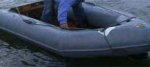
towing inflatable backwards - great success - film

dylanwinter

Well-Known Member
Joined
28 Mar 2005
Messages
12,954
Location
Buckingham
www.keepturningleft.co.uk
the D rings pulled out of the plastimo tender

so as a test I drilled two holes in the transom and towed it backwards

great success

especially when kept close to the stern

it would have been better to have two towing eyes in the bottom of the transom

it also makes transferring bodies and engines to the outboard much, much safer


the tender rows and motors extremely well but the D rings are pathetic
 
It looks dreadful at the beginning where the transom acts as a sea anchor.

Another benefit is that if (in a bit of a breeze, F5 plus) it lifts & flips over as they are prone to do, it will not end up with the transom stopping dead in the water as you merrily sail away (that's how my D-ring got ripped out).
 
It looks dreadful at the beginning where the transom acts as a sea anchor.

Another benefit is that if (in a bit of a breeze, F5 plus) it lifts & flips over as they are prone to do, it will not end up with the transom stopping dead in the water as you merrily sail away (that's how my D-ring got ripped out).

I think towing rings low down will solve that problem when on a longer line

I tried that one expecting to fail

getting into the dinghy was a real improvement
 
Is this some sort of joke?

You tow a dinghy 20ft behind at 4kts and encounter resistance from the transom; then you hoik it up against your own stern and the resistance disappears!

And you say 'The people on the web will say that will never work, that will never work'. Do you think we are stoopid!?

You will be looking to patent the drilled holes next.
 
Last edited:
Is this some sort of joke?

You tow a dinghy 20ft behind at 4kts and encounter resistance from the transom; then you hoik it up against your own stern and the resistance disappears!

And you say 'The people on the web will say that will never work, that will never work'. Do you think we are stoopid!?

You will be looking to patent the drilled holes next.

deepest apologies

but

thanks for watching the film

D
 
Last edited:
Looks good in calm conditions and probably less drag with the bows rather than the transom in the water. However if it was at all lumpy I reckon water would get between dinghy transom & boat and eventually something would break ! If you could pull it up a lot higher then maybe ok.

Given up towing our dinghy completely these days - just another avoidable fail/trouble point imo. Really want davits ;)
 
If the securing lines are passed over the pulpit so they take a lot of the weight, then your boat speed will improve as there will be less drag in the water. Surprisingly it does not matter which way round the inflatable is.
 
If the securing lines are passed over the pulpit so they take a lot of the weight, then your boat speed will improve as there will be less drag in the water. Surprisingly it does not matter which way round the inflatable is.

I have in the past lashed my inflatable vertically across the pulpit rail. because I have an aft cabin, it adds little to the air resistance & is clear of the water AND unable to flip which is the biggest danger for transomed dinghies.
 
Remarkable how many people you see towing dinghies, some even with outboard attached ! Used to do it regularly until we had the flying dinghy phenomena one day and only a small miracle saved the floor. That was after hundreds of successful tows so quite a rare occurrence but once it happened we are now never fully at ease unless it is lashed on the foredeck.
 
Most people seem to assume that there will be little drag from towing a dinghy, but not so - just try pulling on the towing warp and you'll feel like you're trying to lift the thing bodily, one-handed. Due to access problems to our mooring, I sailed across to the Folly Inn to meet up with other club members for lunch. Not wanting to deflate and have to pump up again, I towed the dinghy. The first thing to strike us was just how awkward it is to heave a 2.7m dink aboard a 27ft boat so as to fit in our designated berth. The second was just how embarrasing it is to be overhauled by everyone, including sailing bathtubs, on the return trip. Time for a second 12V pump to keep on the boat or a padlock to secure the dinghy to the mooring.

Rob.
 
I'd have thought that the wider the base formed when fitting the towing eyes in the transom, the less likely the dinghy is to flip, particularly if they go up over the rail and are cleated to the quarters. Plus, of course, the more of the dinghy is lifted off the water, the less drag you will incur, though taken too far your windage will increase. An inflatable in this position can beseen much like a large fender hanging from the taff rail, but there's no place for leaving oars and engine or loose floors in there!

Rob.
 
The d rings are useless discoverd that years ago so i drilled 2 holes and made a strong web loop that fitted over the bow linking to 2 ropes at the back plus a piece of webbing from the centre bottom transom along the keel. Then used a bridle on the bow loop has lasted for years. Still have zodiac(1974) and still works but heavy and got fedup repairing air leaks. So do have a seadink.JPGgo
 
If the securing lines are passed over the pulpit so they take a lot of the weight, then your boat speed will improve as there will be less drag in the water. Surprisingly it does not matter which way round the inflatable is.

Do you mean pulpit :confused:

This might work if you are going backwards but the pushpit rail would be better used if you are going forward.

From your film, the drag on the transom of the dinghy would increase if you went much faster. Very shortly you would fill the dinghy with water and then it would really drag.

Tied high to your transom, pushpit, would work well, with the bow in the water.
 
Top