Towing a rigid tender

Re: Rigid small dinghies, not without problems

Having learn in a Gaff rigged boat without an engine towing a 14' clinker dinghy behind to tow us into harbour etc I really can't see what he problem is.

Yes it slows the boat down but also gives considerably more fun when you get there.

I now have a hard dinghy 9' long that I sometimes tow when I am too lazy to lift it using the spinnaker halyard and anchor winch [ or blocks and tackle] onto the large foredeck. Tows Ok with the aforementioned low towing point and an adjustable towing line.
 
Re: Rigid small dinghies, not without problems

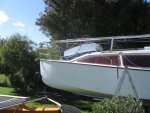
DSCN2089.JPGIMG_1048.JPGIMG_1050.JPGIMG_1051.JPG

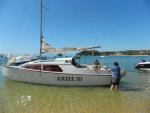
26 ft trailer yacht. I dont much care for inflatables.
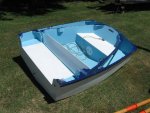
DC8/D9 dinghy - free design available on t'internet.
I do believe i am the first in the world to make this into a nesting design. (Ask me for details.)
Cost me GBP 250 to build including paint and oars.
I used 4 mm ply with a single glass skin. Weighs not much.
Its a genuine pleasure to row.
Planes with 3.3 hp. Can be dragged up beaches.
Nests on the foredeck, but on short hops tows like a dream.
But is tippy when getting aboard.
I want to develop a 9 ft sailing version which would take up only 5 ft on the foredeck.
Just saying...
 
Re: Rigid small dinghies, not without problems

View attachment 53607View attachment 53608View attachment 53609View attachment 53610

26 ft trailer yacht. I dont much care for inflatables.
DC8/D9 dinghy - free design available on t'internet.
I do believe i am the first in the world to make this into a nesting design. (Ask me for details.)
Cost me GBP 250 to build including paint and oars.
I used 4 mm ply with a single glass skin. Weighs not much.
Its a genuine pleasure to row.
Planes with 3.3 hp. Can be dragged up beaches.
Nests on the foredeck, but on short hops tows like a dream.
But is tippy when getting aboard.
I want to develop a 9 ft sailing version which would take up only 5 ft on the foredeck.
Just saying...

do you have a link to the plans somewhere?

that might work

D
 
Re: Rigid small dinghies, not without problems

Didn't I send you £50 worth of paper plans for a very similar nesting dinghy a few years ago, after deciding not to build one myself after all?

Pete

You did,

and they are in one my yellow boxes

I reckon that the optimist rig would drive it along okay
 
Last edited:
Re: Rigid small dinghies, not without problems

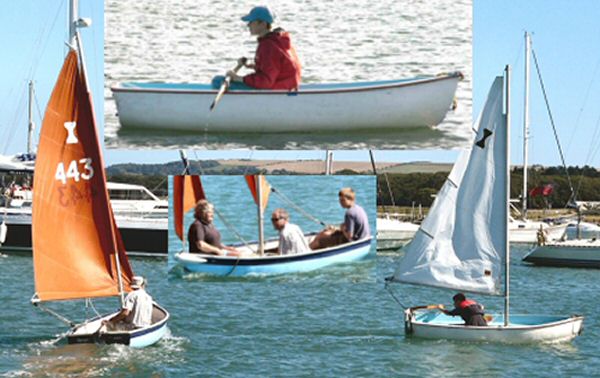
We have towed our 9ft Bobbin dinghy behind us for the last 10 years or so. Mainly south coast. We have never had more than a litre or so of water inside it and the only time I've had it bash the stern was when I forgot to lengthen the tow rope whilst crossing a bouncy Chichester bar. It rows and sails very well and a 2HP outboard is plenty. Two part mast + boom stow alongside the guard rails.

bobbin.jpg

that looks bloomin perfect

My parents had one of these as a tender and I learnt to sail on it, however it did have the habit of trying to overtake the "mothership" and weighed about a ton.
 
Re: Rigid small dinghies, not without problems

One point to remember when switching from inflatable to rigid - you can't slide in over the side when swimming as you can in an inflatable.
 
Towed a tender for many years in Scotland. It was a Norwegian built triple hull type thing about 8ft, self draining and almost as stable as an inflatable. Although quite heavy it was a great to row and carried two adults, two kids and a dog simultaneously. Wish I'd never sold it.
 
Towed a tender for many years in Scotland. It was a Norwegian built triple hull type thing about 8ft, self draining and almost as stable as an inflatable. Although quite heavy it was a great to row and carried two adults, two kids and a dog simultaneously. Wish I'd never sold it.

Speaking of kids - there's nothing like learning to row a small dinghy to start them off understanding how boats behave, how to behave in boats and basic boat handling. (Has anyone else read that charming book - "First You Must Row a Little Boat"?) And I would far rather have children rowing around an anchorage in the evening than roaring around with an outboard in an inflatable.
 
Speaking of kids - there's nothing like learning to row a small dinghy to start them off understanding how boats behave, how to behave in boats and basic boat handling. (Has anyone else read that charming book - "First You Must Row a Little Boat"?) And I would far rather have children rowing around an anchorage in the evening than roaring around with an outboard in an inflatable.

I agree but prefer such kids to practice in a big squishy fender rather than pointy bowed attack vessel.
 
I agree but prefer such kids to practice in a big squishy fender rather than pointy bowed attack vessel.

not sure rowing an inflatable tender is as nice as rowing a good dinghy. Besides, most of the rowing will be done by either a 59 year old bloke or a 60 year old woman - perhaps an 8 year old labrador
 
Last edited:
not sure rowing a tender is as nice as rowing a good dinghy. Besides, most of the rowing will be done by either a 59 year old bloke or a 60 year old woman - perhaps an 8 year old labrador

Not sure? How often do you see anyone, old or young, rowing an inflatable for pleasure? Of course some row better than others and no doubt someone will pop up to claim that they row their inflatable for miles and it's as nippy as a Regents Park skiff. But the fact is, the only reason to row an inflatable is because the outboard won't work or you can't be bothered to put it on. Never just for the fun of it. There's no pleasure and precious little learning to be had from the dismal business of rowing an inflatable.

As far as fenders are concerned (as mentioned by Robin) all I can say is - since when did a boat have to be a fender in order to be well fendered? :rolleyes:
 
With oars of a reasonable length, inflatables row quite well. Admittedly, they don't carry their way in the same way that a proper rowingboat does. Probably if you're always going to be landing at a pier or a jetty or a pontoon, it doesn't matter what kind of dinghy you use, but cruising on the West Coast, a high proportion of landings will be on beaches or on rocky shores. There, the advantage of a light rubber dinghy is obvious.
 
With oars of a reasonable length, inflatables row quite well. Admittedly, they don't carry their way in the same way that a proper rowingboat does. Probably if you're always going to be landing at a pier or a jetty or a pontoon, it doesn't matter what kind of dinghy you use, but cruising on the West Coast, a high proportion of landings will be on beaches or on rocky shores. There, the advantage of a light rubber dinghy is obvious.

Not obvious to me. Isn't it better to land on beaches and rocky shores in a dinghy which can't get punctured by sharp rocks or bits of debris?
 
Not obvious to me. Isn't it better to land on beaches and rocky shores in a dinghy which can't get punctured by sharp rocks or bits of debris?

Well, I suppose it's good to be able to carry the dinghy up a beach, but I wouldn't fancy carrying one across rocks.

Tragically, I haven't done much sailing in the glorious west of Scotland but I was in and out of rocky Breton rivers and harbours all the time many years ago when inflatables were as rare as hen's teeth. We seemed to manage pretty well with little clinker jobs.

But I think the real issue is what the tender is used for. Just going to and fro between mother ship and shore? An inflatable has lots of advantages, as well as the disadvantages of having to carry petrol, heave the outboard over the rail, pollute the environment and shatter the peace of a quiet anchorage etc. (because, realistically, nobody actually chooses to row any distance in an inflatable) But the whole point of a rigid dinghy is that is is so much more than a tender. It's a simple pleasure, but one I would hate to give up - a peaceful potter amongst quiet little creeks and inlets as the sun goes down...............:)
 
Top