JumbleDuck
Well-Known Member
Re: Rigid small dinghies, not without problems
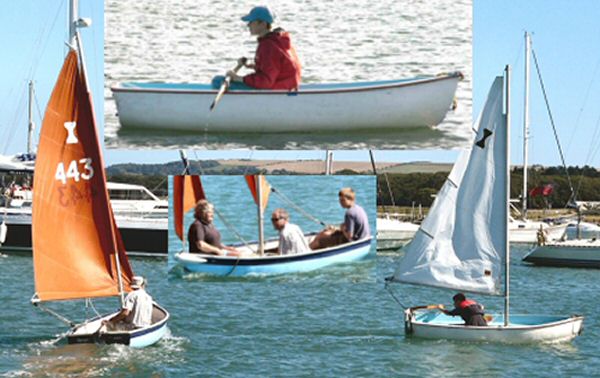
The dinghies I tow have never tried to come aboard, or at least they have never come near enough to make a proper try. That's why I have a 10m painter. It can look a bit silly, but it avoid the problem. My crew will cheerfully get aboard the sailing one even when it's completely swamped (capsizing is FUN) and if I don;t feel like getting my feet wet I can pump out from the cockpit before getting aboard ... the joys of low freeboards.
The Heyland dinghy is definitely a lot more stable than the pram in which one does have to take a reasonable amount of care.
It would be interesting to know what sort of dinghy Adlard Coles was towing. I suspect that lightweight fibreglass tenders tow a lot better than older, heavier wooden ones. It's important to get the towing angle right as well: the painter should slope up, but not too much. This often means fitting a lower towing eye than the manufacturers original thought necessary. On my last boat I would shift the painter to the high side (not as hard as it sounds - just loop round the "Other" quarter cleat if necessary) for long reaches. As my current boat has no transom the towing points are quite near the middle and so this isn't an issue.
I would not presume to tell other people what sort of dinghy to use. A rigid one works for the sailing I do at the moment, but I probably wouldn't take one across the North Sea to Norway, for example. One of the disadvantages of a boat which is pointy at both ends is the limited locker space: even a small inflatable would either take up all of my single cockpit locker or have to be tied on deck somewhere.
I recall being rammed from behind by the pram, when running downwind, and on one occasion, after three long days of heavy rain, there was so much water in the thing, that I couldn't safely get aboard it to bail it out.
The dinghies I tow have never tried to come aboard, or at least they have never come near enough to make a proper try. That's why I have a 10m painter. It can look a bit silly, but it avoid the problem. My crew will cheerfully get aboard the sailing one even when it's completely swamped (capsizing is FUN) and if I don;t feel like getting my feet wet I can pump out from the cockpit before getting aboard ... the joys of low freeboards.
I too dislike inflatables and bought an 8' pram and it rows really well. The issue is boarding and disembarking, unstable in the extreme compared to an inflatable.
The Heyland dinghy is definitely a lot more stable than the pram in which one does have to take a reasonable amount of care.
I know Jumbleduck manages it, but after my experiences towing a rigid - nicely shaped Caricraft 10 with the rig off - I wouldn't do it anywhere likely to get remotely lumpy.
I don't think it's in the modern editions but in an earlier ' Heavy Weather Sailing ' Adlard Coles describes towing a dinghy across Lyme Bay when things became boisterous; it swamped, dragged, ultimate PITA then broke free, he was unable to recover it as way too risky.
It would be interesting to know what sort of dinghy Adlard Coles was towing. I suspect that lightweight fibreglass tenders tow a lot better than older, heavier wooden ones. It's important to get the towing angle right as well: the painter should slope up, but not too much. This often means fitting a lower towing eye than the manufacturers original thought necessary. On my last boat I would shift the painter to the high side (not as hard as it sounds - just loop round the "Other" quarter cleat if necessary) for long reaches. As my current boat has no transom the towing points are quite near the middle and so this isn't an issue.
Inflatable tenders are the way to go, decide how you are going to store it and get on with it.
I would not presume to tell other people what sort of dinghy to use. A rigid one works for the sailing I do at the moment, but I probably wouldn't take one across the North Sea to Norway, for example. One of the disadvantages of a boat which is pointy at both ends is the limited locker space: even a small inflatable would either take up all of my single cockpit locker or have to be tied on deck somewhere.


 )
)