Totally spooked out by my first ever boat

I'd had a monohull for 18 years, and pretty much knew how to get her to do what I wanted, and when it was best not to even try. Even then cockups, while rarer and less spectacular as the years went by, never went away completely. Then I got a cat with twin engines and was utterly clueless until I got some useful advice and a bit of practice.

The own boat tuition recommended above is an excellent advice. Get your sailing partner trained at the same time. I don't know your situation, but far too many couples have a big strong hubby at the wheel while a physically much weaker wife is heaving on ropes, a task made even harder because she's inadequately trained as well.


We have First Mate I/C steering when leaving or docking, anchoring or picking up a mooring. For the reasons already stated.

Handling our fenders and lines is not for First Mate, They are big and heavy. If she stepped ashore with a line in a tricky blow there is no guarrantee she could make it secure quick enough.

Not only that, she has made it VERY clear that if anyone is going to scratch our boat it is going to be her.............................. ;)
 
Ade, anyone who didn't make a mess of it the very first time of piloting a boat is telling porkies.

Our first boat was 8m, single inboard / outdrive without a bow thruster, my first few attempts at mooring were "interesting" to say the least but having mooring buddies nearby on our marina helped considerably.

But fast forward a few trips and you start reading the elements and how the effects your boat and it all settles down, but remember, just enjoy it.

Where are you based? If you're in a marina, or club, see if anyone is happy to give own boat tuition, we certainly have a few in our marina who are more than happy to help.
 
I have just been given a new berth in our marina, it's a finger pontoon and a bit tight, but not as tight as my old one. The boat is twin engine on shafts. For some reason I had a bit of a struggle getting in on my first attempt. Keep it SLOW and well fendered and you shouldn't come to too much harm.
 
The first time things go wrong it is a disaster... as time goes on, you will learn something from previous cock ups. .
As some have suggested, you could get some practical help, it does not have to be some sort of organised course could simply be somebody with some experience of boat handling and its associated perils.
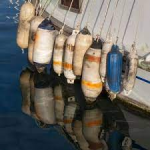
There is no such thing as "Too Many Fenders."
This could help.

1665558074428.png
 
Last edited:
....how do I sell it quickly bearing in mind the last thing I want to do is show a potential buyer around the boat or even try it when I know so little about it.
Have a word with yourself and get some practice in on calm days , possibly with an instructor
Or sell it via a broker.
 
Been there, got the tee shirt - my first trip on my current boat after being launched was to go to the fuel pontoon, but managed to hit the stern of a very nice wooden boat as I berthed. The owner was going to have some work done on the stern that autumn so was not too expensive for me.
 
Been there, got the tee shirt - my first trip on my current boat after being launched was to go to the fuel pontoon, but managed to hit the stern of a very nice wooden boat as I berthed. The owner was going to have some work done on the stern that autumn so was not too expensive for me.
Haven’t we all. If the lovely chap on the Quest 33 Prout in Ryde Marina in 1998 is reading, I am still sorry, and grateful.
 
the first yacht i had was 17ft, the mast came down. around 2010

the second yacht a 22ft, grounded and lost the rudder around 2013

current yacht a 30ft, crashed into a large navigation buoy in 2021. hull and toerail damage

things happen, what inurance is for. its not always smooth sailing. pick yourself up and carry on, it makes you learn quickly and you aim not repeat the events and makes you stronger
 
The accident where Milano Bridge hits the crane was caused by approaching too fast and the props and rudder being partially out of the water due to insufficient ballast according to the accident report.
 
As every tuition advice, never go faster than your comfortable hitting something in close quarters, slow is steady when berthing or leaving
I agree with that in no wind conditions but one reason to avoid berthing and unberthing in a wind is that it requires the experience to know how to use extra bursts of speed to safely turn and dock.
 
How to you avoid berthing in a wind?
By avoiding days when it’s likely to be windy in that harbour - can’t always be done of course but sometimes we change our destination or choose to anchor outside instead. Where that can’t be done then getting a marinaro in a rib to stand by to nudge is sometimes the answer if the space is tucked in very tight somewhere.

Many marinas seem designed for 35 foot boats but now have ranks for 45-55 foot boats pointing at each other. Mostly though with sufficient speed we park fine in a wind but it’s not for the faint-hearted.
 
Own-boat tuition together with one or two others you are likely to go boating with works well in my experience. It is more cost-effective and you can watch each other as you all learn. Helps the 'crew' know what to expect in future as well!
 
I have been boating all my life, living by the water and a boat mad father, but I was feeling much the same as Ade earlier this year. I moved up from a 19ft outboard powered sports boat to an Aquador 32 - very grown-up by comparison. Despite a lifetime of boating experience I felt overwhelmed for the first few weeks. Although I would never have sold in haste, I felt like it a time or two.
Since then we had a great time on her. Lots of nights away, couple of trips to Fowey and one to the Isles of Scilly.

Stick with it Ade, take the advice of all the others on this thread. We all believe in you!!(y)
 
Top