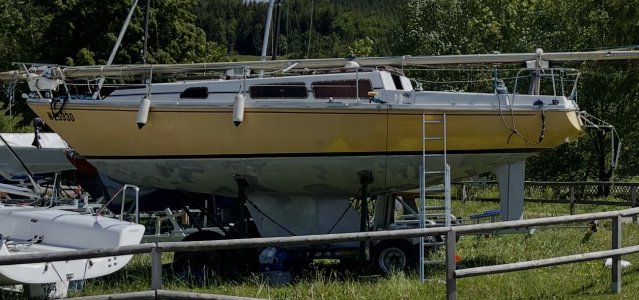
Tornado 31. Anything Known?

ducked

Well-Known Member
Joined
6 Oct 2024
Messages
1,636
Location
Tainan, Taiwan
Visit site
Idle curiosity, I hope, but one advertised where my parents retired.

Past ads stress spaciousness. Look alright, but companionway hatch seems rather unusually wide, capsize ratio is above 2, and some, apparently not all, mount the chainplates on the coachroof, which seems a structural compromise, though I daresay it can work.

I suppose whenever you get a boat you start seeing ads for "better?" ones, so any negative info on this design would be especially welcome
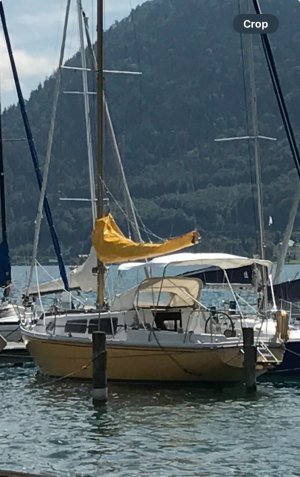
 
American design by Frank Butler (Catalina Yachts) built in Spain. One of many short lived designs from the early days of GRP boat building. sailboatdata.com/sailboat/tornado-31/
Thanks.

"Early days of GRP boat building" is unfortunately a bit of a positive IMO, and also applies to the Trident 24 I've got . Catalina connection, which I wasn't aware of, probably is too.

I suppose short-lived could be a negative, though the customer isn't necessarily always right. More importantly, it probably is reflected in a lack of available information/support, unlike the Trident, which has an especially active OA.

Fin-keel on balance (NPI) is a bit of a negative for me, though less so on the West Coast of Scotland, where it is.

I just came across a website sailboatlab.com, which seems to do an editorial summary based mostly on sailboatdata.com.

For the Tornado 31 they say:-

"The Tornado 31 is a heavy sailboat which is under powered. It is very stable / stiff and has a low righting capability if capsized. It is best suited as a coastal cruiser. The fuel capacity is originally very small. There is a short water supply range."

The DLR is 307.94, in the heavy range. I'd guess by "underpowered" they mean undercanvassed, reflecting SA/D of 12.95, and low righting stability probably reflects the capsize screening formula of 2.05. Stability/Stiffness is complicated, so I dunno, but maybe they are simplistically basing that on the ballast ratio of 44.12

Of the Trident they say

"The Trident 24 is a moderate weight sailboat which is a good performer. It is stable / stiff and has a good righting capability if capsized. It is best suited as a coastal cruiser. The fuel capacity is originally very small. There is a very short water supply range."

"Good performer" probably reflects the SA/D ratio of 18.34, which surprisingly puts it in the nominal "racer" range, though since its shorter I suspect in practice it might still be slower, consistent with the hull speed difference (5.84 v. 6.31 knt). Ballast ratio is 37.13, so less but still nominally in the offshore range. On the OA website they say it initially heals and then stiffens up, perhaps reflecting the narrower beam of 2.26 m (compared to 3.05m for the Tornado) giving less form stability but a better capsize screening index of 1.87

TBH I dunno how meaningfull these indicators are, The Trident doesn't seem to compare badly, but I'd guess bigger will generally tend to be better.

Anyway the Dinky Die is cast.

.
.
 
There are many old boats of that type around as builders rushed to take advantage of the properties of GRP which allowed the building of hulls where the redundant bits of keel (aft deadwood and forefoot) to provide more space for the propeller and a more efficient rudder. Higher ballast ratio than common now because of lack of form stability. so just an old fashioned boat that had a short production life partly because of where it was built in Europe and partly because that style of boat was quickly overtaken by much better performing boats that were not so closely related to obsolete design principles.

Now it is just another old boat of low value but if the style suits you and it is in decent nick no reason not to consider it. BTW don't get too hung up on the details of statistics. They need o be read in the context of the design - for example ballast ratios are misleading. Old style boats need high ballast because they have low form stability. They also often like this boat have low sail areas because they have poor stability as thee ballast is often too high up. So you are right in your observations. A lot has been learned about yacht design since the 70s
 
There are many old boats of that type around as builders rushed to take advantage of the properties of GRP which allowed the building of hulls where the redundant bits of keel (aft deadwood and forefoot) to provide more space for the propeller and a more efficient rudder. Higher ballast ratio than common now because of lack of form stability. so just an old fashioned boat that had a short production life partly because of where it was built in Europe and partly because that style of boat was quickly overtaken by much better performing boats that were not so closely related to obsolete design principles.

Now it is just another old boat of low value but if the style suits you and it is in decent nick no reason not to consider it. BTW don't get too hung up on the details of statistics. They need o be read in the context of the design - for example ballast ratios are misleading. Old style boats need high ballast because they have low form stability. They also often like this boat have low sail areas because they have poor stability as thee ballast is often too high up. So you are right in your observations. A lot has been learned about yacht design since the 70s
What I like about these dawn-of-GRP designs is

(a) The oft-repeated mantra that they are overstrength because they didn't know enough to make them weaker. Might even be true sometimes
(b) Related to above, they dont always have cored decks ( Trident doesnt, dunno about Tornado) and never/hardly ever have cored hulls or hull liners, tricks learned since the 70's that I just dont fancy in an old and probably neglected boat
(c) The low value. Both these boats were advertised as nominally free
(d) I think they look nicer. Perhaps this shouldnt be nearly as important as performance, but in fact it is.
 
What I like about these dawn-of-GRP designs is

(a) The oft-repeated mantra that they are overstrength because they didn't know enough to make them weaker. Might even be true sometimes
(b) Related to above, they dont always have cored decks ( Trident doesnt, dunno about Tornado) and never/hardly ever have cored hulls or hull liners, tricks learned since the 70's that I just dont fancy in an old and probably neglected boat
(c) The low value. Both these boats were advertised as nominally free
(d) I think they look nicer. Perhaps this shouldnt be nearly as important as performance, but in fact it is.
If all that makes them superior to more modern boats one wonders why boats are still not made like that. They are offered free because they are worthless. Accepting such a kind offer is just an entry point to a lifetime of expenditure on something that will never have any real monetary value. If that is what you want go ahead and enjoy1
 
If all that makes them superior to more modern boats one wonders why boats are still not made like that. They are offered free because they are worthless. Accepting such a kind offer is just an entry point to a lifetime of expenditure on something that will never have any real monetary value. If that is what you want go ahead and enjoy1
Didn't say all that made them "superior", which is always going to be debatable.
I said that all that is why I like them, which isnt.

You can easily settle such a debate, if you wanted to have one, by "letting the market decide", assuming a rational market, the-punters-are-always-right stylee,. Most of the punters will fully support that line of argument. .

Are boats bought as an investment? What is the optimum boat investment strategy to maximise returns?

Perhaps buy a supertanker just before they closed the Suez Canal, but its a bit late for that.
 
Last edited:
American design by Frank Butler (Catalina Yachts) built in Spain. One of many short lived designs from the early days of GRP boat building. sailboatdata.com/sailboat/tornado-31/
Hi
It’s not a tornado
It’s a TORONADO
Built in Spain . Mine is from 1974.
I own one for 12 years .
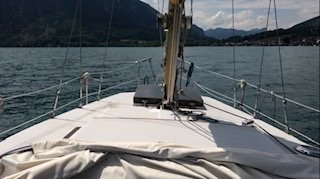
Attersee in Austria ( lake 25 km long , 5 km wide ) can have serious storms ./ wind due to the mountains next to it ….

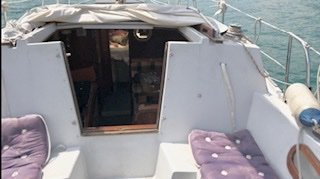
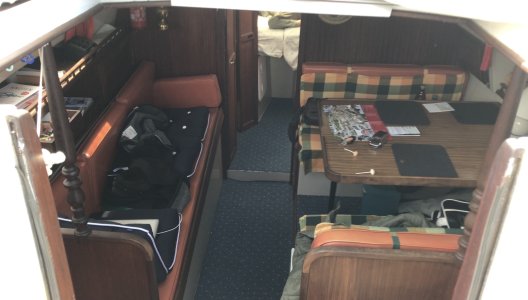
Super stable boat . Best interior design . Really big front berth . Big single berth . Fixed table / banks can be lowered to another big bed . + another side berth .
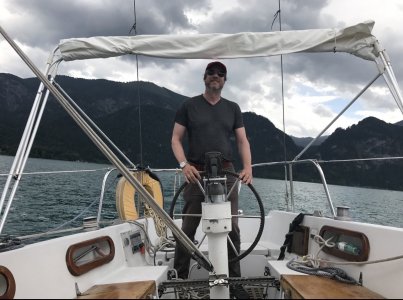
Hydraulic steering .
Big water tank
All real wood inside
Big outside area
Sits 6 plus 2 behind the big steering .
Removable table in the middle .
Medium wind 5 knots just with the fock
I paid 25.000 euros for it 12 years ago. Worth every penny
Still has the original fridge working .
No shower . The bathroom ( sink/ toilet ) is a walk trough to the front berth . It can be closed with doors from both sides.

25 hp, two cylinder Volvo penta
Uses very little diesel ( was rebuilt a while ago) and pushes the boat easily.

I heard that they even crossed the Antlantic in this model

I just love the big exterior with no mast crossing through the middle of the cabin . Fixed table which sits 4-6 people on the side .
Nothing to convert if you sleep 6 people really comfortably
Sails well . Not slow . Lots of storage !
I looked at so manny other boats the past years and could afford a lot of boats but I am just so happy with it ( space inside / outside , just so solid …)

I don’t know how it would behave with big waves at sea…

I try to find some pics

Great condition after 50 years.
 
I THINK that's a different boat, consistent with the different name, and the different hull.

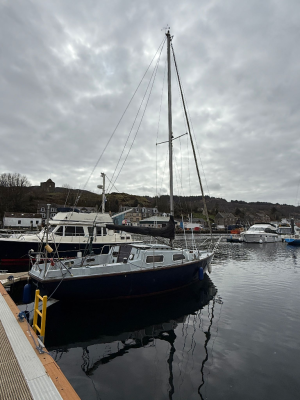
The "Lonely Boats" one advertised in Tarbert Loch Fyne is no longer available, and looked like this.

1765783588332.png
 
It has the plate design Frank Butler , 9,2 m length etc inside . I will try to find a pic .Maybe they did not build 2 the same or a custom build or an evolution . I think they did not build too manny. I find it interesting that the name tornado was actually used on similar boats while mine is a TORONADO. I always thought people just misspelled it.
 
Probably like the Pandoras Leisures and Hunters - a bit bigger each year or restyled to the latest fashion by adapting the same basic mould. The Martinlotus one looks a bit newer style than the Loch Fyne one - like the original Pandora to the International - also of 1974.
 
Last edited:
Top