Too many wires

apogee

Well-Known Member
Joined
1 Aug 2009
Messages
130
Location
Devon / IW
Visit site
I have so many wires connected to my house battery +ve, including two from different sets of solar panels, and one from a mains charger. Can I join any or all three of these before connecting to the battery or do they all need to terminate individually?
 
In my view it better to have a bus bar with a single wire from the battery to the bus bar then connect all the different devices connected to the bus bar.

You also need a fuse between the battery and the bus bar and using a bus bar allows you to use a single fuse rather then one for each device connected directly to the battery
 
In my view it better to have a bus bar with a single wire from the battery to the bus bar then connect all the different devices connected to the bus bar.

You also need a fuse between the battery and the bus bar and using a bus bar allows you to use a single fuse rather then one for each device connected directly to the battery
How does that work if the connections are all rated differently?
 
In my view it better to have a bus bar with a single wire from the battery to the bus bar then connect all the different devices connected to the bus bar.

You also need a fuse between the battery and the bus bar and using a bus bar allows you to use a single fuse rather then one for each device connected directly to the battery
You'll still need he same indivual fuses for each circuit.
The fuse, and wiring, between the battery and the bus bar will have to be rated for the total, or at least the maximum, load expected.
(If the connection between battery and bus bar is short and direct a fuse here may no be necessary.)

This applies to the positive (normally). A similar bus bar setup, but without the fuses, can be used for the negative connections
 
Something like this
connect_12v_items_appliances_fuse_box_wiring_diagram_campervan_busbar.png
 
The fuse protects the cable.
So the fuse at the battery protects the cable to the bus bar, and should be appropriately rated.
It will also protect any cable from the bus bar with the same dimensions.
But if you need a finer cable from the bus bar, then yes put the right size fuse at the bus bar end.
Code:
Battery -- [20A fuse] ---------- 20A cable ---------- Bus Bar
                                                                                                                                                                       |
                                                      +---- 20A cable ----
                                                      +- [5A fuse] --- 5A cable ---
                                                     +---- 20A cable ----
 
well of cause there will be some protection to sech device depending the current carrying capacity of the cables.

In my case I have circuit breaker to each of my solar panel regulators, wind generator and battery charger, plus circuit breakers for each appliance.

The main point is to get rid of direct multi connections to the battery/s
 
The fuse protects the cable.
So the fuse at the battery protects the cable to the bus bar, and should be appropriately rated.
It will also protect any cable from the bus bar with the same dimensions.
But if you need a finer cable from the bus bar, then yes put the right size fuse at the bus bar end.
Code:
Battery -- [20A fuse] ---------- 20A cable ---------- Bus Bar
                                                                                                                                                                       |
                                                      +---- 20A cable ----
                                                      +- [5A fuse] --- 5A cable ---
                                                     +---- 20A cable ----

That's totally ignoring loads or cumulative loads. The two 20a cables from the busbar would have to be collectively connected to less than 15a loads, which begs the question, why use 20a cable ?

A more "normal" approach would be to fit cables from the busbar to the loads, suited for those loads and fused accordingly. Then fit a cable between the battery and the busbar, sized and fused for the combined load of everything coming from the busbar.

In reality, there will usually be an isolator between the battery and the busbar, so it would be common to fit cable from the domestic bank to the isolator rated the same as the engine battery, to allow for emergency engine starting, fused accordingly. Then, from the isolator to the busbar, either rated for the combined loads (as above) or it could be the same size cable as to the isolator, in which case no additional fuse would be required, but each circuit from the busbar should be fused accordingly.

Fuses may generally be rated for the cable or the combined expected loads, if it's going to a switch panel (for instance) it may as well be rated for the cable, as everything after the switch panel would be individually fused. If any load involves a motor, it's usual to rate the fuse for the motor, in case of an overload, thus protecting the motor (especially windlass and thruster motors, which usually have thermal circuit breakers).
 
Last edited:
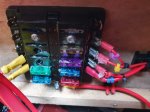
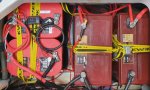
yes just been there and done that following a recent post
see red tops on the top left of the image
and small fuse board fitted next to the trojan which is on 24/7 (yes too much vaseline)
 

Attachments

  • Trojan always on Fuse board 070321 small.jpg
    Trojan always on Fuse board 070321 small.jpg
    79.1 KB · Views: 48
  • battery tidiness 070321 small.jpg
    battery tidiness 070321 small.jpg
    111.8 KB · Views: 45
yes just been there and done that following a recent post
see red tops on the top left of the image
and small fuse board fitted next to the trojan which is on 24/7 (yes too much vaseline)

It looks like you've been using a cheap and nasty crimping tool like this:

b_TT70.gif


It won't take much to pull those wires out of the terminals. Treat yourself to a half decent one of these:

0-702-50-durite-ratchet-crimping-tool-for-pre-insulated-terminals-9809-p.jpg


Don't have to be Durite, but the ratchet type is important for reliable crimps.

It also looks like you've been using yellow crimps on thin (2.5mm ?) wires, not a good way to get a proper crimp.
 
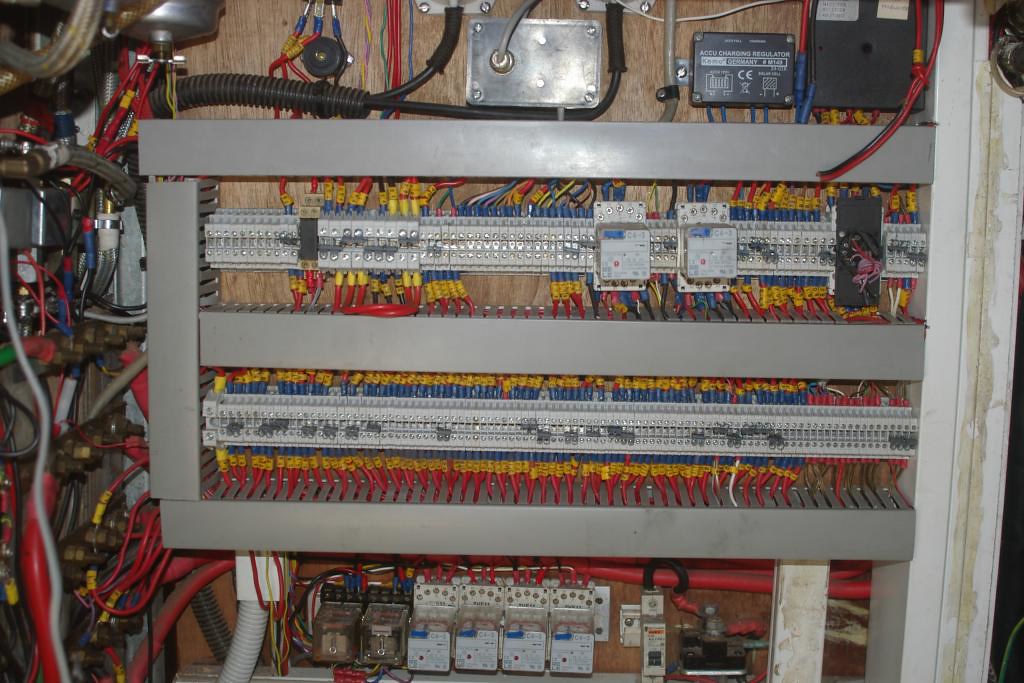
I notice you have coloured cables ties on the wires. Is that for identification, if so there are numbers available to identify wiring son of the are coloured so are just one colour.

This is more important when you have lots and lots of wiring like I have.

36086375355_253a4ac727_b.jpg
 
Top