Tohatsu 8 hp 2st twin 2004- hardly runs and won't idle- HT test??

sparkie

Well-Known Member
Joined
15 Oct 2002
Messages
617
Location
New Quay
Visit site
Hi all, just before the end of last season, I had a complete engine failure (just suddenly died at 3/4 throttle) after a long hard run against the tide. Fortunately I'd just arrived back in the bay and a friend towed me into my mooring. After about half an hour I tried it again and it worked fine(!). As a precaution I stripped the carb, cleaned and ultrasonic cleaned it, didn't find anything at all, and replaced it. Also replaced the plugs just in case. All was well, ran ok for lift-out, and before storing for the winter I ran it for at least 30 mins in a tank.

Decided to give it a good clean, service, new anodes etc last week, all completed, thought I'd give it a run in the tank, started second pull, ran normally for about a minute and then stopped. Started again (with choke) and now won't run at all without half choke and at high revs.

Must be fuel still thinks I, so ultrasonic cleaned carb again, all back together, cleanest carb in the known universe, still the same. Checked the plugs, wet. Thinking now could be an ignition problem after all. There is a spark at the plugs when out, but difficult to say if it's good enough. I'm thinking could be the CDI unit, but as they're £140 I need to be sure before replacing it.

Is there any test (or testing facility) that would give me a definitive answer???

Any advice greatly appreciated, I need to know if I can afford my single malt for Christmas or not......!

Cheers
 
Hi all, just before the end of last season, I had a complete engine failure (just suddenly died at 3/4 throttle) after a long hard run against the tide. Fortunately I'd just arrived back in the bay and a friend towed me into my mooring. After about half an hour I tried it again and it worked fine(!). As a precaution I stripped the carb, cleaned and ultrasonic cleaned it, didn't find anything at all, and replaced it. Also replaced the plugs just in case. All was well, ran ok for lift-out, and before storing for the winter I ran it for at least 30 mins in a tank.

Decided to give it a good clean, service, new anodes etc last week, all completed, thought I'd give it a run in the tank, started second pull, ran normally for about a minute and then stopped. Started again (with choke) and now won't run at all without half choke and at high revs.

Must be fuel still thinks I, so ultrasonic cleaned carb again, all back together, cleanest carb in the known universe, still the same. Checked the plugs, wet. Thinking now could be an ignition problem after all. There is a spark at the plugs when out, but difficult to say if it's good enough. I'm thinking could be the CDI unit, but as they're £140 I need to be sure before replacing it.

Is there any test (or testing facility) that would give me a definitive answer???

Any advice greatly appreciated, I need to know if I can afford my single malt for Christmas or not......!

Cheers

Observing the spark at the plugs when out tells you very little. It should be possible to get a spark to jump a 7/16" air gap. You can make an improvised spark tester with a couple of nails through a piece of (dry) wood with their points bent towards each other with a 7/16" gap between them. Obviously better if you buy or borrow a "proper" adjustable tester.

You will find information on testing the ignition circuit, if necessary, in the CDI Electronics "Troubleshooting Guide". http://www.cdielectronics.com/wp-content/uploads/2013/02/CDI Troubleshooting Guide - 2012.pdf. You will however need a DVA adapter for a multimeter to measure the voltage peaks ( this is not the same as the max reading hold facility which you will find on many mostly priced multimeters.) You will find circuits on line for a simple, easy to make. DVA adapter
 
It might be worth unscrewing the plug caps from the lead and snipping 1/2" off the leads before screwing back on. This should rule out corrosion in the leads causing a weak spark - I had this issue with my motorcycle and it was the last thing I tried when having running issues / engine cutting out especially in the rain. It worked / was the issue and is a quick and easy thing to do.
 
Any flow restriction between tank and carb?

Hi, no, all working perfectly. New line connector, clean filter and pipes in good order, also pump diaphragms in good order. Squeezing bulb makes no difference to problem. Only thing that keeps it going is half choke and 3/4 throttle. Thanks for the interest. Cheers.
 
If the choke makes it run better it might be a serious air leak into the engine.

I had a Johnson with a similar fault, it turned out to be the crankshaft oil seal under the flywheel.

Big job-complete strip of the power head, crankshaft and pistons out, new seals and bearings.

It started and ran like a new one after the rebuild.

Whatever you find, good luck.
 
Hopefully, not the Op's problem but, top and bottom crankshaft seals and bearings fairly easy to replace on Tohatsu twin 2 stroke 8 & 9.8 but if centre bearing and/or oil seal knackered, new crankshaft and rods needed - big ends are roller bearings so no split caps.. Crankshaft halves are press fit and no keyway and according to Tohatsu UK aligning and balancing costs more then a new crankshaft.
 
Hopefully, not the Op's problem but, top and bottom crankshaft seals and bearings fairly easy to replace on Tohatsu twin 2 stroke 8 & 9.8 but if centre bearing and/or oil seal knackered, new crankshaft and rods needed - big ends are roller bearings so no split caps.. Crankshaft halves are press fit and no keyway and according to Tohatsu UK aligning and balancing costs more then a new crankshaft.

Just the same as motorcycle two stroke twin cranks then. If the bits can be purchased many bike specialists can handle the job easily.

I could, still have the big press and the crankshaft can be trued in a lathe on centres if a trueing jig is not available.

To true a crank, you hit it with a lead hammer. Hitting it in the correct place is the key. More problematical is getting the pressed length correct-often a special jig is used for this. I still have a few somewhere, Jawa and Yamaha IIRC. The three cylinder Kawasaki's added a further dimension to the job...………………….

Balancing should not be required unless rods have been changed-the reciprocating weight should be the same.
 
Hi both- all very interesting and useful info. The intermittent nature of the fault and the relatively low usage of the engine (so far as I can estimate- didn't buy it new) tend to count against a mechanical fault in the engine. If it proves otherwise I suspect that the costs will exceed the value of the engine and it will end up as spares. HOWEVER- we're a long way from that yet hopefully. For the moment I'm still pursuing the HT line of inquiry, am waiting for a spark tester to arrive (no doubt from China), so that I can be better informed on that front. Anyway thanks for the interest and help. Cheers.
 
Hi both- all very interesting and useful info. The intermittent nature of the fault and the relatively low usage of the engine (so far as I can estimate- didn't buy it new) tend to count against a mechanical fault in the engine. If it proves otherwise I suspect that the costs will exceed the value of the engine and it will end up as spares. HOWEVER- we're a long way from that yet hopefully. For the moment I'm still pursuing the HT line of inquiry, am waiting for a spark tester to arrive (no doubt from China), so that I can be better informed on that front. Anyway thanks for the interest and help. Cheers.

Decent 2 strokes are in demand and fetching good money so it's worth fettling. My old 9.8 had an overheating problem and needed the head off to replace thermostat and I decided to strip to check pistons. Only problem I found was a gritty bottom crankshaft bearing, new one coming from Japan. All other spares, gaskets, seals etc. were off the shelf from Tohatsu via an agent so, don't give up, a new engine will cost you far more. There's a parts list here - https://tohatsuoutboardparts.com/Pa...s Catalog M8B-9.8B (2003) - (00221030-5).pdf
 
Thanks for the encouragement and the spares link. Yes it's a very good engine when running ok so I will persevere..........! Cheers.
 
When my Johnson had the crank seal failure, bearings were found to be 6002 or 6003 ball races, modified by having a tiny roll pin inserted in the outer race to stop it moving. The dealer price was £57.00 plus VAT each.
I had plenty of good quality-Koyo, from Japan-bearings which were OE fit on many lightweight Japanese motorcycle front wheel bearings. Retail, under a tenner each. These were used with Loctite and seals from the local bearing shop. 8 years on, the current owner tells me it is running perfectly. He said it did not start once. He had to pull the cord again...……………………

I had an anvil, mounted on a slice of good size tree trunk with a half inch sheet of duraluminium folded to fit across the flat top. One flywheel was placed on this, the other whacked with the lead hammer-in the estimated correct place-to move the flywheels into the right place so the shafts were true. You had to hit hard-it would often take 40 plus tons on the press to shift a crankpin in a new Speedway engine, a bit less when they had had a couple of crankpins fitted. The aim was a thou-I once got zero movement on a GM crankshaft with the dial gauge mounted on the mainshafts as close as possible to the flywheel outer edge.

The lead hammer was made from a tinned fruit can-scrap lead melted onto a steel shaft with cross bolts to secure it inserted into the tin, the tin pre split and wired together, peeled off afterwards.

Often a sharp " Click " could be heard as the pin moved in the flywheels, over the deeper thud of the lead hammer.

It was satisfying work, now fast becoming a lost skill.
 
Observing the spark at the plugs when out tells you very little. It should be possible to get a spark to jump a 7/16" air gap. You can make an improvised spark tester with a couple of nails through a piece of (dry) wood with their points bent towards each other with a 7/16" gap between them. Obviously better if you buy or borrow a "proper" adjustable tester.

You will find information on testing the ignition circuit, if necessary, in the CDI Electronics "Troubleshooting Guide". http://www.cdielectronics.com/wp-content/uploads/2013/02/CDI Troubleshooting Guide - 2012.pdf. You will however need a DVA adapter for a multimeter to measure the voltage peaks ( this is not the same as the max reading hold facility which you will find on many mostly priced multimeters.) You will find circuits on line for a simple, easy to make. DVA adapter

Hello again Vic, I bought a spark tester and have just done a few tests. First 2/3 pulls 11mm spark, then none. Reduced gap to 9mm, sparks ok most times, sometimes none. Tried in other HT lead, only 6mm spark, sometimes none. These are all when pulling really hard, faster than I normally do with the plugs in. It would often start just when I was turning it over to prime it. I'm a bit puzzled however by the disparity between the two cylinders, I would have thought there would just be one coil??

Anyway, I'm 80% sure that the CDI unit is failing, and this would probably get worse when hot, so explaining the original complete shut down. I'm therefore minded to replace it, as I doubt if I could trust it again on the basis of this erratic performance.
 
Hello again Vic, I bought a spark tester and have just done a few tests. First 2/3 pulls 11mm spark, then none. Reduced gap to 9mm, sparks ok most times, sometimes none. Tried in other HT lead, only 6mm spark, sometimes none. These are all when pulling really hard, faster than I normally do with the plugs in. It would often start just when I was turning it over to prime it. I'm a bit puzzled however by the disparity between the two cylinders, I would have thought there would just be one coil??

Anyway, I'm 80% sure that the CDI unit is failing, and this would probably get worse when hot, so explaining the original complete shut down. I'm therefore minded to replace it, as I doubt if I could trust it again on the basis of this erratic performance.

I think I agree

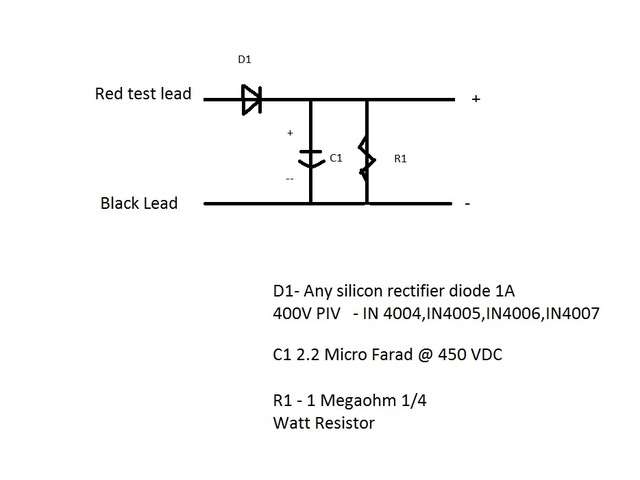
If you have not done so it might be worth checking the kill switch circuit for any obscure faults by disconnecting it, and checking the output from the exciter coil with a Multi-meter equipped with a DVA adapter ( which will measure the peak volts of the pulses)

Circuit for a DVA adapter

dvacircuit.jpg
 
Last edited:
Hello again Vic, tested the kill circuit, no change with it disconnected, measured resistance and voltage (with DVA) of exciter coil, both well within the specified limits, so ordered a new CDI unit- currently on its way from Singapore.....

Thanks for your help

Peter
 
Top