
To fill or not to fill

Stemar

Well-Known Member
Joined
12 Sep 2001
Messages
25,577
Location
Home - Southampton, Boat - Gosport
Visit site
Above Jazzcat's loose skeg is this void.
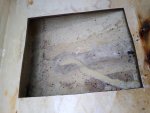
Void.jpg
The transom's to the right, and the locker whose bottom I've cut out is self-draining - or self flooding if there's too much weight aft.

The skeg is well attached, but the hull flexes and there appears to be a lot of P in the in the GRP, but not so much GR, so I'm going to build up several layers of glass and epoxy to reinforce it all. then see how it goes

The void was full of water and a good dose of crud; I've no idea how it got in there as it's apparently all sealed. It's only a few litres, but it's weight aft that I don't need. Is there a closed cell expanding foam I could use to make sure it doesn't fill up again? Places like Screwfix describe some of their foams as waterproof, but they're a bit coy about whether that means it's genuinely closed cell, or if it means it just doesn't dissolve in water
 
Can't you fill it with closed cell sheets cut to fit?

But maybe what DJE says is the way to go?
 
Last edited:
I suspect that there is a crack in the floor or joint with the hull letting water through. Could put in a new floor using the old one as a base and then an inspection hatch or/and put a dinghy bung in the bulkhead as low as possible so that you can drain the space into the big locker or will the fuel tank be in the way?
 
Foaming Epoxy?
Above Jazzcat's loose skeg is this void.
View attachment 125852
The transom's to the right, and the locker whose bottom I've cut out is self-draining - or self flooding if there's too much weight aft.

The skeg is well attached, but the hull flexes and there appears to be a lot of P in the in the GRP, but not so much GR, so I'm going to build up several layers of glass and epoxy to reinforce it all. then see how it goes

The void was full of water and a good dose of crud; I've no idea how it got in there as it's apparently all sealed. It's only a few litres, but it's weight aft that I don't need. Is there a closed cell expanding foam I could use to make sure it doesn't fill up again? Places like Screwfix describe some of their foams as waterproof, but they're a bit coy about whether that means it's genuinely closed cell, or if it means it just doesn't dissolve in water
Thanks for that photo - I always wondered what was under the locker bottom. Similarly there are voids under the forelockers each side, under the locker floors. I like the foaming epoxy suggestion for filling the voids but what a price!
 
Water is obvs finding its way in somehow; finding that is important for peace of mind. As the compartment was sealed I'd consider removing the whole floor and just have the hull(reinforced as you intend) as the locker bottom, then you can keep an eye on it and see if there's a problem. A lift-out grid can be made from wood or GRP to give a flat floor/keep stored items out of any water if desired. Sealed voids are rubbish unless you're after buoyancy against flooding and as you have found fill up with water if there's no means to inspect.
 
Last edited:
One way to stop the flexing might be to install some GRP stiffeners bonded to the hull; with limber holes where required to allow any water to drain away.

Taper them at the ends to avoid having a stress point there.

See pages 8 to 18 of this:

https://www.westsystem.com/wp-content/uploads/Fiberglass-Manual-2015.pdf
Poingnard is correct. Simply adding a few layers of glass to the bilge will not stiffen up the skeg(s) sufficiently. Best would be to glass in one or two transverse floors. They can be made of ply, glued, filleted and glassed over. I would use epoxy.

Leave the void open, but round off the corners to avoid stress risers. Have a simple lid to cover it, if necessary.
 
Ply is a mediocre core material for a floor; use foam or a preformed bit of GRP.
Perhaps, but common enough and will outlast the OP's boat and it's owner, especially if done with epoxy rather than polyester. The ones on my own boat are well over 40 years old and appear to be still in good nic even though they were done with polyester resin.
 
The reinforcing is a good idea - thanks! Now why didn't I think of that? I haven't got any marine ply, just some BWP stuff, but I do have some pressure treated pine, so I think I'll use that - around 1" square section, with enough layers of cloth epoxied over it to make the wood irrelevant.

As for filling the void, the budget is minimal, so I think I'll paint the whole of the inside with epoxy to try and keep the water out, then fill it with polystyrene cut to fit as best I can, put the lid back with more epoxy and call it a day. There are too many other jobs to spend all winter on that one!
 
Top