TMC toilet is filling the bowl 24/7

I don’t need a lecture.
The pump on my boat is isolated from the sea until commanded. No seawater can get above the waterline in the heads without my making it do so. I can safely leave the seacocks open should I wish to.
A safety feature that I’ve had for twenty years and one suggested by the builder.
If you shut your seacock and only open it for use then you do not need and antisyphon at all!

Surprised you seem unable to understand the principles and follow the simple reliable instructions from the manufacturer.
 
Last edited:
If you shut your seacock and only open it for use then you do not need and antisyphon at all!

Amazed you seem unable to understand the principles and follow the simple reliable instructions from the manufacturer.
I understand perfectly. The heads are below the waterline. I’ve introduced another layer of safety.
 
From your diagram that is similar to my set up except that I have a Jabsco manual pump. When you suck on the inlet on my boat the antisiphon valve sucks air not water. The outlet pressurises from the toilet to the sea and shuts the valve. If your system works then fine. It all depends upon how high the valves are above the waterline and the position of the bowl relative to the waterline.
 
Last edited:
I might just replace the Jabsco with a Lavac that I have in the attic at home. The Jabsco joker valves need renewed every year it seems. I never seem to get a second year without back leakage and they are a pig to remove and an even bigger pig to replace.
Something is wrong for you to need to replace it annually. Took me about 15 mins the first time I had to replace an old joker valve.
 
See my post#9
You will need to put your finger on the inlet valve when pumping, otherwise it won’t draw water in. Not a problem, just a routine thing to do.
No need to do it when discharging.

I now have a anti syphon valve between pump and bowl. No need to hold finger as it does not draw air.

The valve can be opened and closed/tightened. I am guessing it should be left open/loose?

 
I now have a anti syphon valve between pump and bowl. No need to hold finger as it does not draw air.

The valve can be opened and closed/tightened. I am guessing it should be left open/loose?


The valve must not be closed at any time, as that would prevent the anti-syphon function from operating, and negate the point of installing it in the first place. You are correct that it does not ever need to be closed in your installation

Just to be clear and precise to avoid anyone else reading this getting confused. - You say 'it does not draw in air'. That's incorrect: it actually does (and must do to make it work as an anti-syphon device). I know (but others reading later may not appreciate) that what you mean is that it does not draw in air when you are pumping, which is what would happen if someone had, incorrectly, installed the valve between the water intake and the pump.

The valve should automatically temporarily close (to prevent water spraying out) under the pressure created in the pipe when you operate the pump, and then automatically fall open again (to let air in) when you stop pumping.

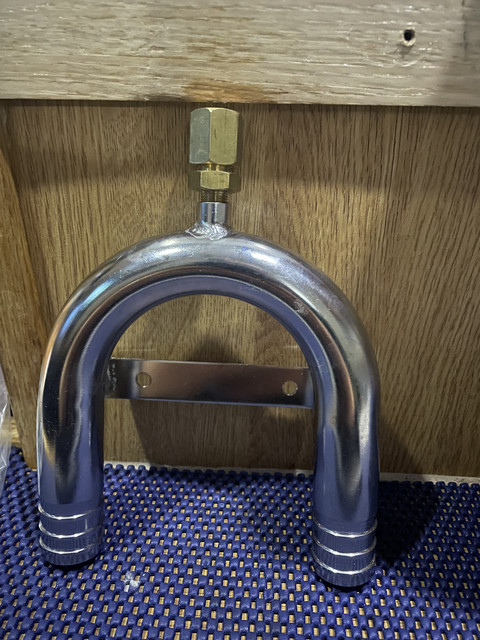
The bend and valve you have is fine for the job you are using it for, but I suspect it would have been unnecessarily expensive for this particular role. It seems designed for the heat etc. the anti-syphon bend & valve in an engine cooling system may be subjected to. A cheaper plastic anti-syphon bend/valve fitting would have sufficed for the low temperatures, pressures, etc. in a toilet water inlet.

Glad you got it sorted.
 
Last edited:
The valve must not be closed at any time, as that would prevent the anti-syphon function from operating, and negate the point of installing it in the first place. You are correct that it does not ever need to be closed in your installation

Just to be clear and precise to avoid anyone else reading this getting confused. - You say 'it does not draw in air'. That's incorrect: it actually does (and must do to make it work as an anti-syphon device). I know (but others reading later may not appreciate) that what you mean is that it does not draw in air when you are pumping, which is what would happen if someone had, incorrectly, installed the valve between the water intake and the pump.

The valve should automatically temporarily close (to prevent water spraying out) under the pressure created in the pipe when you operate the pump, and then automatically fall open again (to let air in) when you stop pumping.

The bend and valve you have is fine for the job you are using it for, but I suspect it would have been unnecessarily expensive for this particular role. It seems designed for the heat etc. the anti-syphon bend & valve in an engine cooling system may be subjected to. A cheaper plastic anti-syphon bend/valve fitting would have sufficed for the low temperatures, pressures, etc. in a toilet water inlet.

Glad you got it sorted.
That is exactly what I meant to say :)
Well, that one is now mounted behind a diesel heater, so it is subjected to quite a bit of heat at times.
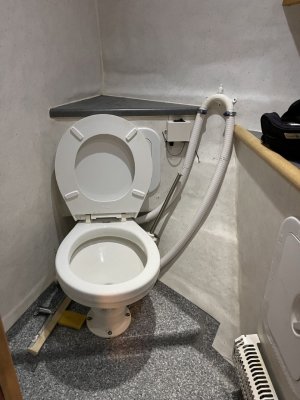
The one fitted between toilet bowl and pump is cheap white plastic. This is the second position I try it in. First position was about the same height as the bowl. Not enough. This time I thought I had it, but after a few hours the bowl was full... Not overflowing, but I wouldnt take a piss in there ;) So I guess I will have to move it again... It is kind of hard to tell where the water line is from the outside!
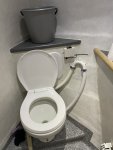
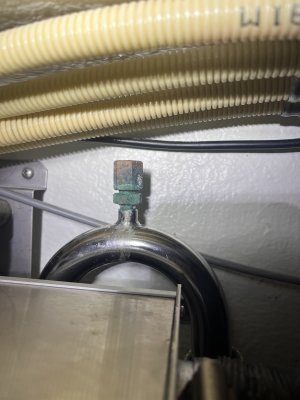
IMG_8984.jpeg
 
That is exactly what I meant to say :)
Well, that one is now mounted behind a diesel heater, so it is subjected to quite a bit of heat at times.
The one fitted between toilet bowl and pump is cheap white plastic. This is the second position I try it in. First position was about the same height as the bowl. Not enough. This time I thought I had it, but after a few hours the bowl was full... Not overflowing, but I wouldnt take a piss in there ;) So I guess I will have to move it again... It is kind of hard to tell where the water line is from the outside!
View attachment 152378

The valve and top of the loop must be above the waterline at any angle of heel (or rolling). In any small- ish boat this would likely be significantly higher than the toilet bowl - e.g. near the ceiling of the compartment.

The nearer to the side of the boat the loop and valve is, the higher it needs to be to remain above the waterline when the boat is heeled or rolling, as well as when it is at rest.. The nearer the loop and valve is to the centreline of the boat the lower in it can be.

You should be able to work out fairly easily approximately where the waterline is by measuring up and down, inside and out, from e.g. the side decks. You can establish exactly where the waterline is by using a long thin transparent plastic tube with some water in it, and ends of the pipe open. You'll need one person outside holding at a height where the water in the tube is at the boat's waterline, and another inside to mark the height shown by the height of the water in the tube. Don't forget to factor in heeling and rolling!
 
The person inside does not see the tube?
Sure you can measure, but as you say it will vary with conditions. Safest things is probably putting it as high up as possible.
 
The person inside does not see the tube?
Sure you can measure, but as you say it will vary with conditions. Safest things is probably putting it as high up as possible.


The tube needs to be long enough to go from outside the boat to inside, plus at least a metre or more extra at both ends with just air in it. It would be easier to explain with a drawing/diagram, but I can't do that now.

Perhaps someone else can explain or show how it's done.
 
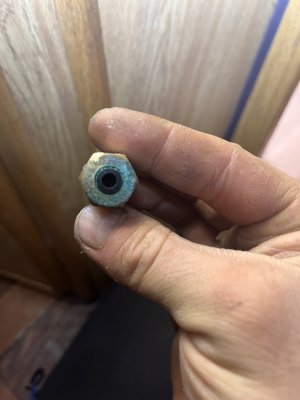
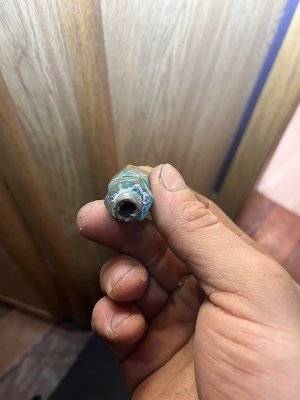
So I left the top fitting kind of loose. Now it looks like shit already. Seems like som water have leaked out.
IMG_0969.jpegIMG_0970.jpegIMG_0971.jpeg
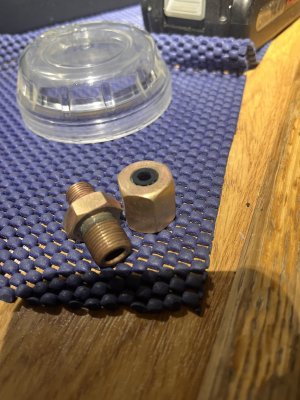
Gave it a good soask in vinegar and a littler bit of scotch brite polishing. Looking at it now I dont see the problem in screwing it tight, The rubber membrane at the top is a one way valve that you can not close no matter how tight you screw the fittings together.
IMG_0973.jpeg
 
We had a TMC electric toilet on our Hartley 32.

The persistent leak like yours was the 'O' rings on the pump shaft. Short life items. Changed them, did not last long.

Boat now sold, but not because of that minor fault!

PM me if you want a brand new Burnsco TMC Gasket kit for a tenner posted.
 
Thanks LittleSister, I have sailed on a few boats with Jabsco toilets (and always hate them) an currently own one. They have never had a loop in the pipe between pump and bowl despite being installed below the waterline and have always used the wee short pipe supplied with the toilet and seemingly permanent but as people say "Every day is a school day." I have looked at the Jabsco toilet manual and you are absolutely correct. Thanks for the information, and for adding another job to the winter layup list!

I might just replace the Jabsco with a Lavac that I have in the attic at home. The Jabsco joker valves need renewed every year it seems. I never seem to get a second year without back leakage and they are a pig to remove and an even bigger pig to replace.
I agree joker valves need regular replacing but it takes under 5 minutes from walking in with a screwdriver to walking back out again. I’m not sure what the issue is?
 
So I left the top fitting kind of loose. Now it looks like shit already. Seems like som water have leaked out.
View attachment 168158View attachment 168159View attachment 168160
Gave it a good soask in vinegar and a littler bit of scotch brite polishing. Looking at it now I dont see the problem in screwing it tight, The rubber membrane at the top is a one way valve that you can not close no matter how tight you screw the fittings together.
View attachment 168161

People are wittering on about joker valves, but that is in the outlet pipe. It looks to me that the anti-syphon valve you show is narrower than an outlet pipe and is on the inlet side. The valve you have is a metal one, such as one needs for an engine anti-syphon that will be carrying hot water. For toilet purposes, which only carries cold water, you only need a cheap plastic one, so if you can;'t get your valve to operate properly you could just swap your U-bend and valve for a plastic one.

I don't understand why you left the valve loose. It needs to be tight to ensure that it is the one-way valve in control. If it is loose it will allow water to escape, but judging by the crud on the valve water is escaping from the top - the valve itself - not just at your lose joint between the valve and the pipe. The valve should prevent water escaping when the pipe is under pressure (i.e. when pumping), but allow air in when it is under suction (when you stop pumping).

The inlet valve should be between the toilet pump and the bowl, not between the inlet seacock and the pump, and the U-bend and valve should be at such a height that it is above the waterline. Therefore there should be air in the bend and top of the pipe. You should be able to remove the valve from the bend when you are not pumping without any water coming out of the aperture, but when you pump water would come out if the valve were not in place.
 
I have 2 x TMC electric toilets and I posted about a similar problem during the summer
Electric toilet syphon problem - advice welcome.
Since then the second one has developed the same problem. I'm convinced the problem is in the pump rather than the anti- syphon loop or valve. I haven't got around to swapping the pump for the spare I have in stock but it's on my list for the New Year.
Initially I made the same mistake as the OP in leaving the anti-syphon valve head loose and it leaked when I flushed the toilet. It needs to be closed fully but not over tightened.
 
My problem turned out to be the sintered bush the 'O' rings worked on.
Sintered what? Is it what keep water from leaking between macerator and pumps?
People are wittering on about joker valves, but that is in the outlet pipe. It looks to me that the anti-syphon valve you show is narrower than an outlet pipe and is on the inlet side. The valve you have is a metal one, such as one needs for an engine anti-syphon that will be carrying hot water. For toilet purposes, which only carries cold water, you only need a cheap plastic one, so if you can;'t get your valve to operate properly you could just swap your U-bend and valve for a plastic one.

I don't understand why you left the valve loose. It needs to be tight to ensure that it is the one-way valve in control. If it is loose it will allow water to escape, but judging by the crud on the valve water is escaping from the top - the valve itself - not just at your lose joint between the valve and the pipe. The valve should prevent water escaping when the pipe is under pressure (i.e. when pumping), but allow air in when it is under suction (when you stop pumping).

The inlet valve should be between the toilet pump and the bowl, not between the inlet seacock and the pump, and the U-bend and valve should be at such a height that it is above the waterline. Therefore there should be air in the bend and top of the pipe. You should be able to remove the valve from the bend when you are not pumping without any water coming out of the aperture, but when you pump water would come out if the valve were not in place.

I completely overread into you saying that the valve must be left open. I thought I closed it by tightening. But I understand better now ;)
I got the metal one because I like stuff in stainless. More solid. What would be the point in swapping it out now?
I believe water have been coming out the top during heavy rolling. Same as bowl is not filling much in port, -but out at sea its overflowing...

Toilet bowl had filled up again tonight while I was sleeping. Outlet overboard valve was shut. Checked the inlet anti syphon for water and it was completely dry. So my guess is that it must have been the water in the outlet hose slowly draining into the bowl.

This the inlet syphon
IMG_0985 – stort.jpeg
 
We liveaboard and the heads does get a reasonable amount of use (over 40 years now). We did find the anti syphon on the water inlet to be a pain. We fitted it as we did get water flow into the bowl past the pump plunger and into the bottom of the bowl. This was because the pump O rings seemed to wear reasonable quickly. We removed the syphon break and fitted a ball valve (plastic seacock) instead of the syphon break. This sits nicely behind the toilet on bulkhead. We could just turn off the main seacock but it is in a locker under the spare laundry. A simple easy solution BUT does depend on a well disciplined action every time.

Hope this helps someone.
 
We liveaboard and the heads does get a reasonable amount of use (over 40 years now). We did find the anti syphon on the water inlet to be a pain. We fitted it as we did get water flow into the bowl past the pump plunger and into the bottom of the bowl. This was because the pump O rings seemed to wear reasonable quickly. . .

I'm puzzled as to why you found the anti-siphon a pain.
 
Today I realized that my problem is also water flowing past the pump and into the bowl. As the anti-syphon is between bowl and pump it does nothing to stop it. Have ordered a maintenance set and will see if I cant make the pump hold its water!
 
Top