
Tips for upwind sailing

Alan_B

Well-Known Member
Joined
19 Aug 2013
Messages
103
Location
Lisburn / Craigavon
Visit site
Hi all,

I don't post regularly but lurk a lot and was hoping you all could share some wisdom.

Boat in question is an elderly Hunter 701 used for club racing. Masthead rig, large overlapping genoa and fairly small main sail. Sails are 'ok', the main being in better condition than the headsail. 2 people on board. Gross weight maybe 1600kgs, fin keel with a bulb.

In downwind weather and anything off a beat she absolutely flies. Happy to carry full main and genoa in 20knts steady wind, anything over this we would drop to a 2 and so on. On a true hard beat though, we find she just will not point as high as we would like.

Last night is a good example. Wind a steady 14knts, and on a beat we are averaging 4.5 - 5 knots. Put pointing a fair touch lower than other boats in the fleet - a couple GK24s etc. Jib cars have been set per the conditions. The main seems to set perfectly (traveller used) but we can never get up as high as we would like.

It has been mentioned a few times to us that the mast might need more rake in it, especially as down wind she is very quick for her size (can stay with 29ft Maxi's) With little data available for our boat is this going to be a tweak and try job? Is there anything else that influences a boats pointing ability? Or could it just be the fact that its an old design?

Ideally, I'd love new sails as I think a new genny would help, but with two owners in their 20's we are more likely to spend the money on a holiday to Magaluf ;)

Any advice would be greatly appreciated!
 
First check mast set up of boats that are pointing well.

Second check your forestay sag compared to others. Not into this class of sailing but was aware of one boat that got good results in J24 class sailed with knackered sails and lots of foresail sag! This brings you to considering the right mast bend and forestay sag to suit your sail shape to get the best shape for upwind sailing.

Thirdly what condition/make are your sails. In the class of dinghy that we raced certain makes performed better and one make needed a different set up to perform well.

Lastly is your pointing technique bad. Go for speed first then edge up, don't point high first as you will appear to be pointing high but be making lots of leeway.

Above point are fairly basic but hopefully not teaching you to suck eggs. Not sure of your experience level but windsurfers make good dinghy sailors and dinghy sailors make good big boat sailors- can't beat time on the water in competitive situations. On my 43 I can always tell the helms dinghy experience when they tack.
 
First get the forestay tight, then check the position of maximum draft of your Genoa.
I suspect your elderly sail is probably stretching like nicker elastic upwind as the wind gusts, and this will destroy pointing ability.
Also second the point about getting the boat up to speed after a tack before squeezing up to optimum angle. If you don't get the keel working with decent flow over it the boat will just go sideways.
I asume you have telltales on your Genoa and have them working properly, and know how to,use them?
 
Upwind the headsail is king, and if you have a large overlapping genoa that is past its prime, all the tweaks you can do will improve things a little bit, but the big gains in speed and pointing ability will only come with a new sail because you need to get the maximum draft of the sail fairly well forward and a sail that has stretched will not be capable of making the perfect shape any more, because you cannot get it flat enough. A bit of experimenting with halyard tension might be a good idea. Forestay tension and halyard tension are not the same thing and have slightly different effects and getting the right combination of the two might not be easy but is worth some experimentation.
 
Thanks for the tips everyone.

Headsail has tell tales and we know how to use them :) Also we would build some speed before hardening up.
Interested in the forestay adjustments. How do you judge the draft of the headsail? Our forestay is fairly tight at the moment, but we are going down on Sat morning to slacken everything off and start from scratch. In terms of slackening the forestay, how would this affect the boat in windier conditions? We are happy to go out in 30knots of wind - would it need tensioning again for this?

I cant for the life of me remember who made the headasail. Maybe Crusader, or Jeckels? Its a bit of a thing to tack, it is not quick to come over and get set which also slows us down. Helmsman has to hold the sheet while I skirt it over the guard rails.

I am going to sign up for an 'improve your sailing course' so you never know, that might help things!

I guess I am presuming we are sailing to how the boat is set up judging that we are getting 5 knots on a beat, but if we could carry that speed and point higher it would definitely benefit us.

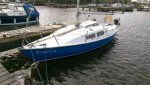
Pic of boat :)

IMG-20150426-WA0001.jpg
 
If your forestay is too slack, then the tack of the sail will sag off pushing the draft further back in the sail.

When you are sailing upwind, look forwards along the centreline ?(using the mast as a vertical line if you will) and see if the front edge of your genoa is sagging off the leeward. If it is, apply more tension to the backstay until it's pretty-much straight.

Next, if your sails are old, you are likely to have a streched leech which is hooking. With older sails, you want to set the genoa cars a bit further back so that you bring the foot of the sail almost flat, but leaving the leech to twist-off a bit (not too much though, just enough so the sail isn't stalling).

Next, don't be tempted to over-pinch. I've sailed with lots of people over the years who have the habit of trying to point too high just to try to get up as high as the others. Your foils (keel and rudder) are essentially underwater sails, and the more water flow you get over them, the more lift they will give you. So you need to work the boat upwind by going for speed, then squeezing up, and then as the speed starts to drop-off, knock the helm off a couple of degrees again to regain the speed. If you don't have the speed, the boat may be pointing higher, but it will be sliding sideways and your VMG will be much worse.

Also, what is your rudder balance like upwind? What you are looking for is a small amount of weather helm (wants to turn the boat into the wind). If you have too much, then drop-off a bit of kicker until it comes right. If you have neutral or lee helm, then this would suggest that your rig is in the wrong place (mast foot and/or rake).

Hope that helps.

PS. If you want to get some idea of the shape of the sail (where the maximum draft is), draw some horizontal lines at 1/4, 1/2, and 3/4 of the way up with a market pen. You want the maximum draft at about 40-45% of the way back when sailing (the marker line wants to look like a wing profile, with the maximum depth in front of the middle).
 
Last edited:
Thanks for the tips everyone.

Headsail has tell tales and we know how to use them :) Also we would build some speed before hardening up.

Interested in the forestay adjustments. How do you judge the draft of the headsail? Our forestay is fairly tight at the moment, but we are going down on Sat morning to slacken everything off and start from scratch. In terms of slackening the forestay, how would this affect the boat in windier conditions? We are happy to go out in 30knots of wind - would it need tensioning again for this?

I cant for the life of me remember who made the headasail. Maybe Crusader, or Jeckels? Its a bit of a thing to tack, it is not quick to come over and get set which also slows us down. Helmsman has to hold the sheet while I skirt it over the guard rails.

I am going to sign up for an 'improve your sailing course' so you never know, that might help things!

I guess I am presuming we are sailing to how the boat is set up judging that we are getting 5 knots on a beat, but if we could carry that speed and point higher it would definitely benefit us.

Pic of boat :)

View attachment 51660

Take pics of the sails, from the middle of the foot towards the head - both sails - when hard on the breeze and post them here. Also a pic of the slot from the aft corner of the boat. That will give us a real starting point.

Whilst the advice being given here is all very good, it is a little bit like directions to London without knowing if we're starting from Bristol or Birmingham...
 
I've not sailed a Hunter but would also suspect the sails, even if they do look "OK". Also, some boats just don't like being pinched. My current boat is close-winded for her age, but I used to race with our Mystere in the '70s. Although she was fast enough for a dated design, I could never point anywhere like most of the other boats, but frequently beat them to windward by carrying little leeway. The only time I lost out was when it was helpful to pinch up to get to a mark for a short distance.

Although pinching is never good sailing, the best VMG on my current boat, in still water, is obtained by sailing far higher than I would naturally sail, but requires great delicacy and concentration.
 
14knots of wind, full genoa and main is pushing it on a lightish boat.
unless it was 9 - 10knts true and 14knts apparent.
Whats the weather helm like?
Big pull, medium or neutral?
How tight was the jib halyard?
Wind up the back stay

Like Flaming said its hard to know sitting here as there are so many factors to consider and tweak.

Get some leech tell tails on the genoa to set the cars correctly. they generally won't last a season but they will allow you to calibrate better.
I'd try some beats upwind with genoa only and take some readings, speed, wind angle etc
Also sea state will make a big difference in your boat, in a chop you will have to crack off a little otherwise you'll stop, flat water and you can pinch, etc
 
Hi all,

I don't post regularly but lurk a lot and was hoping you all could share some wisdom.

Keep records!
Mark the controls on your boat (the halyards, sheets, genoa cars, etc) so you have fixed positions you can go back to and use as reference for tweaks. Then when you go out, get going on a long straight tack and write down the position of everything - including number of people and whether they are in the cockpit or on the rail, the wind strength and sea state, and how well you are doing at a small range of wind angles - 40, 45, 50. If you can get a sense of leeway then write that down too.

For tweaks, I would say either spend £20 buying a rig and sail tuning book and work through that seeing what works best for you boat (because you are writing everything down), or go out on someone else's boat that goes particularly well upwind and ask questions and take photos.

Good luck, once you start getting a good methid of recording everything and develop a baseline then the process is actually quite fun.
 
>Whats the weather helm like? Whats the weather helm like? Big pull, medium or neutral?

Good point, it should be neutral, if the rudder is not central it will create drag and slow the boat down. The only way to achieve it is to balance the sails.
 
>Whats the weather helm like? Whats the weather helm like? Big pull, medium or neutral?

Good point, it should be neutral, if the rudder is not central it will create drag and slow the boat down. The only way to achieve it is to balance the sails.

5 degrees rudder is the best for upwind work. If wheel steered put a mark on the wheel to indicate where this is.
 
>5 degrees rudder is the best for upwind work. If wheel steered put a mark on the wheel to indicate where this is.

We found a Hydrovane can steer any course better than any helmsman because it reacts to even tiny wind direction changes immediately. To do that it needs a balanced boat with a neutral helm and as said no rudder drag.
 
>5 degrees rudder is the best for upwind work. If wheel steered put a mark on the wheel to indicate where this is.

We found a Hydrovane can steer any course better than any helmsman because it reacts to even tiny wind direction changes immediately. To do that it needs a balanced boat with a neutral helm and as said no rudder drag.

If you're setting up a boat to have an entirely neutral helm when hard on the breeze, you will not be getting the best VMG to windward. Difference in cruising terms would be fairly small but you're certainly not going upwind as well as "any helmsman."
 
Top