
Tiny transducer leak in the front of my boat?

JollyRodgers

Well-Known Member
Joined
18 Dec 2014
Messages
174
Location
Surrey
Visit site
Hello,

I have just got my boat (Sadler 32) into the water and after a short (45min) trip of motoring it from one place into the marina, I noticed that there is a very small leak coming out from the transducer, where the boat measures the speed.

The attached picture was before I had wiped it up with a sponge, but it was still a little damp afterwards - although nowhere near like it is in this picture. I figured because after I had wiped it up, the boat was stationary in a marina, so no water was being pushed up?

What would be the best way to solve this? I did a bit of research on Google, but only found some suggestions and never found out exactly what people did to fix the problem in the end.

I could use some Waterweld or Silaflex and go around the edges and presumably this would fix the problem (temporarily) and then make sure I keep an eye on it throughout the season - then when the boat comes out of the water fix it properly then?

How big of a deal is this? I spoke to someone in the marina and he said something along the lines of "if you boat isn't sinking, then dont worry about it.", but I didn't think that was very helpful at all. I was actually thinking that if I ignored it for long enough, the boat could end up sinking haha..

edit: for some reason the photographs are upside down. I would adjust them in photoshop, but I have to pop out. Will do it when I get home, but for now you get the idea.
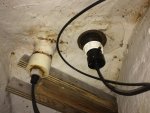
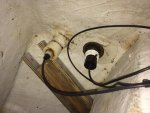
IMG_4644.jpg
IMG_4643.jpg
 
It depends where the actual leak is coming from.

Try removing the transducer and quickly replacing it with the blank. You can then replace the o-rings on the transducer, if necessary, and grease it with silicone grease which should seal it if that is the source of the leak.

Richard
 
Would agree with RichardS. I have also found it possible to cross thread the transducer slightly and it's not easy to spot until you notice a slight leak. Take the transducer out, replace the O-ring, re grease, screw in very carefully, and then see if you still have the leak.
 
As above if the O-ring seals are leaking.
Some transducers are intended to be replaced in one particular direction; eg the Raymarine Airmar transducer has a very small keyway, which is easy to overlook. If it's accidentally replaced pointing the wrong way, then a small leak can result. Check that this isn't your problem.
If the leak is between the hull material and the transducer body, you'll have to find some gunge that sticks to wet plastic, not too easy.
 
I could use some Waterweld or Silaflex and go around the edges and presumably this would fix the problem (temporarily) and then make sure I keep an eye on it throughout the season - then when the boat comes out of the water fix it properly then?
Read more at http://www.ybw.com/forums/showthrea...k-in-the-front-of-my-boat#oRFXfSkqfFVHLK4z.99

If it is around the skin fitting then I would advise the use of CT-1 as it sets even in water. Not Sikaflex or Silicone

If it is leaking from the unit where the transducer pushese in it will be easy to do as advised ie 'O' rings and lubricant of silicone grease.
 
Last edited:
That looks like a NASA transducer. The installation instructions specify that the fixing nut and some length of thread should be encapsulated in GRP paste. It would be well worth trying to dry off and do this work even if the leak proves to be from the top of the tube. Google for handbook.
 
If it is around the skin fitting then I would advise the use of CT-1 as it sets even in water. Not Sikaflex or Silicone

If it is leaking from the unit where the transducer pushese in it will be easy to do as advised ie 'O' rings and lubricant of silicone grease.

It appears to be leaking from the very bottom of the whole unit. Not sure if you can see because the picture quality/lighting isnt fantastic, but there is a black threaded part under the white plastic bit.

The leak is coming form the bit below that. The Dark black part, or the brownish circle looking part. Right from the very bottom of the fitting. That is why I was considering sealing the bottom of this bit with sealant. If it was the O-Rings that needed replacing, wouldn't the leak be coming from further at the top and dripping down the whole structure?

I've stuffed a handtowel around the base of the whole unit for the meantime. Should I try tightening the white part and seeing if that makes any difference?
 
Last edited:
You might try tightening the locking nut as it looks like the seal between the housing and the hull has failed. Think you will have difficulty sealing that by just outside ingredients sealant on the outside as it really needs removing and reversing. You might get underwater curing epoxy to stick.
 
If it's leaking from where you describe, then it's not the O-rings, and tightening the white nut won't achieve anything,
Tightening the black ring nut, if that is possible, might help, but you really need to get some sealant underneath that nut.
Do be aware though that it the source of v. small leaks can be difficult to pinpoint.
I think your handtowel is just a case of out of sight, out of mind!:)
 
I had a very similar problem with my nasa log transducer, which would leak a small amount when sailing, but not when moored.
Firstly I agree with others that initially you should remove the transducer from the skin fitting and make sure the o-ring is good (or better just replace it) as this is a relatively easy task, which can be done with the boat in the water. Note that as the seal between the transducer and skin fitting is made by the o-ring, getting the threads crossed on the thing which screws down to hold it in place will not cause a leak, although should obviously be avoided. Also as the transducer is round, it won't leak simply because the arrow isn't pointing in the correct direction either, although again, this is best avoided.....
If this does not fix the problem, I'd conclude that the cause of the leak is that the skin fitting has not been properly sealed into the hull, and when the boat is moving, water is forced in. To fix this properly, the boat needs to be out of the water, so the skin fitting can be removed, and refitted as per nasa's instructions, but with the following refinement. Apply marine silicon sealant to the fitting, and install, but only do the nut up to a gentle hand tight, so you don't squeeze all the sealant out. Leave overnight, and then, once the sealant has gone of, tighten the retaining nut fully. You can then go on to encapsulate the nut in grp paste, but do clean up really well, as if there are traces of silicon left, the grp won't stick.....
I lived with our small leak for a season, having tried to seal it from the inside unsuccessfully. The method described above worked well, and it hasn't leaked since.
 
You might try tightening the locking nut as it looks like the seal between the housing and the hull has failed. Think you will have difficulty sealing that by just outside ingredients sealant on the outside as it really needs removing and reversing. You might get underwater curing epoxy to stick.
I'll give the sealant a go. It can't do any (or much) harm and for £6, may save me having to spend £200 to get it lifted out and checked out and then put back into the water. If the sealing doesn't work, then I guess I will have to lift out and get it properly looked at.

If it's leaking from where you describe, then it's not the O-rings, and tightening the white nut won't achieve anything,
Tightening the black ring nut, if that is possible, might help, but you really need to get some sealant underneath that nut.
Do be aware though that it the source of v. small leaks can be difficult to pinpoint.
I think your handtowel is just a case of out of sight, out of mind!:)
When I was looking at the leak, it was pitch black and I didn't spend more than 20 seconds looking at it to be honest, as I was late for something and had to dash. I'll have a proper look at it when I am down there on Friday and see if i can find out exactly where it is coming from.

Hahaha, I didn't think throwing an old handtowel over it was going to fix it. I just hoped that it wouldve absorbed some of the water and there won't be a huge puddle down there when I come back on Friday.

The handbook also says do not try to over tighten the locknut. Underwater epoxy sounds like it may be the way to go.

Do you think something like this maybe go to use? http://www.amazon.co.uk/dp/B000KKPF...m=A3P5ROKL5A1OLE&pf_rd_r=077D57C6KSNHSR1TMD6S

I had read about people with similar problems and their leak was caused by over tightening the locknut in the first place. No idea what has caused this, or how long it has been like this for. Previous owner never mentioned anything about it to me either.
 
I had a very similar problem with my nasa log transducer, which would leak a small amount when sailing, but not when moored.
Firstly I agree with others that initially you should remove the transducer from the skin fitting and make sure the o-ring is good (or better just replace it) as this is a relatively easy task, which can be done with the boat in the water. Note that as the seal between the transducer and skin fitting is made by the o-ring, getting the threads crossed on the thing which screws down to hold it in place will not cause a leak, although should obviously be avoided. Also as the transducer is round, it won't leak simply because the arrow isn't pointing in the correct direction either, although again, this is best avoided.....
If this does not fix the problem, I'd conclude that the cause of the leak is that the skin fitting has not been properly sealed into the hull, and when the boat is moving, water is forced in. To fix this properly, the boat needs to be out of the water, so the skin fitting can be removed, and refitted as per nasa's instructions, but with the following refinement. Apply marine silicon sealant to the fitting, and install, but only do the nut up to a gentle hand tight, so you don't squeeze all the sealant out. Leave overnight, and then, once the sealant has gone of, tighten the retaining nut fully. You can then go on to encapsulate the nut in grp paste, but do clean up really well, as if there are traces of silicon left, the grp won't stick.....
I lived with our small leak for a season, having tried to seal it from the inside unsuccessfully. The method described above worked well, and it hasn't leaked since.

Thanks for that, it was really helpful. It will be interesting to see how much (or little) water there is from the leak when I return to the boat on Friday, after leaving it for a week in the pontoon. After I had cleaned it up and left it for about 1hr or so, there was hardly any water at all. More like a condensation amount, so most of the water get blew up into through sailing - as you described.

I know really, the logical and sensible thing to do would be to take the boat out of the water and have it properly sorted, but I don't really want to admit that to myself and if there is something that I can do to put a temporary solution on it, then that would be best.
 
Do you think something like this maybe go to use? http://www.amazon.co.uk/dp/B000KKPF...m=A3P5ROKL5A1OLE&pf_rd_r=077D57C6KSNHSR1TMD6S

I had read about people with similar problems and their leak was caused by over tightening the locknut in the first place. No idea what has caused this, or how long it has been like this for. Previous owner never mentioned anything about it to me either.

I've always got a pack of Milliput which is a two part 'putty' that can be applied and will set under water. The one you point to looks more like an adhesive which you would find hard to get the required thickness without fillers.

I have read (but not seen) that over tightening the locknut can cause the through hull unit to crack on the threaded part. Another reason, I think, for encapsulating as much as possible.
 
I've just emailed a company at the marina for a quote on how much it will cost for a lift out, for them to fix the leak and also install a new windmeter for me, as well as look into why the speed instrument isn't display. Not sure if I am being an idiot or if it is broken.

Kind of makes sense to get everything fixed and sorted properly before the season starts, rather than start the season with a load of the instruments not working and a leaking boat.
 
I've just emailed a company at the marina for a quote on how much it will cost for a lift out, for them to fix the leak and also install a new windmeter for me, as well as look into why the speed instrument isn't display. Not sure if I am being an idiot or if it is broken.

Kind of makes sense to get everything fixed and sorted properly before the season starts, rather than start the season with a load of the instruments not working and a leaking boat.

I'd suggest breaking the jobs into parts. Get the marina to lift and scrub. Then look at your jobs and decide a way forward.

You mention a windex. Remember a rigger can only go up the mast when you are in the water. Perhaps do that first?

You don't say where you are, people on here may be able to recommend people to help you.
 
I'd suggest breaking the jobs into parts. Get the marina to lift and scrub. Then look at your jobs and decide a way forward.

You mention a windex. Remember a rigger can only go up the mast when you are in the water. Perhaps do that first?

You don't say where you are, people on here may be able to recommend people to help you.

The boat is in Chichester Marina. I didn't know that a rigger could only go up the mast over water. The people who looked at it used a crane with a bosuns chair underneath it to look at it, when it was ashore in Bosham, so presumed the same could be done in Chichester.
 
I've just emailed a company at the marina for a quote on how much it will cost for a lift out, for them to fix the leak and also install a new windmeter for me, as well as look into why the speed instrument isn't display. Not sure if I am being an idiot or if it is broken.

Kind of makes sense to get everything fixed and sorted properly before the season starts, rather than start the season with a load of the instruments not working and a leaking boat.

I agree it's good to get it all sorted, but this is the Practical Boat Owners' Forum so why not think about doing it yourself instead? I'm not local but lots of people reading this are, so maybe someone more knowledgeable may lend you a hand too?

I would wonder what caused this - did one of the slings catch on it when she was launched?

I'd be doing some sums about how quickly the water is coming in and how big a locker it is in etc - if you are going to leave it for a few days. Also, as it's a Sadler, is the bottom double-skinned or is that only the topsides?

Then I would be thinking of alternatives to lifting the boat for what is a small job. Where round there can you dry the boat out (assuming a fin keel)? Anywhere at Bosom?

If you could dry her out then you could take the transducer thruhull fitting out and re-seat it (or renew it if you have a spare to hand). I think they are meant to be bedded in silicone but check with NASA - Sikaflex is better and cures with moisture I think so easier if drying out.

Also, consider learning how to get to the top of your mast using a bosun's chair? You'll need a physically-fit friend to winch you up and a head for heights on a reasonably calm day. Be bold!
 
I agree it's good to get it all sorted, but this is the Practical Boat Owners' Forum so why not think about doing it yourself instead? I'm not local but lots of people reading this are, so maybe someone more knowledgeable may lend you a hand too?

I would wonder what caused this - did one of the slings catch on it when she was launched?

I'd be doing some sums about how quickly the water is coming in and how big a locker it is in etc - if you are going to leave it for a few days. Also, as it's a Sadler, is the bottom double-skinned or is that only the topsides?

Then I would be thinking of alternatives to lifting the boat for what is a small job. Where round there can you dry the boat out (assuming a fin keel)? Anywhere at Bosom?

If you could dry her out then you could take the transducer thruhull fitting out and re-seat it (or renew it if you have a spare to hand). I think they are meant to be bedded in silicone but check with NASA - Sikaflex is better and cures with moisture I think so easier if drying out.

Also, consider learning how to get to the top of your mast using a bosun's chair? You'll need a physically-fit friend to winch you up and a head for heights on a reasonably calm day. Be bold!

True about doing it yourself. The main concern was that I paid for a lift out, attempted the work, and then put it back in the water and it hadnt worked and then having to pay it out and get someone to do it properly afterwards. As far as I am aware, the slings didnt catch on it when it was being lifted. I can only assume that it was leaking last season, but the owner had forgotten to tell me about it and figured I would find out when it got into the water.

I could the boat (fin keel) against the posts at Itchenor and wait for the tide to go out, but I dont feel confident enough in my sailing/balancing ability to do so and that's ignoring the fact I have no idea what I would be doing with the skin fitting on the outside too.

I could do the bosun chair, but I dont think my girlfriend would be strong enough to winch me up. I'd have to find somewhere around who will help out. I'd also have to figure out before hand how to install the Windex, so I wasn't winched up and had no idea what I was doing - shame it's not lower down :)
 
Top