Tightening Prop Shaft ‘Face Seal’

CJ13

Well-Known Member
Joined
10 Jan 2008
Messages
717
Visit site
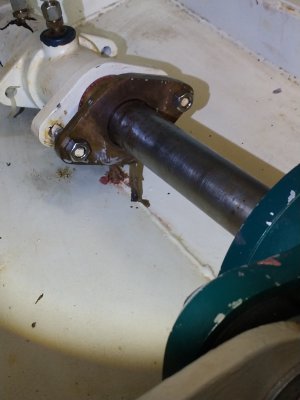
On our new to us River Cruiser the Prop Shaft runs through the stern tube in grease. The seal is what I think is termed a 'Face Seal' (see attached photo).

Our surveyor identified that the seal was leaking grease & the seller employed a mechanic to replace the seal. I'm told the new seal consists of 4 layers of rope & the Face Plates need tightening as the seal beds in.

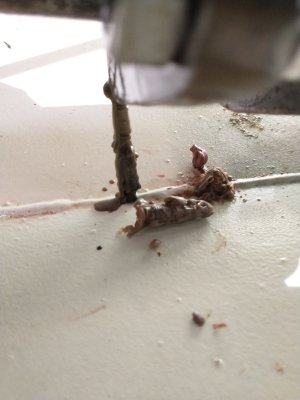
After 4 hours running there was a dribble of grease under the seal ( see attached photo), but no water penetration. I tightened the seal about 1/2 turn on the nuts & after 3 hours there's a similar dribble of grease.

I'm unsure how much to tighten the nuts- any advice appreciated!
 

Attachments

  • IMG_20250510_095838444.jpeg
    IMG_20250510_095838444.jpeg
    776.9 KB · Views: 13
  • IMG_20250510_100952424.jpeg
    IMG_20250510_100952424.jpeg
    1.4 MB · Views: 13
That's not a 'Face Seal', which relates to a wholly different mechanism.
Yours is a traditional Stuffing Box, or gland, seal which is usually reliable.

If the old packing material is replaced properly with new - which is not a complex if sometimes awkward job - then there should be no significant leakage of grease or water. Once correctly and progressively tightened, there should be an occasional drip of 3-4 drops of water/minute when running under engine.

You're unlikely to do any harm. Check for 'warm vs 'hot' stern gland when running. If hot, back off a half turn both sides.

I'd try tightening another 1/2 turn, then another. If that doesn't stop the grease leakage, perhaps the system needs opening up and the packing material replaced - this time, done properly. And check that both bolts are actually firmly fixed in their respective female holes. If one is loose, grease leakage is the result.
 
Last edited:
Rotate the shaft by hand in each direction. I assume that there will be little resistance at present as indicated by the grease leak. Check that the yoke plate is parallel with the body flange, if not tighten the nut to rectify it. Check that rotation is easy. Gradually tighten the nuts about half a turn at a time until the resistance to turning the shaft increases. Now run the engine in gear, checking that the temperature of the gland does not increase significantly. a little warmth is OK but never so that you cannot hold it comfortably.

Ideally there will be a few water drips as zoidberg says, but this is not essential. Check occasionally when motoring. If there are water leaks tighten each nut gradually.
 
Top