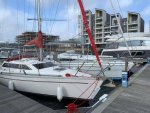
Tie down your boats, folks!

I went to the boat, still afloat, yesterday to double a couple of lines, though it is in a reasonably sheltered corner. My wife tells me that I should have left the wind instruments on to record the maximum, and I rather wish I had.
 
I went to the boat, still afloat, yesterday to double a couple of lines, though it is in a reasonably sheltered corner. My wife tells me that I should have left the wind instruments on to record the maximum, and I rather wish I had.
If the wind instrument is still attached to the masthead then you missed the worst of the storm :)
 
Here's what it's been like in Brighton Marina, 14.30 now & the bugger's still blowing strong. Wind's got under my pontoon finger, it's now missing 4 or 5 planks & seen a couple of shredded sails and a canvas canopy destroyed...:(
Good boat you’ve got there ?

Why the builders couldn’t have arranged things bows- on to the prevailing weather I never had a convincing response to ! Would have been cheaper on pontoons too?
 
Living on board so at least we are here if anything starts to flap around. Can keep an eye on neighbouring boats too.....all good thus far.
There was a big storm coming through a few years back, so I thought I'd spend the night on board. Given the proximity of other boats and the time it takes to start a VP2003 midwinter - only a minute, but too long when your boats making an escape bid, I decided to sit it out on the club pontoon, thinking the same as you.

When it all hit the fan around 3AM, I double-checked my lines and lookup the pontoon. Nope. My chances of becoming a statistic were far too high if I ventured down a pontoon that was going up and down more than a foot and rolling through angles pontoons aren't supposed to do. I stayed aboard. The other boats survived without me, though a few left on their moorings headed for Portchester.
 
someone checked on mine during the worst today, looked untouched. i did go down yesterday morning to double some lines and tie the genoa and sprayhood

pic they took-

Chatham Marina


274290485_10226004927088310_4527493922438137445_n.jpg
 
I'd say that here (near enough, Romsey, Hants) it's been the worst since 1987, or very close to it. Very little rain, so, oddly, at times it's been quite bright. Lots of power cuts local to us. FIngers still crossed on that one. I felt that by, yesterday, going through the task of getting out the generator from the strongroom *in the garden, loading it onto it's trolly, firing it up and getting out the special lead, all ready to plug it in, might be the best way of assuring the power stayed on.

* So much thieving here from garages and sheds (ignored by the filth of course) I got a 2-3mm steel shed made c 30 years ago with no windows and a difficult lock, in which all my expensive gardening stuff is kept.
 
I'm lucky enough to have a commanding view of many swinging moorings in portsmouth harbour.
I did not see any sunken boats or any break free from their moorings today. That's always a good thing.
Two boats had headsails unwrap even though the sheets were wound around the sail a few times. I think that happens when the headsail is not furled tight enough ?
Within an hour of the sails flogging both boats were dismasted.
 
Two boats had headsails unwrap even though the sheets were wound around the sail a few times. I think that happens when the headsail is not furled tight enough ?
Within an hour of the sails flogging both boats were dismasted.

I think it's what can happen if you depend solely on the sheets and the furling line to keep it in place. Wrapping the headsails few times, and furling the sail tight, might well make you 'luckier', but doesn't really address the fundamental issue, in my view.

I always tie a separate piece of strong cordage around the sail when leaving the boat, taking it through the clew eye to avoid the risk of it gradually sliding down due to vibration.
 
I think it's what can happen if you depend solely on the sheets and the furling line to keep it in place. Wrapping the headsails few times, and furling the sail tight, might well make you 'luckier', but doesn't really address the fundamental issue, in my view.

I always tie a separate piece of strong cordage around the sail when leaving the boat, taking it through the clew eye to avoid the risk of it gradually sliding down due to vibration.
In winter never leave the sails on, in or out of the water.
 
I'd say that here (near enough, Romsey, Hants) it's been the worst since 1987, or very close to it. Very little rain, so, oddly, at times it's been quite bright. Lots of power cuts local to us. FIngers still crossed on that one. I felt that by, yesterday, going through the task of getting out the generator from the strongroom *in the garden, loading it onto it's trolly, firing it up and getting out the special lead, all ready to plug it in, might be the best way of assuring the power stayed on.

* So much thieving here from garages and sheds (ignored by the filth of course) I got a 2-3mm steel shed made c 30 years ago with no windows and a difficult lock, in which all my expensive gardening stuff is kept.
If you do this, please disconnect your house from the mains. You don’t want to electrocute the lines man fixing your supply
 
I think it's what can happen if you depend solely on the sheets and the furling line to keep it in place. Wrapping the headsails few times, and furling the sail tight, might well make you 'luckier', but doesn't really address the fundamental issue, in my view.

I always tie a separate piece of strong cordage around the sail when leaving the boat, taking it through the clew eye to avoid the risk of it gradually sliding down due to vibration.
I don't regard that as sufficient. I have seen boats with tightly-coiled jibs and the leach torn and flapping in the wind. These will probably be old sails with decayed stitching, but as I have said elsewhere I wrap the spinnaker halyard round the sail in a spiral as many times as possible, in the opposite direction to the sail furl, leaving no stretch unprotected.
 
I don't regard that as sufficient. I have seen boats with tightly-coiled jibs and the leach torn and flapping in the wind. These will probably be old sails with decayed stitching, but as I have said elsewhere I wrap the spinnaker halyard round the sail in a spiral as many times as possible, in the opposite direction to the sail furl, leaving no stretch unprotected.

Indeed, thinking about it further we rescued a neighbouring jib (twice, in very high winds) when it began to 'balloon' in mid-section, the regions above and above and below being still quite tight, and I suspect that is not uncommonly the way the damage begins, where the furl is inevitably less tight.
 
Top