Tidal current gribs covering the Solent?

TopBanana

Well-Known Member
Joined
14 Aug 2017
Messages
152
Location
Poole, Dorset
Visit site
I've been playing with qtVlm for weather routing. It seems to work pretty well, but given most of my sailing is around the solent, tidal streams are a huge factor. The weather providers don't include this data in their gribs. Is there a good source for this? I've seen a couple of source for ocean streams, but I imagine the inshore waters to be far more complex than these models could allow for.

Many thanks
 
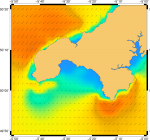
The grib files for tides/currents are available and cover the whole English Channel. They are 18.9MBytes for a set of hourly gribs over a few days. They might be detailed enough in the Solent - I haven't looked yet as I very rarely go there. But I attach an output for Land's end which you can look at and try to judge whether the resolution is sufficient for your purposes.

The data needs quite a lot of processing to make useful pictures however, so I will get around to it for the Solent if someone PMs me and asks for it. zygrib can render them, but it's not pretty!

I'd be grateful for any feedback on is whether a tidal atlas containing this sort of image (rather than the traditional monochrome one with curved arrows) would be useful. The graphics would be one per hour around HW (so 13 graphics) and with a scale for Brest Coefficient = 100 so you'd have to scale for the actual tidal range on any given day.

tmp.png
 
I know I'm not answering your question for qtVlm (because I've not played with that for a while) but the Sailgrib WR Android app could be worth looking at.

It includes downloads for various tidal regions, one of which is the Solent. The weather routing is nicely tunable as well, including options for motoring if sailing speed drops below a user defined speed and reduced speed at night.

There's a free (limited routing to a few days ahead) version as well as the full paid for version.
 
Thanks jdc. Where did you source that grib?

Cheers Martin, looks quite neat and reasonably priced. How do you go about transferring the route to your chartplotter?
 
Just checked the Sailgrib WR app and it seems to get the tides data from Mercator_Ocean.

It looks like Tidetech also use Mercator from MyOcean..

Tidetech website shows the detail available in the solent here
 
Just checked the Sailgrib WR app and it seems to get the tides data from Mercator_Ocean.

It looks like Tidetech also use Mercator from MyOcean..

Tidetech website shows the detail available in the solent here

Looks like extrapolation from very little data.
The flows around Cowes and Portsmouth don't look right, especially around the turns.
 
Thanks jdc. Where did you source that grib?

I git it from http://grib.weather4d.com/Ocean/ and the file for the channel is called Manche.grb.gz

This gets a grib which zygrib can render, but I process it more doing:
Code:
grib_copy -w dataDate=20180128 Manche.grb tmp.grb
grib_copy -w dataTime=1930 tmp.grb tmp1.grb
# which selects the data and time I want to look at
Code:
grib_to_netcdf -D NC_FLOAT -o mygribdata.nc tmp1.grb
# which converts it from grib to a netcdf file, which is then compatible with all the rest of the data I have, such as coastlines and bathymetry
Code:
grdmath mygribdata.nc?p3049 DUP 10 LT MUL 1.94 MUL = xvec.nc
grdmath mygribdata.nc?p3050 DUP 10 LT MUL 1.94 MUL = yvec.nc
# which converts the velocity from m/s to knots as well as filtering out rogue values
Code:
grdsample speed.nc -Gresampled.nc -I0.1m
#which interpolates so the blockky nature of the grib isn't seen (does what 'smooth colours' does in zygrib)
Code:
grdimage resampled.nc -JM18c -R-5.85/-4.983/49.817/50.35 -CCA_colours_stream.cpt -P -K > tmp.ps
#renders it as a PostScript file for the bounding box minlong/maxlong/minlat/maxlat = -5.85/-4.983/49.817/50.35
Code:
grdvector xvec.nc yvec.nc -JM18c -R -Q0.033i+e+jc -Si1.2c -W -P -O -K >> tmp.ps
#adds arrows scaled to the magnitude of the stream velocity

And then I can add anything I like, such as coastline data from 'pscoast' in the image I attached beforehand.

The data has to be looked at carefully: there are rogue values, and in some places it's missing and/or going over a bit of the land. It's exactly what you'd expect for a grib! It's also plotted every hour, and is not aligned to local HW so if one wants to make it human readable one has to do some averaging and re-sampling in time as well as 2-D space.
 
Last edited:
Top