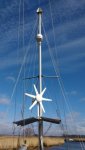
Thumbs up for ketches

In the old days, I suspect people would have tutted that 2 masts were not enough for a 70m boat?
What's right for 70metres is weak justification for 35 feet.
What does that mean? You think it should have more masts? Its ok at 70m but smaller its no good? Where is your threshold between sizes? 50m? 45ft? Your post says nothing but it appears that sombody is prepared to spend many millions building
a superb ketch but you think its wrong. Maybe slightly prejudice?
 
What does that mean? You think it should have more masts? Its ok at 70m but smaller its no good? Where is your threshold between sizes? 50m? 45ft? Your post says nothing but it appears that sombody is prepared to spend many millions building
a superb ketch but you think its wrong. Maybe slightly prejudice?

No, I think it's very nice, but not very relevant to boats of more modest size. A lot of people like ketches because they offer smaller sails than a cutter, as people seek to reduce reliance on the kind of mechanical aids that superyachts are completely committed to.
In superyacht size, a sloop mast is an engineering challenge. In our league engineering is not a problem, but air draught might be for some people.
 
No, I think it's very nice, but not very relevant to boats of more modest size. A lot of people like ketches because they offer smaller sails than a cutter, as people seek to reduce reliance on the kind of mechanical aids that superyachts are completely committed to.
In superyacht size, a sloop mast is an engineering challenge. In our league engineering is not a problem, but air draught might be for some people.
So in your opinion, what is the smallest size ketch that is acceptable? The high tech 75 footer that my friend skippers? The Ocean 71 that another friend sails with his wife around the Caribbean? The Amel 53s that you see dozens off out here mainly sailed by husband and wife? My diminutive 44ft Van de Stadt? If they are ok at 70m, what size isnt ok?
 
Small ketches are OK. Motor-sailors are OK. If people want these boats, that's great.
Other people even enjoy owning and boating entirely under motor.
Personally, I enjoy a boat that will sail well closehauled. I've yet to see a ketch that excels upwind.
I don't have a great affinity for the 'we'll motor if the wind's not fair on the beam' mindset, which seems to be too common among ketch-owners and increasingly also with AWB 'drivers'.
 
I don't have a great affinity for the 'we'll motor if the wind's not fair on the beam' mindset, which seems to be too common among ketch-owners and increasingly also with AWB 'drivers'.

Ohh thats fighting talk :D
I Choose a ketch due to the sail plans that can be adopted to the conditions and the smaller sails to manage , as crewing double handed only, and going for a trip around the world in the near future.
So though long and hard and did much research and came up with the Ketch Rig to suit what was best for us.
I dont think there is a perfect sail plan as every set up will be how you want to sail, were you want to sail, and how fast you like to sail and how those sails handle with limited crew.

But I Love my Ketch:D
 
Ohh thats fighting talk :D
I Choose a ketch due to the sail plans that can be adopted to the conditions and the smaller sails to manage , as crewing double handed only, and going for a trip around the world in the near future.
So though long and hard and did much research and came up with the Ketch Rig to suit what was best for us.
I dont think there is a perfect sail plan as every set up will be how you want to sail, were you want to sail, and how fast you like to sail and how those sails handle with limited crew.

But I Love my Ketch:D
Ditto. I would agree totally but we did add a second inner forestay two feet back from the main forestay that flies our working jib. The advantage this sail gives us in winds above 20kts going hard on the wind IMHO certainly offsets the drag of the mizzen mast. A similar sloop with a reefed overlapping genoa in the same conditions does not out perform us upwind. Modern similar sized cruising production boat we have sailed in company with in these conditions simply dont perform especially with a decent sized sea. We are fortunate that we have a tall mast for a ketch and large sail area with a deep lead fin.
 
Ditto. I would agree totally but we did add a second inner forestay two feet back from the main forestay that flies our working jib. The advantage this sail gives us in winds above 20kts going hard on the wind IMHO certainly offsets the drag of the mizzen mast. A similar sloop with a reefed overlapping genoa in the same conditions does not out perform us upwind. Modern similar sized cruising production boat we have sailed in company with in these conditions simply dont perform especially with a decent sized sea. We are fortunate that we have a tall mast for a ketch and large sail area with a deep lead fin.

May I ask do you have your inner forestay on a furling system or do you clip it on (hanked)
And if hanked do you find this better or you would want to add a furling system
I have an inner hanked on but sometimes find if a pain to go forward
 
May I ask do you have your inner forestay on a furling system or do you clip it on (hanked)
And if hanked do you find this better or you would want to add a furling system
I have an inner hanked on but sometimes find if a pain to go forward
Our inner forestay is a furler. Our large genoa is 700sqft. The working jib is 285sqft. We find going to windward that we rarely reef the genoa but instead furl it and go straight to the working jib on the second furler once we have circa 20kts over the deck. The genoa gets an easier life not being reefed and the jib sets and pulls better than a reefed genoa of greater area. I think if we had a hanked on jib we certainly wouldnt use it so often
 
Our inner forestay is a furler. Our large genoa is 700sqft. The working jib is 285sqft. We find going to windward that we rarely reef the genoa but instead furl it and go straight to the working jib on the second furler once we have circa 20kts over the deck. The genoa gets an easier life not being reefed and the jib sets and pulls better than a reefed genoa of greater area. I think if we had a hanked on jib we certainly wouldnt use it so often

Thanks for the info , me thinks a furling system is in order for my xmas list
 
Hard on the wind in 30/35kts gusting more, up the Windward passage between Cuba and Haiti. Full working jib and two reefs. Tough conditions for any boat. We were a little over powered at times so dropped to three reefs on the main and tried motorsailing. We needed sail area to push our heavy boat through these seas. Our friend who took the photo was on a light 40ft cruiser racer. He dropped his sails completly as he could make little progress under sail and when he motorsailed he leaned over so far he exceeded the maximium angle to operate the engine. Engine only in these conditions looked miserable to us but he said he could see our keel a few times!!
 

Attachments

  • 0833142E-358D-413D-9DBB-C256A31AC268.jpeg
    0833142E-358D-413D-9DBB-C256A31AC268.jpeg
    254.9 KB · Views: 1
Hard on the wind in 30/35kts gusting more, up the Windward passage between Cuba and Haiti. Full working jib and two reefs. Tough conditions for any boat. We were a little over powered at times so dropped to three reefs on the main and tried motorsailing. We needed sail area to push our heavy boat through these seas. Our friend who took the photo was on a light 40ft cruiser racer. He dropped his sails completly as he could make little progress under sail and when he motorsailed he leaned over so far he exceeded the maximium angle to operate the engine. Engine only in these conditions looked miserable to us but he said he could see our keel a few times!!

Ahh an old Trintella, very nice and excellent value! Re the modern 70m ketches you referenced, for the reasons outlined by lwl these will have been worked within entirely different design envelopes.

But why do you keep repeating that posters are knocking ketches? Not a single one has! Almost all say that no boat is great at everything, but most are good/great at something. In this light old vintage ketches may well be great at anchor (why you started this thread), may well have a soft sea motion, and are often nicely fitted out, fair enough. Fast boats will on the other hand be be wetter, lack some cabin space, etc., also fair enough.

The problem seems to be some inner need you have to be faster than anyone else, perhaps explaining why on almost every thread you pop-up on, you end up telling stories of beating off modern cruiser/racers.

If the boat in the pic is indeed a Trintella 44 it has a 44' LOA, 35'LWL, a smallish mainsail of about 37m^2 and a slightly bigger jib. A lovely boat, I'm sure, but boat design hasn't stood still in forty years. Modern race oriented boats will walk away from an older vessel and offwind some will even be planing in the conditions you describe!

They will be less good at other things, of course. Which is back to where we started :rolleyes:
 
Last edited:
One unexpected problem I came across. On a long windless night passage we were motoring with the mizzen sheeted in hard to reduce rolling, I did a long stint on the helm in the small hours and had a constant drizzly rain, I was soaked. I then realised that I was the only one that got wet. The night time mist was condensing on the sail and falling on me. The owner obviously knew about this and cunningly avoided that watch.
 
Ahh an old Trintella, very nice and excellent value! Re the modern 70m ketches you referenced, for the reasons outlined by lwl these will have been worked within entirely different design envelopes.

But why do you keep repeating that posters are knocking ketches? Not a single one has! Almost all say that no boat is great at everything, but most are good/great at something. In this light old vintage ketches may well be great at anchor (why you started this posted), may well have a soft sea motion, and are often nicely fitted out, fair enough. Fast boats will on the other hand be be wetter, lack some cabin space, etc., also fair enough.

The problem seems to be some inner need you have to be faster than anyone else, perhaps explaining why on almost every thread you pop up you end up telling stories of beating off modern cruiser/racers.

If the boat in the pic is indeed a Trintella 44 it has a 44' LOA, 35'LWL, a smallish mainsail of about 37m^2 and a slightly bigger jib. A lovely boat, I'm sure, but boat design hasn't stood still in forty years. Modern race oriented boats will walk away from an older vessel and offwind some will even be planing in the conditions you describe.

They will be less good at other things, of course. Which is back to where we started :rolleyes:

I dont disagree apart from the need to be faster. That only rises as an issue when people suggest that ketches are all slow.
If we were lucky enough to be able to have a new boat designed, there are changes we would make. Off wind planing performance wouldnt be one of them but a longer waterline to reduce pitching and a taller mast would be on the list. We would have a lighter fit out using light weight construction techniques for furniture such that the saved weight would allow us to carry more fuel and stores. The amount of teak in our boat is OTT. We would also reduce the size of the water tankage from 800 litres. With a large watermaker a tank that large is unnecessary for us.
 
I dont disagree apart from the need to be faster. That only rises as an issue when people suggest that ketches are all slow.
If we were lucky enough to be able to have a new boat designed, there are changes we would make. Off wind planing performance wouldnt be one of them but a longer waterline to reduce pitching and a taller mast would be on the list. We would have a lighter fit out using light weight construction techniques for furniture such that the saved weight would allow us to carry more fuel and stores. The amount of teak in our boat is OTT. We would also reduce the size of the water tankage from 800 litres. With a large watermaker a tank that large is unnecessary for us.

A longer waterline and a taller mast should always be on everyone's wish list.
But taller mast singular?
Your photo of your boat going really nicely upwind shows that when push comes to shove, the mizzen is usually best handed first. Whereas armchair literature tends to blather on about dropping the main and sailing on jib and mizzen.
If you want good upwind performance in strong breeze, a deep heavy lead keel and a cutter rig is a good starting point. The spare mast at the back isn't so significant.
FlyingGoose makes some fair comment relating to a small crew being able to handle more rig in ketch form than they could as a sloop, for a given level of reliance on aids like furlers. That makes a lot of difference to some people and I don't seek to knock that. I'd rather be sailing a ketch than motoring a sloop because I don't have the muscle on board to deal with the sails. Same as I'd rather use a roller reefing in mast main, than not use a fully battened mylar monster.
 
A longer waterline and a taller mast should always be on everyone's wish list.
But taller mast singular?
Your photo of your boat going really nicely upwind shows that when push comes to shove, the mizzen is usually best handed first. Whereas armchair literature tends to blather on about dropping the main and sailing on jib and mizzen.
If you want good upwind performance in strong breeze, a deep heavy lead keel and a cutter rig is a good starting point. The spare mast at the back isn't so significant.
FlyingGoose makes some fair comment relating to a small crew being able to handle more rig in ketch form than they could as a sloop, for a given level of reliance on aids like furlers. That makes a lot of difference to some people and I don't seek to knock that. I'd rather be sailing a ketch than motoring a sloop because I don't have the muscle on board to deal with the sails. Same as I'd rather use a roller reefing in mast main, than not use a fully battened mylar monster.

Agreed. For us, we use the working jib and mizzen combination in strong conditions only off the wind. I dont find the mizzen helps appreciably when closer than 50deg to the apparent wind.
We have a fully battened roachy mizzen larger than the original sail plan by virtue of the additional roach. The main is fully battened and both sails are fully equipped with cars. We found the intermediate sliders between battencars created friction so replaced with an all car system. The improvement over sail handling was a vast improvement for us. Our jib/genoa set up is I think called a Solent rig. We maintain the performance advantage with fully battened sails when reefed which I feel gives us the far more punch to windward as seen in the photo. Combined with the full working jib we can powerfully deal with large seas and still make progress. The disadvantage/advantage with the heavy boat is she will power through seas using here momentum but if she gets stopped it takes an age to build up speed again if you are still slamming in to seas. We often need to crack off a little to build up speed again. The weight does however make the motion bearable.
 
Top