Lomax
Well-Known Member
To meet safety standards (accessibility), and for convenience, I need to mount the main battery cut-off switch through the bulkhead separating the engine room (where the battery bank will be situated) from the cabin, so it can be reached without having to crawl into the engine bay. I've found the Durite 0-605-50 through-hole switch:
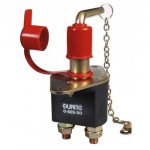
This is perfect in every way apart from only having a 250A continuous rating (2500A for 5 seconds). My spreadsheet of consumers tells me I will have a maximum draw of just under 400A, if every single consumer is on at full power. That is I would need to be flushing the loo while hauling anchor, having a shower, playing music at full volume and drawing 2.2kW from the inverter, with all lights and nav gear on, and the three bilge pumps, refrigerator and Webasto running. While I cannot see this ever happening, it would be relatively easy to hit 300A by maxing out the inverter while using some other high-power equipment - but only for a few minutes perhaps. Now I know there are isolator switches with higher ratings, such as the Durite 0-605-55:
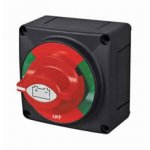
This is rated at 550A for 1 hour and 2500A for 5 seconds, but it is a surface mounted switch and thus would necessitate running the 70mm2 positive lead through the bulkhead and back, which would be awkward, ugly and ineficcient. By contrast a through-hole switch could be mounted so the terminals are right next to the batteries and the main fuse. And the ratings are confusing; Durite say the 0-605-50 can handle 250A indefinitely and 2500A for five seconds, while the 0-605-55 has a time limit of one hour on its 550A rating, with the same 2500A/5s intermittent rating. Now I imagine that any two switches which can handle 2500A for five seconds ought to have similar continuous ratings, and I'm wondering if perhaps the 0-605-50 might actually be good for ~400A/1h, and that therefore the through-hole switch would be adequate for my system. Does this seem like a reasonable assumption, and if not, can anyone suggest another through-hole cut-off switch that can handle higher currents?
This is perfect in every way apart from only having a 250A continuous rating (2500A for 5 seconds). My spreadsheet of consumers tells me I will have a maximum draw of just under 400A, if every single consumer is on at full power. That is I would need to be flushing the loo while hauling anchor, having a shower, playing music at full volume and drawing 2.2kW from the inverter, with all lights and nav gear on, and the three bilge pumps, refrigerator and Webasto running. While I cannot see this ever happening, it would be relatively easy to hit 300A by maxing out the inverter while using some other high-power equipment - but only for a few minutes perhaps. Now I know there are isolator switches with higher ratings, such as the Durite 0-605-55:
This is rated at 550A for 1 hour and 2500A for 5 seconds, but it is a surface mounted switch and thus would necessitate running the 70mm2 positive lead through the bulkhead and back, which would be awkward, ugly and ineficcient. By contrast a through-hole switch could be mounted so the terminals are right next to the batteries and the main fuse. And the ratings are confusing; Durite say the 0-605-50 can handle 250A indefinitely and 2500A for five seconds, while the 0-605-55 has a time limit of one hour on its 550A rating, with the same 2500A/5s intermittent rating. Now I imagine that any two switches which can handle 2500A for five seconds ought to have similar continuous ratings, and I'm wondering if perhaps the 0-605-50 might actually be good for ~400A/1h, and that therefore the through-hole switch would be adequate for my system. Does this seem like a reasonable assumption, and if not, can anyone suggest another through-hole cut-off switch that can handle higher currents?
Last edited: