Thread lock on mooring shackles

Rhylsailer99

Well-Known Member
Joined
19 Jun 2020
Messages
776
Visit site
I'm replacing my riser chain with 12mm rated chain and have bought good quality rated shackles from Jimmy green. Should I use thread lock as an extra security underwater as well as the Monel wire. I don't intend to undo the shackles once In place. I just won't to check that no strange reactions might take place. Chain and shackles are all galvanised.
 
A common failure mode for shackles on moorings is for the threads to corrode away. The pin is then only held in place by the wire. We always coat the threads of the pin with mastic (or Threadlock) to keep water away from the threads.
 
I agree. The OP might not intend to ever undo the shackle again, but I don’t think one can ever be that certain.
Mike
I think if I had to undo one I would just hacksaw it and replace. Ater hearing the boat next to mine broke free it's made me a bit paranoid hence why I'm replacing all my chains,shackles and swivels with Jimmy green rated ones with rated quality chain.
 
Club near me has experimented and recommends Araldite (or similar) on threads to seal & protect against corrosion. I have used this for last few years, and agree. Can be disassembled by a good hammer blow, and threads are prefect. Plus Monel, of course.
 
Having had mooring shackles rust away in the threads and drop out I always use stainless now. When nicely tight I pein over the thread end with a lump hammer and use Silkaflex or the like as a thread seal.
 
Having had mooring shackles rust away in the threads and drop out I always use stainless now. When nicely tight I pein over the thread end with a lump hammer and use Silkaflex or the like as a thread seal.
I used to also think stainless was the best but after a lot of Google I came to the conclusion stainless is a bad choice under water. Correct me if I am wrong but everywhere I read galvanised is the best choice.
 
  • Like
Reactions: t21
It's certainly true that good galvanised shackles offer much the best performance underwater. However, every harbour mooring authority can show examples of deeply-corroded shackle pins. How come?

One plausible explanation is our habit of racking the screw-pin up as tight as a large wrench can make it. This causes, in the sharp points of contact of the 'male/female' threads, micro-damage to the galvanising coating - which is where the corrosion starts and then develops.
I'm advised there is no need to over-tighten the screwpins PROVIDED there is adequate wire-locking to prevent the screw-pin rotating loose.
'Locktite' thread-locker compound, or similar, also has a useful role.
 
That isn't at all plausible; it's just not how galvanising works, it protects the underlying steel by being an anode, small breaches of the coating have little or no effect.
 
That isn't at all plausible; it's just not how galvanising works, it protects the underlying steel by being an anode, small breaches of the coating have little or no effect.
Indeed, but the galvanising on a shiny shackle or little bit of mooring wire is trying to protect several metres of rusting chain.
If the pin is not tight, it will fret in the body of the shackle.

People in the trade seem to use big plain steel shackles and weld the pin in.
 
I'm replacing my riser chain with 12mm rated chain and have bought good quality rated shackles from Jimmy green. Should I use thread lock as an extra security underwater as well as the Monel wire. I don't intend to undo the shackles once In place. I just won't to check that no strange reactions might take place. Chain and shackles are all galvanised.

Background from the other side of the world.

I think our moorings are to a different design to yours

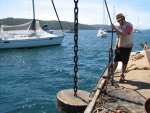
Ours are large concrete blocks (this is a 1t block, we use 1.5t blocks for our cat) with large chain recycled from the mining industry - as shown in the photo. The large recylcled chain is then attached to a sweep chain of about 20cm, wire, size. The sweep chain is then attached to rope, in the mans hand, at the top of which is a small buoy.

40wandeen yachts mooring screen 027.JPG

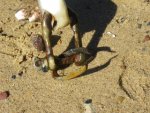
The mooring pennant is attached to the 20mm sweep chain with a shackle. There is also a swivel, but I forget where it is in the sequence.


IMGP1634.jpeg

The sweep chain, mining chain and shackle sit on the seabed and are dragged round, on the seabed, by tide and wind.

The pennant floats, along with the marker buoy.

None of the components are galvanised, complete waste of time - it wears too quickly. If the mooring is not serviced the shackles - it sees the most wear, lasts 2-3 years In this case the chain has worn before the shackle - but its a close run thing. Galvanising would last a few weeks, maybe 4 and effectively offers no, or minimal, protection (I have the pictures - but not handy). Failure is from the tension in the mooring, the yacht, and the sand. The end of the shackle pin is polished but hardly worn. I'd worry about relying on Monel wire it would abrade quite quickly because it is thin (unless beefy).

The seabed is silica sand.

The shackle pins are welded in place.

Freeing a decent red Loctite is hardly difficult - a blow torch (as you use to make creme broulee is sufficient) and is surely part of every well endowed galley. Red Loctite I have tested set off underwater, easy to test whichever you have. Apply to small nut and bolt, leave in salt water overnight, try to disengage.

Hope this helps.

Jonathan
 
Have the mods put a lock on this thread?

Seems very unreasonable.
It is clearly a thoroughly relevant boaty subject politely dealt with by all concerned.
 
I have read many times that 'black iron' shackles offer optimum corrosion resistance underwater. Despite several searches I have been unable to find what this material is or if anyone supplies it. The 'black' description suggests wrought but I doubt if anyone makes these today.
 
Background from the other side of the world.

I think our moorings are to a different design to yours

Ours are large concrete blocks (this is a 1t block, we use 1.5t blocks for our cat) with large chain recycled from the mining industry - as shown in the photo. The large recylcled chain is then attached to a sweep chain of about 20cm, wire, size. The sweep chain is then attached to rope, in the mans hand, at the top of which is a small buoy.

View attachment 125178

The mooring pennant is attached to the 20mm sweep chain with a shackle. There is also a swivel, but I forget where it is in the sequence.


View attachment 125181

The sweep chain, mining chain and shackle sit on the seabed and are dragged round, on the seabed, by tide and wind.

The pennant floats, along with the marker buoy.

None of the components are galvanised, complete waste of time - it wears too quickly. If the mooring is not serviced the shackles - it sees the most wear, lasts 2-3 years In this case the chain has worn before the shackle - but its a close run thing. Galvanising would last a few weeks, maybe 4 and effectively offers no, or minimal, protection (I have the pictures - but not handy). Failure is from the tension in the mooring, the yacht, and the sand. The end of the shackle pin is polished but hardly worn. I'd worry about relying on Monel wire it would abrade quite quickly because it is thin (unless beefy).

The seabed is silica sand.

The shackle pins are welded in place.

Freeing a decent red Loctite is hardly difficult - a blow torch (as you use to make creme broulee is sufficient) and is surely part of every well endowed galley. Red Loctite I have tested set off underwater, easy to test whichever you have. Apply to small nut and bolt, leave in salt water overnight, try to disengage.

Hope this helps.

Jonathan
Quite similar to Menai Strait practice except that concrete blocks move in the strong tides of the strait. A pair of 50 kg admiralty type anchors is joined by a 1 inch, 25 mm, ground chain, mostly recycled from Manchester Ship Canal lock gates. These are laid up and down tide. A swivel is attached to a link in the centre of the ground chain with a 3/4 inch, 20 mm, riser to the buoy.

There were no shackles at all, all joints being welded rebar 'paperclips'.
 
Most of my customers expect galvanised shackles. However, when I recover the moorings at the end of this month there will be little evidence of galvanising, I can supply uncoated for less & they last just as long.
I would not use locktight as the threads degrade & the locktight would no longer work. What we use is Stockholm Tar ( used for horses hooves so obtainable from Tack shops) This protects the thread & it can be undone at a later date. We have found wire seizing to fail & generally a decent cable tie will last 3 years perfectly OK on submerged parts of a mooring. They have to be applied in a certain way. Above the water ( buoy mooring pennant etc) the UV attacks them but as they can be easily replaced annually it is not a problem.
From comments & discussions that i have had with others it is clear that different areas require different solutions. So what works for us, does not necessarily work elsewhere. Therefore, if one wants to set up a mooring in a particular area one needs to research what others use. Generally the harbour master is a mine of information & most are willing to help.
 
Last edited:
That isn't at all plausible; it's just not how galvanising works, it protects the underlying steel by being an anode, small breaches of the coating have little or no effect.
Disagree.

There's a considerable volume of eng-technical material directly related to this and closely-related topics. Google Scholar, for example, offers several dozen references; here's just one of many.... Influence of Corrosion on Fatigue of the Fastening Bolts

Bolts/threaded fasteners are manufactured with a designed 'Preload' range. Over-tightening of most - including hot-dip galvanised items - can create thread-root incipient fatigue cracks, both in the anti-corrosion coating and in the body. Corrosion at the micro level is initiated. This is accelerated in corrosive environments - such as salt water.

It is appropriate to tighten threaded fasteners ( bolts/nuts ) sufficiently to avoid 'backing off' under cyclic loading and/or vibration. It also appropriate to avoid over-tightening, for that adds nothing to the strength of a shackle-and-pin assembly, and introduces conditions for early fatigue cracking and corrosion propagation.

The practice of some 'mooring contractors' of applying all the leverage-torque they can muster simply leads to earlier corrosion and failure.
 
Top