
This exhaust elbow is a goner...right?

RJJ

Well-Known Member
Joined
14 Aug 2009
Messages
3,159
Visit site
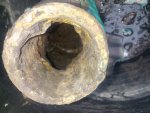
Hi again. This looks to be on its way to scrap...right?

Photo is looking into the exhaust pipe end, towards the engine. You can see the water inlet from heat exchanger on the right-hand-side.

Any tips on fabricators for a replacement costing <£450? Engine is Penta D2 55, based in Hamble. Thanks folks.
 

Attachments

  • IMG_20200215_111727478.jpg
    IMG_20200215_111727478.jpg
    410.7 KB · Views: 240
Hi again. This looks to be on its way to scrap...right?

Photo is looking into the exhaust pipe end, towards the engine. You can see the water inlet from heat exchanger on the right-hand-side.

Any tips on fabricators for a replacement costing <£450? Engine is Penta D2 55, based in Hamble. Thanks folks.
Or do as I did, buy something like this, use a 45 deg threaded elbow and make a flange. I wrote it up for PBO
 
You could try attacking the scale with a hammer and small cold chisel - I expect that would solve the problem one way or another! I have found exhaust elbows made up from black iron pipe fittings, as suggested by Bene 381 above, to be effective on my Bukh
 
I'd have thought it was worth having a go at cleaning it up a bit. If you wreck it, replace it. But if it cleans up, refit it. Frankly, I'm always a bit surprised by the tales of woe on here about exhaust elbows. My old boat had a Volvo Penta 2003T engine, which was 24 years old when I sold the boat, and the original exhaust elbow had never been touched. I used to run the engine fairly hard though, so maybe that blasted everything out!
 
You could try soaking it in sulphuric or hydrocloric acid, keeping children and dogs as far aways as possible. The deposit is primarily calcium, carbonate, impregnated with carbon. The carbon is inert the calcium will dissolve. Its messy. If the elbow has corroded the acid will attack the corrosion. We have found you can reclaim an elbow, usually, once - though sometimes there is a flaw in the casting and it simply attacks the flaw (as well as the calcium). Acid is cheap, new elbows expensive - its worth a try. We have used fully concentrated acid (so be very careful, wear heavy duty rubber gloves) and leave the elbow to soak over night. After it has soaked lift out with a stick and drop into a bucket of fish water, then rinse again.

Before you start - you need to think of how to dispose of the 'spent' acid. Its pretty nasty - not to go down the drain!

Jonathan
 
Highly unwise to use sulphuric or hydrochloric acid I'd have thought, especially if concentrated, they'll eat the metal as quick as they eat the calcium.
If you're going to use acid use dirt cheap pickling vinegar or kettle cleaner which cannot eat the metal. It'll work just the same, but slower.
 
On my last 2 engines, both required new exhaust manifolds, which could be why they were cheap. I removed them and took each one to a welder/fabricator by the Caley canal who fabricated the replacements out of stainless. The problem has ended. They were both below £100 each as well, albeit they're basic pieces of kit, without thermostats and just the cooling outlet from the engine running through them in the standard way.
 
Hydrochloric acid of the typical strength sold for domestic use all over Europe is around 7% w/w, although the bottle may say 20%, which is the dilution rate from conc acid, HCl dissolved in water. The same strength is sold as brick cleaner in many outlets in UK. This will not have the slightest effect on the steel/iron of the elbow but will remove carbonate deposits and rust. Try that first, then tap all over with a small hammer to assess strength. If that treatment does not knock holes in the elbow you should be good for another two years.
 
Can you tell us how many engine hours to cause this?
would be useful to anticipate when my Volvo might need attention...
 
Removing the exhaust elbow is not difficult and I'd suggest having a look at every 1000 hours. Its only 4 nuts, though some are very inaccessible. Be careful to not damage the asbestos gland. Remove nuts, take off elbow, look - replace. Grease nuts before you replace - it will be easier next time.

How long the exhaust elbow takes to become blocked is a moveable feast and will depend on how you run your engine and the amount of dissolved calcium there is in your local seawater. Dissolved calcium varies around the world, it is so high in some areas (I think the Gulf of Mexico is one) that it precipitates out 'naturally' and falls 'like snow'. However this is anecdotal.

I mention 'how you run you're engine' but I don't know the way one should run your engine to keep the blockage rate low - someone will know infinitely better than me - hopefully they will comment.

When ours have blocked, after about 3,000 hours, the blockage has been black, from the unburnt carbon, and the blockage is often described as carbon. This is wrong - its calcium (pigmented with carbon). The amount of carbon may increase as the blockage develops. If it were carbon - it would not dissolve in acid. Acid cleaning is decidedly messy but if you are prepared to invest the time - worth while. The elbows are extortionate (its a bog standard, cheap, casting and they make 1,000s of them - the margins seem excessive), money for old rope comes to mind.

I don't understand why having a stainless elbow reduces the amount or rate of blockage. This implies that the cast elbow somehow acts as a catalyst - and if stainless is such a good, deterrent, why on earth don't engine supplier offer a stainless elbow as standard. On the same theme - why is it not in the engine maintenance manual (they mention other consumables - why not the elbow?). Casting the elbow in stainless (in large numbers) seems an option to consider (rather than fabrication of 'one offs'.) There is an opportunity in there.......

We have found you can clean the elbow only once with 'brickies' acid. The elbow also suffers from corrosion (it rusts) and the acid dissolves rust, as you know from removing rust stains on your deck) but does not dissolve iron or steel unless the acid is at 100% concentration (and I don't think you can easily access such a dangerous product). However corrosion is at work and eventually it wins and the elbow develops a leak (sometimes at a fault in the casting (been there, seen that). I have found that if you want to clean the elbow the easiest way is to remove the rubber hose first - its a real devil to get off, its a bit like wrestling with an anaconda, and is much easier when the elbow is still attached. There might be a better way - but my method is brute force, ignorance and a screw driver to free up the seal between hose and elbow and levering it off, twisting and pulling. If there is a better way - i'd love to know.

Jonathan
 
Difficult to give any hours run information as they fail in different ways. The small Yanmar ones mostly seem to fail by thermal fatigue cracking between the flange and tubes, dictated by number of starts. All the Volvo and Bukh failures I have seen were due to corrosion, so probably hours run. No information on number of hours but most seem to be elderly. Anyone with feedback?
 
With the stainless steel ones, could it be that they're usually of much thinner gauge material, that they cool so much quicker which doesn't allow an opportunity for 'build up', or (obviously) corrosion as it's stainless?
 
Removing the exhaust elbow is not difficult and I'd suggest having a look at every 1000 hours. Its only 4 nuts, though some are very inaccessible. Be careful to not damage the asbestos gland. Remove nuts, take off elbow, look - replace. Grease nuts before you replace - it will be easier next time.

How long the exhaust elbow takes to become blocked is a moveable feast and will depend on how you run your engine and the amount of dissolved calcium there is in your local seawater. Dissolved calcium varies around the world, it is so high in some areas (I think the Gulf of Mexico is one) that it precipitates out 'naturally' and falls 'like snow'. However this is anecdotal.

I mention 'how you run you're engine' but I don't know the way one should run your engine to keep the blockage rate low - someone will know infinitely better than me - hopefully they will comment.

When ours have blocked, after about 3,000 hours, the blockage has been black, from the unburnt carbon, and the blockage is often described as carbon. This is wrong - its calcium (pigmented with carbon). The amount of carbon may increase as the blockage develops. If it were carbon - it would not dissolve in acid. Acid cleaning is decidedly messy but if you are prepared to invest the time - worth while. The elbows are extortionate (its a bog standard, cheap, casting and they make 1,000s of them - the margins seem excessive), money for old rope comes to mind.

I don't understand why having a stainless elbow reduces the amount or rate of blockage. This implies that the cast elbow somehow acts as a catalyst - and if stainless is such a good, deterrent, why on earth don't engine supplier offer a stainless elbow as standard. On the same theme - why is it not in the engine maintenance manual (they mention other consumables - why not the elbow?). Casting the elbow in stainless (in large numbers) seems an option to consider (rather than fabrication of 'one offs'.) There is an opportunity in there.......

We have found you can clean the elbow only once with 'brickies' acid. The elbow also suffers from corrosion (it rusts) and the acid dissolves rust, as you know from removing rust stains on your deck) but does not dissolve iron or steel unless the acid is at 100% concentration (and I don't think you can easily access such a dangerous product). However corrosion is at work and eventually it wins and the elbow develops a leak (sometimes at a fault in the casting (been there, seen that). I have found that if you want to clean the elbow the easiest way is to remove the rubber hose first - its a real devil to get off, its a bit like wrestling with an anaconda, and is much easier when the elbow is still attached. There might be a better way - but my method is brute force, ignorance and a screw driver to free up the seal between hose and elbow and levering it off, twisting and pulling. If there is a better way - i'd love to know.

Jonathan
In my experiences the cast iron goes porous and cheese like, The little bolted on spigot on mine just crumbled away so there is more going on with cast than meets the eye! I suspect carbon is being leached from it.
 
With the stainless steel ones, could it be that they're usually of much thinner gauge material, that they cool so much quicker which doesn't allow an opportunity for 'build up', or (obviously) corrosion as it's stainless?
It's the restraint between the thicker flange and thinner tubes that causes stress as the elbow heats and cools. This is known as thermal fatigue. See the fatigue page on my website for a fuller explanation.
 

Other threads that may be of interest

Top