Thinking of converting a ketch into a sloop

outtametree

Well-Known Member
Joined
17 Feb 2012
Messages
98
Location
Hampshire
Visit site
I have 2 Mikado 56 Ketch’s. One is a massive project, the other I’ve been sailing the acrid dean for a couple of years & put around 5-6000 miles under the keel. Got to the point of not bothering with the mizzenmast sail as unless conditions are absolutely perfect, it either overloads the helm or need to drop it & raise the main. So I have the opportunity to lose it on the project, put a longer boom on the main & take the twin back stays further aft. Apart from the “It was designed as a ketch arguments, There are some schooner rigged versions around, is their any reason not to? The practicalities & comfort are currently outweighing anything I can come up with.
 
I'd have assumed the balance would be too far forward with all of the headrig set and no mizzen, but your experience seems to show that this isn't the case for this design.

You'll presumably be down a little sail area. But again, you seem to be happy without it. Adding some of that area to the main will obviously make it heavier to hoist and handle, and put more load on the spars and rigging (both standing and running). Depends how close to the limit any of those loads feel currently.

Losing the mizzen seems like it should be no problem at all given that you rarely set it at the moment. Adding to the main is the real question.

Pete
 
The rig is tough, each stay has a redundancy on the project, the current boat has less shrouds. I’ll also be moving the back stays aft, moving the chainplates to the outside of the hull & adding a permanent staysail to help with balance. The mainmast is set further aft than many modern, fractionally rigged boats. With the main & mizzen booms being very short, 13’ & 10’6” respectively, I understand your point of overloading the spar & rig.
 
In moderate winds many ketches actually sail better without the mizzen, but it is a really handy place to mount radar scanners, aeriels, etc. The only time it really helps is if you can set a mizzen staysail offwind, or use a (possibly) reefed mizzen as a steadying sail at anchor. Ketches look nice, but were primarily designed to reduce main and genoas sizes in the days before powerful sheet winches and roller furlers.
 
Weve converted quite a few boats from Ketch to Sloop.
Oysters mainly but a few others as well.
It makes sense to me especially if you don't use the mizzen much.
The idea of moving the backstays aft also works for me, (Keep in mind also that moving them aft also increases their effectiveness for a given forestay tension, so static rig load on the backstyays will be reduced)
As mentioned it also allows for a longer boom and on that basis I'd go a little furth and opt for a fully battened main with lots of roach area.

I've had a look at a few photos of similar boats and the rig appears to be Twin flat spreaders > Caps > Inters > Fwd lowers > Aft Lowers.
I'd like to see your rig really before committing to any specific advice however,
(especially as I've also seen a single spreader rig)
I'd want to ensure the spreader roots are very well secured and not the older floating bases.
Consider up rating the Aft lowers as thay will be subjected to much more load with a bigger more powerful main.
Also moveable running backstays will be a must if you fit a staysail, (I guess on its own furler) or a set of diamond stays or both.
Running backstays may well be a good idea anyway as the hounds position for the lowers is not very high.
 
More or less my line of thought too. The mast placement & rig size look to lend itself to an easy conversion.
just seeing if there’s anything I’ve not thought of.
 
Thanks Javelin. The rig is twin backs, caps & inters. With fwd & aft lowers. The spreaders are fitted to welded tangs via a horizontal pin (bolt). Running backs are on the list.
The chainplates are the weak point (in my opinion) & will be replaced With new on the outside of the hull & bolted thru to a backplate of a similar size.
The boat we are using now, a sister, has no inter, runners & the chainplates are 12-15” further in board as at has a 125% Genoa & a hank on“Solent” staysail.
 
Last edited:
Chain plates are one of my hobby horses, I'm constanly amazed at how many boats have really poorly designed chain-plate systems.
Either the grade, section and length of stainless is woefully undersize, or what they are bolted to is equaly as weak, badly positioned to take the loads or weakened due to the fitment of the bolts.
Then we get onto through deck plates that WILL leak over time rotting out the very structure they are attached to.
Oysters, Southerly's, Mason, Passport, Nicholson, Moody's, the list goes on and on.

That said, your idea sounds good thoough I'd urge you to go with welded studs and not through bolts as you will get a far better seal.
The seal being there to obviously stop water coming in but more importantly stopping moisture (which is much harder to stop) seeping down the bolt into the joint creating the ideal enviroment for crevis crack corrosion.
This is also not just a 20year plus issue as I've seen crevis crack corrosion on 7 year old chain plates!
 
Chain plates are one of my hobby horses, I'm constanly amazed at how many boats have really poorly designed chain-plate systems.
Either the grade, section and length of stainless is woefully undersize, or what they are bolted to is equaly as weak, badly positioned to take the loads or weakened due to the fitment of the bolts.
Then we get onto through deck plates that WILL leak over time rotting out the very structure they are attached to.
Oysters, Southerly's, Mason, Passport, Nicholson, Moody's, the list goes on and on.

That said, your idea sounds good thoough I'd urge you to go with welded studs and not through bolts as you will get a far better seal.
The seal being there to obviously stop water coming in but more importantly stopping moisture (which is much harder to stop) seeping down the bolt into the joint creating the ideal enviroment for crevis crack corrosion.
This is also not just a 20year plus issue as I've seen crevis crack corrosion on 7 year old chain plates!
Welded studs from outside in? With a nut inside?
The chainplates I’m thinking of is 1metre long. For the caps&inters to share 100x10mm & for the lowers & backstaye 50x10mm. As the current are nasty glassed into the hull, bent at 90 deg, gusseted under the deck & have a U- bolt thru the deck. Anything I do will be an improvement!
 
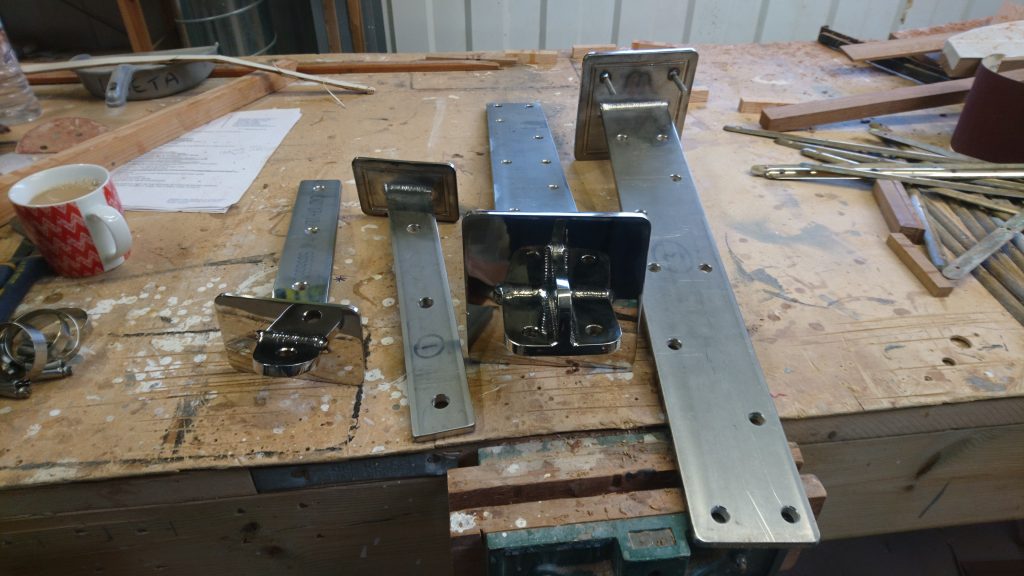
I see you have a Moody so below is a photo of the replacement chainplates I did for a Moody a couple of years back.
Note the welded studs on the welded coverplate and the rebate to form a kind of o-ring seal.
Obviously these studs are not load bearing, they are there just to ensure a good seal on the deck whilst the main chainplate bolts inside take the load.
(didn't need the studs for the lowers chainplates)
The welded studs just eliminate routes for water to get in.
So yes, in your case - Exterior chainplate>studs>through hull>backing plate>nylock nuts.
DSC_0833-1024x576.jpg

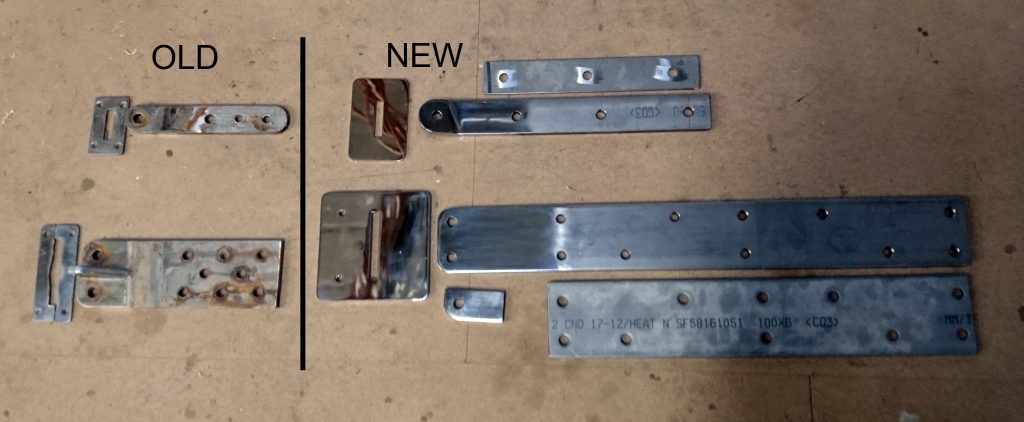
Comparison between original and new before welding, in the Moody case above.
cp004-1024x422.jpg
 
I see you have a Moody so below is a photo of the replacement chainplates I did for a Moody a couple of years back.
Note the welded studs on the welded coverplate and the rebate to form a kind of o-ring seal.
Obviously these studs are not load bearing, they are there just to ensure a good seal on the deck whilst the main chainplate bolts inside take the load.
(didn't need the studs for the lowers chainplates)
The welded studs just eliminate routes for water to get in.
So yes, in your case - Exterior chainplate>studs>through hull>backing plate>nylock nuts.
DSC_0833-1024x576.jpg

Comparison between original and new before welding, in the Moody case above.
cp004-1024x422.jpg
Got it. Thanks for that J.
very much appreciated
 
Top