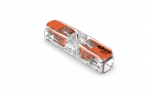
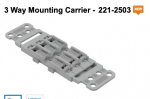
Thin wire connectors

Feed the wire though the deck using one of these: Vertical Cable Seal Power Boat

Make the join inside the boat, in the dry, using Wago connectors. WAGO 221

You can key the connector with some course sandpaper and epoxy it to the deck head.
Another for wago. Get them from screwfix though come in packs, number being dependant of number of connections per block.
 
The benefit of the strip is that you can (sometimes) make a neater job with a single strip having multiple connections and not ending up with a collection of loose Wagos dangling off your cables. So for example in terminating the cable for the MFD a strip is a better way of making the connections (including NMEA)

A screw terminal like that makes a reliable connection with fine wires and are widely used in industrial applications - but I prefer them with a washer beneath the screw. If you prefer it you could crimp a connector on to the end of the wires but I am not convinced that would make for a more secure connection.

Why do you suppose they are designed to be used with ring or fork terminals ? The terminals are securely crimped to the wires, they don't damge the wires like screwing down on bare wires. The tiny little data wires are fragile enough as it is, without crushing them beneath screws, which will turn and chew the wires, even with a washer.

FYI, i don't leave Wago connectors "dangling off my cables". They are securely clipped in place, or, as i suggested to the OP, epoxied to the deckhead. bulkhead or whatever. I actually don't use that many Wagos, i use a variety of connectors, each having their place and each being better suited for particular purposes. I do use the connector strips you linked to, but only with crimped on rings or forks.
 
I haven't come across the Wagos referred to in post #10. I use the 221s quite a bit and they are great if you can tuck them out of the way and/or put them in a junction box but the strips look useful if you want a wire coming in one side and exiting the other and much neater than using multiple connectors
 
Personally I’d use a four-pole SuperSeal plug and socket, so that it can just be unplugged rather than repeatedly dealing with individual wires. Properly assembled (with adhesive heatshrink from the back of the connector onto the outer sheath of the cable) they’re decently waterproof, whether that’s from rain leaking through the deck penetration or condensation accumulating above the headlining.

Pete
 
I haven't come across the Wagos referred to in post #10. I use the 221s quite a bit and they are great if you can tuck them out of the way and/or put them in a junction box but the strips look useful if you want a wire coming in one side and exiting the other and much neater than using multiple connectors

Exactly so. I wrote #10, and have used those Wago blocks to replace choc strip for fine instrument wires in a dry environment; the spring-loaded connectors are demountable and very easy to use where wires are fine, the tails short and access difficult; IIRC they are also nickel-plated. Wago make hundreds of different connectors, so just referring to 'Wagos' is more than a little ambiguous.
 
Exactly so. I wrote #10, and have used those Wago blocks to replace choc strip for fine instrument wires in a dry environment; the spring-loaded connectors are demountable and very easy to use where wires are fine, the tails short and access difficult; IIRC they are also nickel-plated. Wago make hundreds of different connectors, so just referring to 'Wagos' is more than a little ambiguous.
Indeed. They seem to bring out something new every week! The Gel boxes I referred to in post #3 are really good in damp environments like a binnacle, lockers etc if you haven't used these before.
 
When using Wago 221 connectors I terminate all cables with tinned copper bootlace ferrules which makes it tidier and easier to connect/disconnect. Also "daisy chaining" a number of 5-connection Wago 221's and glueing (CT-1) to a wooden batten makes a neat and effective instrument bus bar.
 
Please don't use these on a boat.

Plus, they can't be reused, so no good for the OPs job.

I've used those without problems on data connections on a boat - they have so far lasted something like 8 years. Of course, don't rely on them for the mechanical connection, I think I just used insulating tape around the looped wires for that.
 
I used automotive connectors for mine, crimped to the wire. As Pete said the ability to unplug a well installed connector is nice. I also added Ethernet plugs and coupler to my radar cable. I didn’t go waterproof like Pete suggested as my boat is dry and I had Ethernet connectors anyway. While I like wagos they don’t scale well for many wires so I tend to only use for power. Anything more than that I find a suitable crimp plug and socket connector.
 
Many thanks for all the replies. My real problem is that the space available is not large, around the central support, and only 40mm deep, and about 15mm wide by 10mm.
It also has to house connections for the vhf aerial, 3 wires to the masthead lights and another 3 to the steaming /deck lights. All connections have to be made above my head, and also need room for 10-12mm tails to everything. It would be nice to have a 4 wire connection in one unit. I cannot seem to find a small chocolate box connection.

On an old boat I had a lovely small flat one with soldered pins for one side, with a connection to small "screw in" heads for the other wire.
Unable to find one of them though.
 
It also has to house connections for the vhf aerial,

If there's any way that you can avoid having a connector in the coax to the VHF you should. I try to run a single wire from aerial to radio, it's a performance when you want to drop the mast but worth it. Even the best connection will cause loss and it's hard to get a good connection at the base of the mast.
 
If there's any way that you can avoid having a connector in the coax to the VHF you should. I try to run a single wire from aerial to radio, it's a performance when you want to drop the mast but worth it. Even the best connection will cause loss and it's hard to get a good connection at the base of the mast.

Best to feed the coax through a deck gland and make the join internally.

When i fit new antennas i always run the cable straight to the VHF, no joins, but leave any slack in the cable beneath the mast, if the mast has to come down, cut and join the cable.
 
Many thanks for all the replies. My real problem is that the space available is not large, around the central support, and only 40mm deep, and about 15mm wide by 10mm.
It also has to house connections for the vhf aerial, 3 wires to the masthead lights and another 3 to the steaming /deck lights. All connections have to be made above my head, and also need room for 10-12mm tails to everything. It would be nice to have a 4 wire connection in one unit. I cannot seem to find a small chocolate box connection.

On an old boat I had a lovely small flat one with soldered pins for one side, with a connection to small "screw in" heads for the other wire.
Unable to find one of them though.

Those measurements don't sound right, 40mm x 15mm x 10mm ?
 
Top