the physics of sailing up wind

The air on the windward side has the option of taking a short-cut along the chord of the sail.

Without Googling I found this in my bookmarks
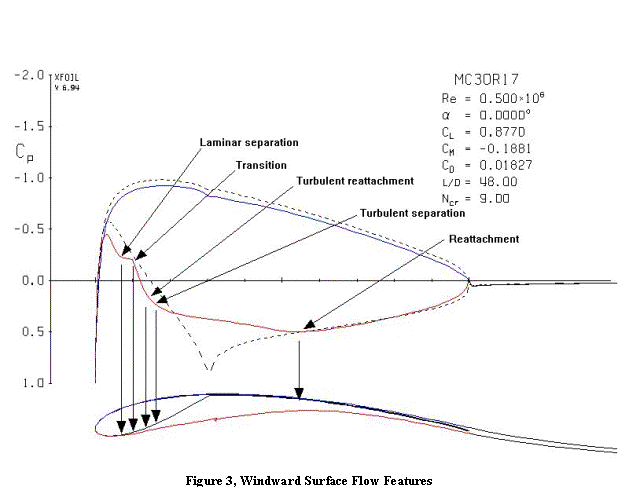
image006.gif


Which doesn't quite show what I'm saying, but on Tom Speers pages you'll find something.
 
Looks like a sandfly with one leg missing about to poke its bitey bit into someone's belly to me.

Maybe I should move onto ink blots?

John
 
Don't assume that the airflow 'meets' again at the trailing edge. The upper air on a wing travels faster - it has been shown in a wind tunnel.

Curvature is only one of the factors at work. A barn door will generate lift at the correct angle of attack. And an aircraft will fly upside down.

If I recall correctly the Wright Bros 'Flyer' aerofoil was very thin indeed - more like a sail (fully battened of course!).
 
Ah Ha! Didn't think of that possibility. But although I agree this has the potential for creating a higher pressure zone on the windward side of the sail, it also implies that the presure would be reduced the closer you get to the sail's concave surface thus causing a tendency for the sail to be "sucked" inwards. I suppose the forces on the two sides of the sail balance out and the net higher presure on the windward side than on the leeward side keeps the sail in shape. It does however imply a rather complex flow over the windward surface with velocities decreasing as the distance from the sail increases. I suppose this is what your diagram is trying to show. Clever stuff this aerodynamics.
 
Tom (then a Major USAF) sailed a Merlin Rocket at Cookham when he was based at High Wycombe.

One of his pet projects was to design a racing mark which would indicate the speed of the current of the Thames.

I'll see if he wants to get involved here!
 
[ QUOTE ]
If I recall correctly the Wright Bros 'Flyer' aerofoil was very thin indeed - more like a sail (fully battened of course!).

[/ QUOTE ]

Likewise DaVinci's glider and the rather more successful ones made by Otto Lillienthal. Langley's wings were also very thin and similar to sails, as were those of almost all other early aircraft apart from some of Hiram Maxim's monstrosities. It is quite possible that the early builders based their construction techniques on already successful techniques, the construction of windmill sails and boat sails.
 
The physics have been very well described elsewhere but when I was a child someone gave me a very neat demonstration of how a force going backwards could push something forwards.

Take a wedge of some slippery material and place it on a slippery surface. Imagine the thick end is the mast end of the sail and the thin end the clew.

Now, move your finger as if it was teh wind coming from forward of the mast and heading towards the surface around the centre of the 'sail' in a straight line. When your finger meets the wedge carry on pressing down but also keeping it going in the same straight line towards the surface. Voila! The wedge moves forwards even though your finder is moving backwards.

Think of the slippery surface as the keel resisting sideways motion and you have a fairly realistic demonstration of how a sail works except that, instead of a finger pushing, the sail has a semi-vacuum pulling.
 
You don't need any thickness to the aerofoil. If you change the direction of flow of a fluid you have changed its momentum because momentum is a vector: Mass x Velocity. Force is equal to rate of change of momentum. So just deflecting the wind across the curved surface of the sail (or the flat surface of Skyva_2's barn door if it is angled to the wind direction) will produce a force.
 
[ QUOTE ]
Explain in no more than 100 words, which a landlubber would understand.

[/ QUOTE ]

wind energy is used by the washing hanging on those sticky up things to move the boat froward. the wind flowing over the washing, called sails, create a force which translates into a reaction propelling the boat forwards - ah ..... ok ...... the wind slows down on one side of the sail and speeds up on the other, creating a resultant force, causing ........ ah, ok .......... um, see,
look - when I blow on this piece of paper it wants to move away from my mouth, ok /forums/images/graemlins/smile.gif well imagine the wind blowing on a sail - yes .... the washing on the line idea ....... so it wants to push the boat along in the same way - ok ...... good
now if I angle the sail slightly it will still push the boat /forums/images/graemlins/grin.gif good, keep nodding if you understand

to follow on, if the wind now comes from the side, and I put the sail this way ...... ok /forums/images/graemlins/smirk.gif or the wind can come from the front of the boat, if the sail is pointing this way it still fills the with wind, and the sail still drives the boat forward /forums/images/graemlins/grin.gif ok ........ so now the boat is going into the wind instead of only with the wind ...... /forums/images/graemlins/smile.gif mmmmmm

.......................... wot do you mean why does the fhit [--word removed--] [--word removed--] ............. (run out of polite words .......... and patience)


. /forums/images/graemlins/cool.gif


OK (thinks stupid effing landlubber) /forums/images/graemlins/mad.gif


howz that /forums/images/graemlins/cool.gif
 
Looking at this as a rude crude engineer I wonder if someone somewhere has set up a wind tunnel experiment to check the laminar flow , turbulent flow , and shock waves generated by excessive flatulence . Did the stream at any point reach Mach 1

Which came first the odour or the sound ?

very curious
 
[ QUOTE ]
Tom (then a Major USAF) sailed a Merlin Rocket at Cookham when he was based at High Wycombe.

[/ QUOTE ]
Edison House in the West End, actually. But my son went to high school in High Wycombe.

Sailing Merlins was great fun.
[ QUOTE ]
One of his pet projects was to design a racing mark which would indicate the speed of the current of the Thames.

[/ QUOTE ]

The pet project I really wanted to do was to stretch a whipped cream-coated rope across the Thames, and plunge it into the water to see the current profile across the river. Now that would have been a photo...

As for the question in question, it's all tiddly winks. The keel/board is the table, the wind is the tiddly, and the hull is the wink. The tiddly pushes one way, the table pushes back, and the wink squirts out between them!
 
Air flowing over the curved sails creates suction on the front surface. This has a small forward component and a large sideways component of force. Conversely there is some drag.

By turning the rudder slightly, the keel is allowed to move through the water at a slight angle to the direction of movement and has a similar water flow over it's curved surface, with a small forward component, a large sideways component, and of course some drag.

By resolving all the forces you will find that the forward components are larger than the drag. However there is some further - sideways drag - called leeway - when you compare the direction you are pointing with the direction you actually go.

How many words is that?
 
[ QUOTE ]
...How is a boat able to sail into the wind ?...

[/ QUOTE ]

A closely related, and even better question is, "Why can't some boats make progress to windward while others do?" After all, the flow physics are the same for a raft with a short square sail as they are for an AC class boat. But the raft probably won't go to windward, while the AC boat points like crazy. So it's not all just "Bernoulli" (whatever that means). There's got to be a connection between the boat's design and it's performance. Good performing boats go to windward, and sail high and fast to leeward. Poor performing boats can't and don't.

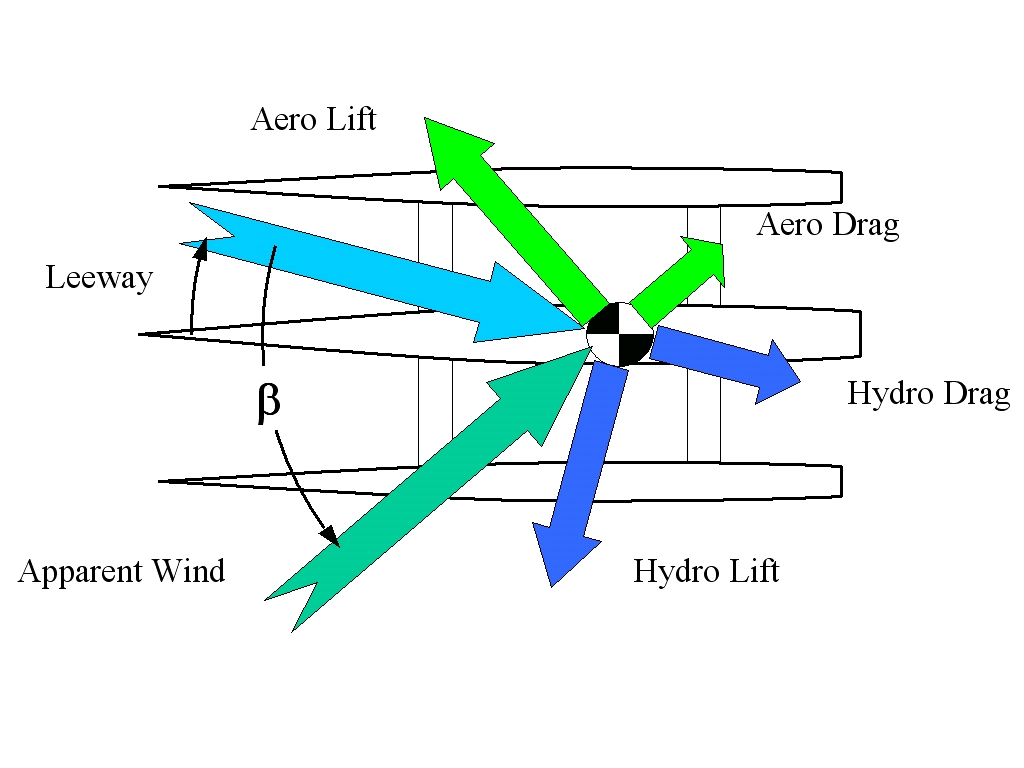
I think the best way to answer the question is to start with a picture:
ForceVectors.JPG

The blue swallow-tailed arrow is the water velocity relative to the boat, and the green swallow-tailed arrow is the apparent wind velocity relative to the boat. the square-tailed arrows are force vectors.

You can resolve the total aerodynamic force into a component perpendicular to the apparent wind (Lift) and one parallel to the apparent wind (Drag). Likewise for the hull & keel. The total aerodynamic force has to point somewhat forward to drive the boat. The farther off the wind you sail, the more the aerodynamic lift and drag point toward the pointy end of the boat. The hydrodynamic lift and drag will adjust themselves to just equal the applied aerodynamic loads. The leeway angle will increase to until the hydrodynamic lift is just enough, and the speed will increase until the drag is just enough.

After that, it's just a matter of engineering or sail trim to maximize the ratio of lift to drag for both the topsides & rig and the hull & keel.

That angle, beta, between the apparent wind and the boat's course through the water turns out to be central to the boat's performance. The boat speed is given by:

Vb/Vt = sin(gamma - beta) / sin(beta)
Vb = boat speed through the water
Vt = true wind speed
gamma = course through the water relative to true wind direction (point of sail)
beta = apparent wind angle

If you want to make progress to windward, gamma < 90 deg, and you have to have beta < 90 degrees. So what goes into beta?

It turns out that beta is equal to the sum of the aerodynamic and hydrodynamic "drag angles".

beta = beta_aero + beta_hydro
beta_aero = arctan(aero_drag / aero_lift)
beta_hydro = arctan(hydro_drag / hydro_lift)

As the lift goes to zero the corresponding drag angle goes to 90 degrees. So no matter how efficient the rig is, if there's no side force from the hull, the hydrodynamic drag angle will be 90 degrees and the boat can't go to windward. If the rig acts like a parachute and produces pure drag, the aerodynamic drag angle is 90 degrees and the boat can't go to windward. That's why a rig has to act a lot like an airplane wing - producing a very high lift/drag ratio - and the hull has to have a keel, and the best keels also work like wings, producing a high lift/drag ratio.

So it's not enough to be able to produce a lot of lift. Both the hull and the rig have to be able to produce lift with a small enough amount of drag that beta < 90 degrees. And since most decent performing craft can go to windward at 45 degrees, beta is typically considerably less than 45 degrees. In fact the lift/drag ratio has to be much greater than 1 (L/D=1 gives a drag angle of 45 degrees, making it virtually the minimum for both rig and hull), so cutting the drag by one lb or newton has a far bigger effect than adding another lb or newton to the lift.

You can work the problem backwards. Say you want to have a given amount of performance upwind - a certain Vb for a given Vt and gamma. That sets the maximum beta you can stand. You can then divide beta into its aerodynamic and hydrdynamic halves and now you have a specification you can hand to the rig designer and the hull designer. And you can trade one off against the other.

To go any further, you have to start looking into what contributes to the drag so you can attack specific design features of the boat. But that's the subject for another post.

Short answer to the quesition: "Because the boat is efficient enough that the aerodynamic drag angle and the hydrodynamic drag angle add up to less than 90 degrees. If they didn't, the boat may sail, but it won't make progress to windward."
 
Welcome to the forum Tom.

This is great stuff albeit a little more than the 100 words which a landlubber would understand /forums/images/graemlins/smile.gif

I recall the Bernoulli effect was the subject of a physics practical at school where we had to launch cardboard tubes, like the inside of a kitchen roll, across the room. I can't remember how we did it, but it proved the point about spin affecting the trajectory due to air moving at a different speed on one side compared to the other. Can'tremember much else, just spending an hour aiming cardboard tubes at each other /forums/images/graemlins/smile.gif
 
Top