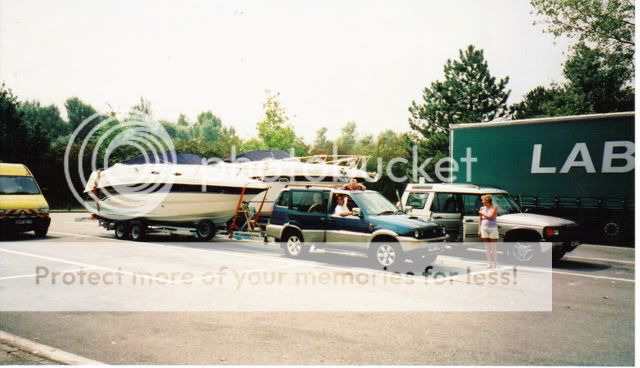
The dreaded trailer snake

winsbury

Well-Known Member
Joined
28 Sep 2012
Messages
519
Visit site
We collected our 1.5 ton boat on a 600kg twin axle trailer using a Honda CR-V last year - apart from the appalling fuel economy and the lack of power the journey went well in spite of being well outside the recommended towing weight ratio. Delivering the exact same boat to the South coast last weekend I used a Discovery 2 TD5 Land Rover, fuel economy was a bit better but it snaked like a black mamba at anything over 50mph and a couple of times I thought new underpants were definitely going to be needed. My sister in law turned over a Discovery 2 with a Caravan last year writing it and the caravan off when it snaked out of control on a long downhill stretch of motorway. I'm wondering if Landy's while rated for 3.5 tonnes aren't really up to the job on motorways due to their soft suspension in the lorry ruts and vague steering. Does anyone else feel the same way or know of any damping system that can help prevent it starting in the first place ? ( I'm assuming we all know about the importance of tyre pressures, nose weight, towball height, gentle acceleration/braking etc. )
 
Last edited:
Towed for years using various ages of Discos and always found them very well planted. Mostly RIBs but also a 22 ft cuddy and a car recovery trailer with a Saab 95 on board. Sounds like the nose weight might have been a tad light?
 
We collected our 1.5 ton boat on a 600kg twin axle trailer

Typo? More than twice the rated load the trailer can carry?

The big question for me is what was the nose weight, and did the tow ball heights match?

My twin axle boat trailer towed like a pig to start with, for two reasons

Firstly the centre of gravity was too far back, and secondly the towball height of the trailer was too high for the towcar (Subaru Forrester)

Problem 1 solved by moving the boat forward on the trailer 6 inches, a simple bir of re jigging while the boat was in the water so next time it came out, it went a little further forward on the trailer.

second problem was solved by using a drop plate "upside down" to give me a second, higher, towball on my Subaru.

Perhaps the Disco's tow ball was too low, and you were having to force the towball of the twin axle trailer down onto it, meaning a negative noseweight?
 
You were well over the maximum towing limit on the CR-V! They're only rated for around 1500kg at best (depending on model).

I've heard that Landies are a bit twitchy with a short wheelbase model and although the other models can tow the weight, they're not good at any kind of speed. You can use a stabiliser to damp the tendency to snake, but if the way you're driving makes the rig prone to it, the situation could be worse when you exceed the influence of the stabiliser.

Rob.
 
1500kg + 600kg = 2100kg total weight being towed - ie I didn't mean the trailer was only rated for 600kg.

Yes possibly the towball heights might be slightly different, I no longer have the CR-V, I sold it because it isn't rated for this kind of towing weight so I can't check for certain.

The boat was sitting a little further back on the trailer than ideal, by about 6 inches, there was plenty of nose weight but no so much I couldnt lift it and all four trailer wheels were firmly on the ground. The boat had not been moved since towed on the Honda which didn't exhibit the problem at all in spite of being an overloaded which should in theory have been a far more difficult beast to control so I don't think the load position is the root the cause.

What was interesting was small vans and 40ft arctics had little or no effect when passing us whereas 7 tonne trucks sucked me in a spat me out like goldfish food almost every time.
 
I have encountered unpleasant towing charcteristics like this, particularly an Impala; usually it's attributable to either a poor trailer design or a mismatch with the tow vehicle. The Impala's trailer is a bit carp; the axles are too far apart, marginally rated for the weight of boat so are wobbly and the frame is made from channel section rather than box so is a bit floppy, so it tows badly whether hitched to a Landrover 110 or a Transit. The Sonata he had before was much nicer to tow, even accounting for the lighter weight; it had a nice Snipe trailer purpose-built for a Sonata and amply rated for the weight, behind a Transit it was stable up to the 80mph we managed to wring out of it(ill-advised and I wasn't driving), even in a crosswind. Your instance however sounds like a trailer/tow vehicle mismatch though, perhaps caravan-style damper would help? Caravans often have awful aerodynamic qualities, and if towed by something boxy like a LR may misbehave terribly. It may be you just need to tow at or below 50; unless on a dual carriage way or motorway that's the limit.

The big question for me is what was the nose weight, and did the tow ball heights match?

My twin axle boat trailer towed like a pig to start with, for two reasons

Firstly the centre of gravity was too far back, and secondly the towball height of the trailer was too high for the towcar (Subaru Forrester)

Problem 1 solved by moving the boat forward on the trailer 6 inches, a simple bir of re jigging while the boat was in the water so next time it came out, it went a little further forward on the trailer.

second problem was solved by using a drop plate "upside down" to give me a second, higher, towball on my Subaru.

Perhaps the Disco's tow ball was too low, and you were having to force the towball of the twin axle trailer down onto it, meaning a negative noseweight?
This is all good stuff too; getting the boat positioned correctly fore-and-aft on the trailer is vital for stable towing, even with the good trailer the Snot was a horror to tow if it wasn't set down in the right place.
 
Last edited:
I'll put money on not enough nose weight. You say you could lift it,so unless you're an Olympic weight lifter it was probably no more than 50 kilos which is maybe two thirds or less of what you want with a big tow

I've always fitted a Bulldog stabiliser to every braked taller I've owned, big help in damping down the effects of passing vehicles etc

Another factor might be that with the CRV you were constantly on the throttle just to keep the thing moving whereas the Disco would be towing it with ease. Snaking is much more likely on the overrun and when you back off, hardly ever happening when you've hour the hammer down
 
I'll put money on not enough nose weight. You say you could lift it,so unless you're an Olympic weight lifter it was probably no more than 50 kilos which is maybe two thirds or less of what you want with a big tow

I've always fitted a Bulldog stabiliser to every braked taller I've owned, big help in damping down the effects of passing vehicles etc

Another factor might be that with the CRV you were constantly on the throttle just to keep the thing moving whereas the Disco would be towing it with ease. Snaking is much more likely on the overrun and when you back off, hardly ever happening when you've hour the hammer down

That all makes a lot of sense - the CRV was definitely on throttle 95% of the time and I could feel the trailer tugging constantly, there was no such effect on the Disco.

I was under the impression nose weight should be no more than 50kg to avoid causing the front (steering) wheels to go light - are you suggesting it should be more like 150kg ? - that's a huge difference !

EDIT - just found this: http://www.caravanclub.co.uk/media/6678669/noseweights-mo.pdf which states 5-7% of towed weight which would indeed put the ideal nose weight to 105-147 Kg in my case. Looks like this might indeed have been the problem. Also I guess the airflow under the boat could have been creating extra lift at speed.
 
Last edited:
I had a friend who owned a caravan company.
They did a lot of testing (and he used to stage rally a caravan outfit).
The trailer snaking is a resonance which can be modified by noseweight, CoG, and suspension compliance, amongst other things.
It may be that your outfit had a resonant patch at your chosen towing speed. Whilst it is true that you may reduce snaking by accelerating, it means that to slow down you need to pass through the resonant period again.

A towing damper sounds the best bet.
 
That all makes a lot of sense - the CRV was definitely on throttle 95% of the time and I could feel the trailer tugging constantly, there was no such effect on the Disco.

I was under the impression nose weight should be no more than 50kg to avoid causing the front (steering) wheels to go light - are you suggesting it should be more like 150kg ? - that's a huge difference !

EDIT - just found this: http://www.caravanclub.co.uk/media/6678669/noseweights-mo.pdf which states 5-7% of towed weight which would indeed put the ideal nose weight to 105-147 Kg in my case. Looks like this might indeed have been the problem. Also I guess the airflow under the boat could have been creating extra lift at speed.


I would take the towing advice from the CC with a pinch of salt, according to their 'rules' the heaviest load anyone should tow would be around 2000kg.

I'm not sure which Disco you are towing with, is it a TD5 or a TDi ? It makes a difference. I'm going to guess its a TD5. If its an ES model it will already have air suspension on the back so if its weaving there is probably something wrong with it. If its a more basic model you can fit airbags inside the springs to improve the towing experience, but you really shouldnt need them.

But IMHO if a Disco cant tow 2000kg in its sleep there is something wrong with the set up. I have towed significantly more than this with both a 300 Series V8 & a TD5 (Over 4000kg's on one dodgy trip) and they were rock solid, unless I let them run away with the rig down hill. As others have said you need a positive nose weight of around 100kg and the trailer needs to be level at this point. You may need to move axles, use a drop plate etc to achieve this.

I did around 20,000 miles towing this 3500kg boat round Europe with a new TD5 ES, its still the best tow car I have ever owned.

26-11-2007212059.jpg


Take some time to set it up properly and you wont know its there.
 
I'm inclined to agree with Landlockedpirate about the advice from theCC,it's very much based upon the assumption that the tow vehicle is an ordinary family car and the load is a stock caravan ( and a single axle one at that)

from memory, the max nose weight for a disco is around 150kg and in my fairly extensive experience of towing all sorts of talkers, the closer you can get to the max the better. For sure, if you can lift it by hand it's too light behind a big 4x4

If the tow ball doesn't have a drop plate or height adjustment it will almost always be too high preventing the trailer from sitting level. Indespension are particularly notable for failing to point this out to customers I've found

There is simply nothing better at towing ( other than an HGV tractor unit!) than a big heavy 4x4 BUT only if the rig is set up correctly.
 
yes its a TD5 with air suspension which had new air bags fitted only a few weeks ago as there was a leak on one of the old ones that only showed up in the cold weather ( a common fault I understand .)

Looks like i will have to tweak it a bit to get the towball height just right to achieve a much heavier nose weight than I had. I also need to make sure the boat's keels are evenly over both axles to keep it as level as possible. Unlike a motor boat or trailer sailor which sit nice and low and steady on a roller or bunk trailer there is a tendancy for a keel yacht to rock forward and back on the flatbed which can be kept in check with the straps but it cant be eliminated completely. This rocking must also have an effect on making the nose weight more variable when driving.
 
it might also be worth considering the alignment of the axle(s). If for any reason, the trailer is not 100% in alignment with the car, then the car is being forced (especially downhil) to go in a direction it does not want to. So the driver corrects; the trailer fights back, and ...snakery.

The ratio of the length of the A frame (ball hitch to centre of axle) to the wheel base of the car also can provoke snaking, especially if the nose weight is wrong.
 
Certainly the first place to look is trailer balance and nose weight. Many vehicles have a pretty narrow band of acceptable nose weights sometimes as narrow as 10-25 kg. To get it right you need to check it properly, a stick and a set of bathroom scales will do, but most caravan shops will sell quite in expensive purpose made devices. Towing stabilisers can make a lot of difference http://www.bulldogsecure.com/view/bulldog-200q-anti-snake-stabiliser/9 as well but getting the trailer balance right for the tow car.
 
I have just towed our clubs new ferry back from Cornwall, a round trip of 300 miles. The total load, boat, with a 4 wheel trailer, and dolly was somewhere in the region of 2.5 ton.
I have an old Mitsubishi Challenger which was superb.
Going back to the OP he was talking of snaking at over 50 mph. Well with that load on I'm not surprised. I did the return trip making sure I did not go much over 45. Along time to do 150 miles, but better safe than sorry.
 
I had a friend who owned a caravan company.
They did a lot of testing (and he used to stage rally a caravan outfit).
The trailer snaking is a resonance which can be modified by noseweight, CoG, and suspension compliance, amongst other things.
It may be that your outfit had a resonant patch at your chosen towing speed. Whilst it is true that you may reduce snaking by accelerating, it means that to slow down you need to pass through the resonant period again.

A towing damper sounds the best bet.

I think that's pretty much where I'd come from too - that and Sarabande's comment about the distance between the rear axle of the towing vehicle and the towball centre as a proportion of the distance from the towball centre to the mid-point of the two trailer axles. I'd also suggest that in side view, there's a factor too - as the towing vehicle rolls, it will do so about it's roll axis. Ideally, the towball centre will be pretty much on the roll axis of the vehicle, if it's above or below it, it will move sideways as the vehicle rolls - in effect "steering" the trailer ever-so-slightly. Lastly, the Discovery has very compliant suspension bushes to allow huge axle articulation and give a reasonable ride. Any wear in these won't help.

There are so many other factors (for example, depending on the design of the trailer suspension units, the trailer wheels will change their toe somewhat under load) that it's almost not worth even trying to get to the bottom of it. As others have said, a relatively inexpensive anti-snake bar is probably the way to go if altering the easy things like noseweight doesn't sort it. We had a Leisure 17 which, despite sitting quite high on an un-damped leaf-sprung trailer, towed like an absolute dream. Our next boat was an Evolution 22, which sat low (being a lift keeler) on a 4-wheel trailer, and towed like an utter pig!
 
I would second the comments that the draw bar weight is not sufficient. A recommended weight here is 10% of trailer weight.
Now if this depresses the back of the tow vehicle too much there are things can be done. You can add helper springs to lift the back against the trailer.
Around here it is common to fit "load leveller" bars. They are a pair about 1 metre long with a right anglked bend in the front. This bent end fits into a steel block mounted under the tow ball. Such that if the bars are lifted at the tip it levers the back up and the front down of the towing car. (the desired effect) The tips of the bars are lifted by chains up into fittings on the draw bar. Turning of the trailer is accommodated by the chains. These are very effective at leveling the tow vehicle.
I have never seen the so call stabilisers providing friction against swaying.
A boat should always be set onto a trailer at a specific location so that the nose weight is always consistent and sufficient.
Fortunately my boat is on rollers so that it is winched up to a vee block for the bow. On a single axle trailer the nose wight would be around 100kgs. Fortunately the big car does not complain too much.
I do second the idea that towing should be no more than 70kmh. In fact I believe there are specific laws on towing speed here limiting around 80kmh. Going slow means you can be safe even if load etc is not well balanced. good luck olewill
 
EDIT - just found this: http://www.caravanclub.co.uk/media/6678669/noseweights-mo.pdf which states 5-7% of towed weight which would indeed put the ideal nose weight to 105-147 Kg in my case. Looks like this might indeed have been the problem. Also I guess the airflow under the boat could have been creating extra lift at speed.

.... and the manufacturers maximum authorised noseweight For the Honda CRV is.......... 60 kg or 100 kg depending on model http://www.caravantalk.co.uk/community/topic/53408-honda-crv-as-a-tow-vehicle/
 
Top