The dangers of boat construction!

The fly in the ointment might not be air moisture, fitting out the boat on the hard could put stresses in a different direction to when it's afloat.

I saw that on a professionally built boat recently. Even though a gap had been left between the door and the frame when built in the factory it jammed when launched. No great problem - it was removed and shaved. The biggest kerfuffle is redoing the finish on the now bare wood.
 
I spoke to the owner (One Rob Stuart, the father of Andrew, the designer of the limbos)of a 3/4 tonner called Dingo. Built years ago. The designer stretched a cord through the middle of the boat from bow to stern & pulled it taught. He measured keel to cord & noted dimension.
They then set the rigging & the dimension had changed by 1.5 inches. Apparently the designer felt this extremely good on a race boat of the era.
I would imagine that modern AWBs move even more. I know that the floor of mine lifted .5 inches when badly chocked in Inverness one year (never happens in Bradwell(y)). I do not know the design of the OPs boat & the door may be fitted across the hull , not longitudinally. But movement must happen & it will be accentuated in waves
 
I spoke to the owner (One Rob Stuart, the father of Andrew, the designer of the limbos)of a 3/4 tonner called Dingo. Built years ago. The designer stretched a cord through the middle of the boat from bow to stern & pulled it taught. He measured keel to cord & noted dimension.
They then set the rigging & the dimension had changed by 1.5 inches. Apparently the designer felt this extremely good on a race boat of the era.
I would imagine that modern AWBs move even more. I know that the floor of mine lifted .5 inches when badly chocked in Inverness one year (never happens in Bradwell(y)). I do not know the design of the OPs boat & the door may be fitted across the hull , not longitudinally. But movement must happen & it will be accentuated in waves
He could always fit a sliding door to the heads like we have. That won't jam?
Our saloon door surround doesn't match the door. That door is in the main bulkhead across the boat. The gap is dependant on rig tension. If the mast isn't on the boat the gap is a different shape. Even with a stiff cored hull, movement happens. The mast compression load on ours is taken by a stainless steel post onto the keel but we still get bulkhead movement when the rig is tensioned. The bulkhead is 2 layers of 25mm Brunzeel ply. Probably the best boatbuilding ply in the world but it still moves. The main cap shroud chainplates bolt to it, hence their ability to change the shape of the bulkhead
 
I would imagine that modern AWBs move even more. I know that the floor of mine lifted .5 inches when badly chocked in Inverness one year (never happens in Bradwell(y)). I do not know the design of the OPs boat & the door may be fitted across the hull , not longitudinally. But movement must happen & it will be accentuated in waves

Some do - lots and some don't - much. My Bav 37 and all the other early J&J designed models were designed to flex. All the door frames were floating in the bulkheads, which in turn were only fully glassed into the hull, not the deck. Rigging loads were taken through tiebars to the hull grid rather than to deck or bulkheads. You could feel movement in a seaway, particularly the gap between the drop down helm seat and the surrounding deck. On the other had the Farr designed 33 was far more rigid with the bulkheads and all the internal furniture glassed in and outboard chain plates.. You can see similar design evolution with Hanse.

Reminds me of the early days of jet airliners. The VC10 was extremely rigid - short wings and a massive centre fuselage section - helped of course by having the engines fuselage mounted at the rear. Compare with a 707 where the wing tips would move up and down several feet in turbulent air and wing mounted engines swaying from side to side. Remember sitting at the rear of one of the first 737s taking off in an undulating and bumpy runway in Malawi and watching the fuselage/cabin twist and turn. All a matter of design philosophy.
 
I spoke to the owner (One Rob Stuart, the father of Andrew, the designer of the limbos)of a 3/4 tonner called Dingo. Built years ago. The designer stretched a cord through the middle of the boat from bow to stern & pulled it taught. He measured keel to cord & noted dimension.
They then set the rigging & the dimension had changed by 1.5 inches. Apparently the designer felt this extremely good on a race boat of the era.
I would imagine that modern AWBs move even more. I know that the floor of mine lifted .5 inches when badly chocked in Inverness one year (never happens in Bradwell(y)). I do not know the design of the OPs boat & the door may be fitted across the hull , not longitudinally. But movement must happen & it will be accentuated in waves
Correction. Rob Stuart is Andrew's older brother, their dad was Bob Stuart. He was the owner of Dingo and Rob and Andrew regularly crewed onboard.
 
A door with a tight fit will be compressed, somewhere, and the glass/epoxy coating will crack and the moisture that is then able to be absorbed will allow the door to distort further.

Give the door a loose fit.

and/or

Scrap the existing door and build a new one from foam.

Jonathan
 
The mast compression loads will bend that bulkhead. Even steel I beams bend/deflect.

I don't intend making the door an "interference fit" but I do not want gaps around the perimeter of the door that you can see through. If I could have a uniform 3-4 mm (1/8+ gap all around I'd be happy.) The fiberglass door moulding won't give me much latitude.
 
Last edited:
A door with a tight fit will be compressed, somewhere, and the glass/epoxy coating will crack and the moisture that is then able to be absorbed will allow the door to distort further.

Give the door a loose fit.

and/or

Scrap the existing door and build a new one from foam.

Jonathan

Nowhere have I said a "tight fit". It is currently binding on the corners as I haven't radiused the corners properly.

When I fit the door on it's hinges I'll have to use spacers to locate the door correctly.
 
It's entirely possible. Plywood stress/strain diagram...

Flexural-stress-strain-curves-for-plywood-reference-panels.png


0.1% might not sound much, but on a 2m bulkhead that's 2mm. Boatbuilders build doors with a noticeable gap to the frame for exactly this reason. A non jamming door is much more important than keeping farty noises out.


"0.1% might not sound much, but on a 2m bulkhead that's 2mm. "

Thanks for that advice Angus. ?

So you'd agree the 3-4mm gap I am planning is quite reasonable?

When I built the compression bulkhead I went way over the designer's specifications. It took two of us to locate it in the yacht. (After I had completed the compression bulkhead I felt guilty that I hadn't kept to the architect's specification)
 
Last edited:
If you insist, it can be done. Afterall, weather tight doors are common however would require a redesign.

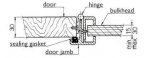
OTOH you could either sound proof the existing or implement a suitable frame and/or sealing gasket:

1653716898320.jpeg

Smartphone: Important to also to document (photos) things or push into confined areas to know what is there

confinedcavity.jpg
 
Last edited:
I spoke to the owner (One Rob Stuart, the father of Andrew, the designer of the limbos)of a 3/4 tonner called Dingo. Built years ago. The designer stretched a cord through the middle of the boat from bow to stern & pulled it taught. He measured keel to cord & noted dimension.
They then set the rigging & the dimension had changed by 1.5 inches. Apparently the designer felt this extremely good on a race boat of the era.
I would imagine that modern AWBs move even more. I know that the floor of mine lifted .5 inches when badly chocked in Inverness one year (never happens in Bradwell(y)). I do not know the design of the OPs boat & the door may be fitted across the hull , not longitudinally. But movement must happen & it will be accentuated in waves

Racing yachts would be much more lightly constructed (and therefore highly stressed) than a heavy displacement cruising yacht.:unsure: I would expect a racing yacht (or lightly built production yacht ) to flex more than HD cruising yacht.
NOTE
It would help if YBW gave some basic information in the members profile (as other forums do) .
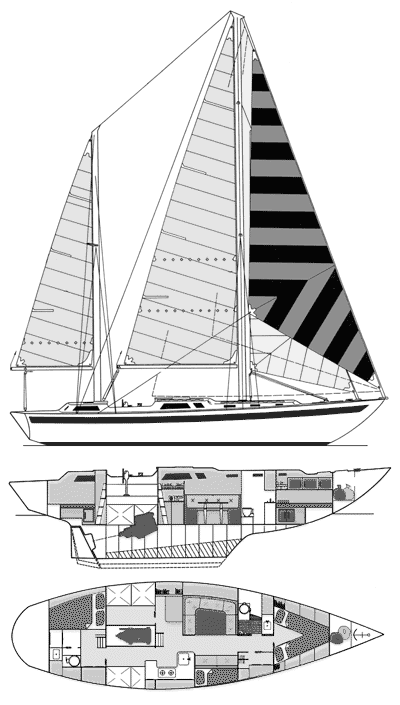
I am building a fiberglass Roberts 43 Mauritius

mauritius_43_drawing.gif
 
Last edited:
Racing yachts would be much more lightly constructed (and therefore highly stressed) than a heavy displacement cruising yacht.:unsure: I would expect a racing yacht (or lightly built production yacht ) to flex more than HD cruising yacht.

NOTE
It would help if YBW gave some basic information in the members profile (as other forums do) .
I am building a fiberglass Roberts 43 Mauritius

mauritius_43_drawing.gif
Looks like a stretched version of my 1980 Ray Wall designed Nicholson39 with a long keel.
PS. no problems with jamming doors on my boat so yours, hopefully, will be similar.
Screenshot 2022-05-28 at 09.35.46.png
 
Regardless of the gap, it would be more effective to make the door close flush against the jamb. You could even have a foam or rubber 'gasket' to seal it further if you are obsessional.
 
Regardless of the gap, it would be more effective to make the door close flush against the jamb. You could even have a foam or rubber 'gasket' to seal it further if you are obsessional.

Thanks for that.

Yes way back in comment #13 I said "I have adhesive backed rubber strip to go between the door and frame so maybe that will be sufficient anyway."

I am probably obsessed but I read comments by others on these forums about people having to use the toilet while the main cabin us in use and how embarrassing it can be .
 
Top