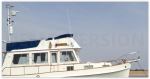
The Billy Ruffian

One of the GB foibles is the high windage area created by the forward sides of the fly bridge. They are large & well forward. Once a side wind gets a hold it's not easy to overcome.

This also shows at anchor with a degree of side to side slewing. I use my steading sail at anchor to control this (a bit).

Hope you sort your controls ok, no fun when that sort of hiccup arrives on the scene, always at an awkward moment of course. Glad you got things under control ok.
 
All good experience Trevor (after the event), with any new boat as you know there is always a learning curve, but if your boat unexpectedly failed, you did very well not to damage anything, your pride will recover! Once you knew something was wrong, could you not have slipped out and onto an easier (or visitors berth), until you got it sorted out?

I have used the same method as Mark, mainly with high winds in Spain, fortunately we do not have to contend with tides anymore!:)
 
All good experience Trevor (after the event), with any new boat as you know there is always a learning curve, but if your boat unexpectedly failed, you did very well not to damage anything, your pride will recover! Once you knew something was wrong, could you not have slipped out and onto an easier (or visitors berth), until you got it sorted out?

I have used the same method as Mark, mainly with high winds in Spain, fortunately we do not have to contend with tides anymore!:)
It was a bit weird as though I was overcome by a thought the marina staff knew better, plus clearly being a bit rusty, nervous of the new boat, but yet knowing the basic that 'thou shall not collide'.

Anyway I have examined the gear selector controls and have measured the distance of each cable at the pivot fulcrum to a fixed position on each engine. There is a variation of up to 10mm between differing levers at different positions ahead or astern.

But the dual control cable arrangement is not one I am familiar with. I think it is Vetus.

The Fly helm control cable goes to the gear selector lever, via a lock block on a slider mechanism operated by the Lower helm control cable. So the Lower helm effectively pulls in and out the end of the Fly helm control cable, which is attached to the gear control lever.

During the measurements I noted one of the movements of the lower helm gear back to neutral did not result in the lever quite reaching the neutral indent, so I suspect that if this specific lever was not exercised past the indent slightly and then back to its indent then the lever at the box would have sat back slightly, requiring an additional distance of travel for this cable to engage drive..

Then the fulcrum bearings themselves had 2mm of slack, which I have now resolved with some small spacers machined to removed this, and the potential was clearly that if the lower helm was not properly placed into neutral (even if it seemed it was) then the extra distance the upper lever would then require, plus the loose fulcrum was likely sufficient to prevent drive engaging.

I also suspect that as these cables and throttles are very new (a mod to allow a dual thruster controller) that the whole lot needs adjusting. I suspect to do this there is a specific procedure, which I do not have, and the makers name for the system is not obvious, but I assume Morse.

Anyone here have any ideas as to the order I adjust these things in to properly set up ?
 
It was a bit weird as though I was overcome by a thought the marina staff knew better, plus clearly being a bit rusty, nervous of the new boat, but yet knowing the basic that 'thou shall not collide'.

Anyway I have examined the gear selector controls and have measured the distance of each cable at the pivot fulcrum to a fixed position on each engine. There is a variation of up to 10mm between differing levers at different positions ahead or astern.

But the dual control cable arrangement is not one I am familiar with. I think it is Vetus.

The Fly helm control cable goes to the gear selector lever, via a lock block on a slider mechanism operated by the Lower helm control cable. So the Lower helm effectively pulls in and out the end of the Fly helm control cable, which is attached to the gear control lever.

During the measurements I noted one of the movements of the lower helm gear back to neutral did not result in the lever quite reaching the neutral indent, so I suspect that if this specific lever was not exercised past the indent slightly and then back to its indent then the lever at the box would have sat back slightly, requiring an additional distance of travel for this cable to engage drive..

Then the fulcrum bearings themselves had 2mm of slack, which I have now resolved with some small spacers machined to removed this, and the potential was clearly that if the lower helm was not properly placed into neutral (even if it seemed it was) then the extra distance the upper lever would then require, plus the loose fulcrum was likely sufficient to prevent drive engaging.

I also suspect that as these cables and throttles are very new (a mod to allow a dual thruster controller) that the whole lot needs adjusting. I suspect to do this there is a specific procedure, which I do not have, and the makers name for the system is not obvious, but I assume Morse.

Anyone here have any ideas as to the order I adjust these things in to properly set up ?
You’ll either think this is the work of the devil or an opportunity. I’ve a set of electronic controls I’d sell. Two control boxes for the engine room that operate short Bowden cables. One box per engine, 2 Bowden cables out of each for throttle and gear.
Electronic controls (3 sets so one for the transom or a spare). Call if you’re interested.
 
I have electronic throttles and apart from the two second delay from moving the throttle to anything happening, for a twin helm boat I think they are great and quite happily accept the short delay.
 
It sounds like you have the Morse changeover gates. There are locking pin points to enable correct set-up
These are supplied with set-up instructions that are probably available from Morse.
 
It sounds like you have the Morse changeover gates. There are locking pin points to enable correct set-up
These are supplied with set-up instructions that are probably available from Morse.
On this set up there is no morse change over gate assembly - I did have this device on my last boat so know what it looks like and how it functions.

Instead near to the gearbox shift lever is a sliding bracket affair. The fly cable is attached to the gearbox lever on its moving end, and its sleeve is anchored to the sliding bracket. The lower cable then moves the sliding bracket, so the lower effectively controls the end of the fly cable. What is now obvious is that precise selection of neutral at either station is crucial. Also the neutral indents on the control levers are a bit vague, and engagement does not occur precisely in all the ahead / astern indents so I suspect the whole set up needs as bit of fine tuning. It is also very new, so I suspect some looseness needs adjusting out.

If anyone is familiar with this set up and how to fine tune I would appreciate some advice, because it is not clear which cable of the paid should be set up first.

I have measured the positional lengths of the gearbox lever fulcrum to a fixed point on the end of the mount holding the slider device at each selection position: Ahead / Astern / Neutral; Fly lever / Lower lever. There is a variation of several mm between Fly & Lower lever movements, when ideally this should be I feel less than say 1mm.

I did find the clevis pins securing the cable fork ends to the gearbox levers very sloppy with a 5mm pin engaged in a 7mm hole. I have now reamed this to 8mm, and made some brass bushes to allow a precise fit. This has certainly improved things.
 
I have asked this question on the PBO forum, but I hope no one objects to me asking it here also.

I am feeding NMEA0183 data stream from my new Plotter to a C80 MFD, and the external info on the C80 shows sentences and bytes are being received, but the MFD is not using the data provided to display position nor AIS.

The same set up worked just fine on my last boat with an identical set up with the NMEA0183 providing the C120 in that case with both GPS positional and AIS data.

I have set the baud rate to AIS 38400, and have changed loads of other settings.

I also did a full reset and now the boat thinks its just off the entrance to Miami harbour !

The GPS source is accurately sending the true boat's position.

The C80 has two inputs for NMEA data in - AIS in and NMEA in. I have tried both separately, so should I try both on the same external feed connection ?
 
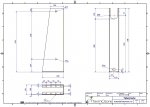
So the mast is now removed from the boat and I have a new tabernacle being made from 316 stainless steel.

This will position a pivot fulcrum precisely at 685mm above the deck, and the mast will fall forwards, where at this height it will rest squarely along the top of the rather stout flybridge table. The radar set protrusion will sit neatly in the gap between the table and forward fly bridge seats.

The hole through the mast will be 22mm, where I will make a phosphorus bronze sleeve to lock into the mast with a 16mm 316 pivot bar. This will prevent any dissimilar metal corrosion of the pivot.

The lower lock pin will have an 18mm hole again with a bronze liner using a 12mm pin again from 316.

I was able to unplug the cables at the radome and thread these out of the mast without cutting. I will need to shorten the mast ~ 2 - 300 mm to provide me sufficient slack in the radar cable for a new route but the radar will still be well above head height, so not a concern for irradiation. But if anyone knows the minimum height for an older 4kw Furuno 1751 mk2 radar above users heads I would like to check this.

I will replace all the mast lights with LED bulbs - Steaming / Anchor / Deck flood, but I want to reduce the cable size, but it is difficult finding the current draw for a typical navigation LED, so unless someone can tell me ~I suppose I will have to measure the flow on a bench test. The feed cables to the mast base are a hefty 2.5mm2, but as the LED current draw will be much less than the older filament bulbs I would like to use 0.25mm2 signal cable, or is this going to be too light a gauge ? The cable run distance from the 2.5mm2 connection point will be for the top most anchor light ~7m out and back.

AssemblyTabernacle.jpg
 
You don't hang around with the modifications , do you ? :)

Have I missed any mention of a counterweight to balance the mast as as it is lowered/raised ? ?
 
You don't hang around with the modifications , do you ? :)

Have I missed any mention of a counterweight to balance the mast as as it is lowered/raised ? ?
Just getting her properly usable, and the mast has been a big headache.

Fitting a counterbalance would be untidy, although I could fit the base section below the fulcrum with lead, but also with the mast tipping forwards there is plenty of deck space to stand and move around for the manoeuvre, and from that position the mast isn't overly heavy.
 
FWIW, a typical LED nav light is about 3.0W.

Boat Light Fittings and LED Lighting - Navigation LEDs - Aten Lighting

and a typical deck floodlight up to 60W, but that is going to blister the varnish. ..

Deck floodlight - Power Beam - Hella Marine - for boats / LED / adjustable (nauticexpo.com)

Just looking quickly at an earlier of BR's profile, with a shorter mast are you going to cast a shadow from a mast-mounted flood light onto the foredeck ?

SN6T0gO.png
 

Attachments

  • 1657449373266.png
    1657449373266.png
    192.1 KB · Views: 1
I have asked this question on the PBO forum, but I hope no one objects to me asking it here also.

I am feeding NMEA0183 data stream from my new Plotter to a C80 MFD, and the external info on the C80 shows sentences and bytes are being received, but the MFD is not using the data provided to display position nor AIS.

The same set up worked just fine on my last boat with an identical set up with the NMEA0183 providing the C120 in that case with both GPS positional and AIS data.

I have set the baud rate to AIS 38400, and have changed loads of other settings.

I also did a full reset and now the boat thinks its just off the entrance to Miami harbour !

The GPS source is accurately sending the true boat's position.

The C80 has two inputs for NMEA data in - AIS in and NMEA in. I have tried both separately, so should I try both on the same external feed connection ?

Memories from the last but one boat but IIRC….
They both are using the AIS data speed and that’s not right for the GPS. My NASA AIS on my last boat had a bridge, so you feed the GPS into that and it feeds it (and the AIS data ) out at the AIS speed.
 
I have asked this question on the PBO forum, but I hope no one objects to me asking it here also.

I am feeding NMEA0183 data stream from my new Plotter to a C80 MFD, and the external info on the C80 shows sentences and bytes are being received, but the MFD is not using the data provided to display position nor AIS.

The same set up worked just fine on my last boat with an identical set up with the NMEA0183 providing the C120 in that case with both GPS positional and AIS data.

I have set the baud rate to AIS 38400, and have changed loads of other settings.

I also did a full reset and now the boat thinks its just off the entrance to Miami harbour !

The GPS source is accurately sending the true boat's position.

The C80 has two inputs for NMEA data in - AIS in and NMEA in. I have tried both separately, so should I try both on the same external feed connection ?
Trev, iirc, @Mr Googler went through all that recently, maybe he can comment?
 
If anyone is familiar with this set up and how to fine tune I would appreciate some advice, because it is not clear which cable of the paid should be set up first.

A few pics could help, I'm quite familiar with a similarly complex system by Kobalt, maybe they are similar?
 
Top