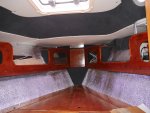
The alternative to vinyl droop!

seafox67

Well-Known Member
Joined
14 Apr 2017
Messages
281
Location
Greenock
Visit site
I have wooden vinyl panels on the ceiling which look great! However, the saloon sides from the panels down to the cupboards is droopy rotting vinyl!

To make things worse, I've recently had to repair a leaky deck fitting which also highlighted the issue that you need to pull the vinyl down to affect repair and the leak had been hidden for some time behind the vinyl.

Rather than replacing or hiding the deck fittings with something else, I am seriously thinking about sanding all the glue and dirt back and painting this area.

A google search has highlighted possible condensation issue and the lack of that 'warm feeling' and seeing the underneath of ugly deck fittings.

Does anyone have any experience using this method of just painting the side walls (and a little bit of the roof)? I can live with a little bit of condensation and deck fittings (At least I will know straight away when they start leaking or need replacing).

Any recommendations for the paint? I was thinking something textured!

Cheers

Paul
 
Last edited:
Why don't you just make a panel that can access the fittings or a lining that is easily removed. My linings are on about 3mm ply and secured in place with screws onto battens and the edge finished with trim. It does not have to be glued straight onto the hull.

If painting is what you want, then any decent exterior paint or interior paint suitable for bathrooms / kitchens will do. The surface will need to be prepared and primed according to the final coating instructions.
 
Have you considered the white UPVC cladding used for house fascia/trims. You can stick it to the boat roof,using builders grab adhesive, it stays white, you can get it in 4" and 12" widths, the joints are invisible, you can route wire through the hollow sections and it gives good insulation as it has a hollow 10mm core. The only drawback is that tight curves are difficult soit is not suitable for all boat areas. Also very cheap, I did my main cabin roof about 10ftx8ft for about £90 including adhesives, edge and centre trims etc..
 
Have you considered the white UPVC cladding used for house fascia/trims. You can stick it to the boat roof,using builders grab adhesive, it stays white, you can get it in 4" and 12" widths, the joints are invisible, you can route wire through the hollow sections and it gives good insulation as it has a hollow 10mm core. The only drawback is that tight curves are difficult soit is not suitable for all boat areas. Also very cheap, I did my main cabin roof about 10ftx8ft for about £90 including adhesives, edge and centre trims etc..

Too many curves and windows :(
 
Is this 'Westerly Droop' we are talking about here?

I replaced most of mine - which was then 15y.o. - in Australia 15 years ago with more foam backed vinyl using proper glue .... not whatever rubbish it was that Westerly used... it is still holding up well.

Area that I didn't do then was the focsle... did that in NZ 3 years ago.

The upholsterer reckoned he couldn't do foam backed vinyl in that area so we went with some charcoal coloured carpet like material that he was trying to shift.

It worked exceedingly well and rather suprisingly we don't get condensation on it.

Deckhead is plywood panels covered with foam backed vinyl.. secured over 4mm closed cell camping mat material...
Then the carpet...
Below that 6mm closed cell (Evo?) camping mat stuff glued to the hull sides... the shiny stuff...

As you can see I am more concerned with function rather than fancy looks ...
 

Attachments

  • P1190708 (1).jpg
    P1190708 (1).jpg
    204.5 KB · Views: 0
When I replaced the foam backed vinyl in my I decided I wanted the bottom if the shroud fixings and the wooden knee they are either side off visible. Originally they were vinyl covered. I flowcoated the knees and cut the vinyl around the shroud bases. Worked well for me.

Thanks for all your replies... I like the sound of using flowcoat


Cheers
Paul
 
I’ve seen lots of Boatshed photos of 60s boats with bare white-painted back-of-the-moulding GRP and think it looks fairly horrible - redolent of the spartan uncomfortable Tillman style of sailing (though of course he was in wood not GRP), all clammy yellow oilskins, lukewarm stew out of a can and mildew. I’d have a boat like that for something like a Jester voyage but I would want more cosy surroundings for normal coastal cruising.

Our previous boat had a good compromise, with small non-structural vertical “ribs” on the GRP (I assume they were strips of foam with one or two layers of glass over the top) and then long horizontal cedar boards screwed to the ribs. The wooden boat term is “ceiling”. The boards had 1/2” gaps between them so the GRP hull was visible, but the visual and tactile effect was of varnished wood. They stopped short of the various knees and bulkheads on the hull so there was no fiddly work of fitting them around things, and the boards were quite thin so they bent to the curve of the hull without any specific shaping work.

The current boat has foam vinyl in a few oddly-curved places, but the larger areas of visible hull side are covered with very thin (2-3mm?) ply stained with a pattern to look like planks. I assume it’s a product that can be bought somewhere.

Pete
 
The solution for condensation is to have a space between the deckhead and the ceiling. This I did by fixing wooden laths to the fibreglass and then to these laths I screwed ply sheets to which I glued non-woven 'carpeting' as used on cheap speedboats and vehicle interiors. The photo shows the finished result; the boat was better insulated and there was no more condensation. The boat was a Centaur.

BwNo3WN.jpg


On the present boat (Centurion 32) there is no problem because the deckhead has a moulded 'lining' and the cabin sides have a ceiling of teak strips that leave a space of around 20m between them and the hull.
 
Rather than replacing or hiding the deck fittings with something else, I am seriously thinking about sanding all the glue and dirt back and painting this area.

Don't do it - it will look truly awful! The alternative solutions others have suggested are infinitely preferable.
 
I stripped some vinyl off the hull sides in the after cabin. No damp problem - the vinyl had been spoiled during work on the rubbing strake. Afterwards the sides were painted with anti-condensation paint, just in case. I didn't bother removing the old glue, just tidying the loose bits.
 
Does anyone have any experience using this method of just painting the side walls (and a little bit of the roof)? I can live with a little bit of condensation and deck fittings (At least I will know straight away when they start leaking or need replacing).

When I replaced the headlining on my Westerly Jouster I gave up the will to live at the interior trim strips (level with the rubbing strips). From there down to bunk level is supposed to be foam backed vinyl, but for the quarter berths I just painted the interior with good ol' Danboline instead. Worked fine, looked fine.
 
Top