Testing MF/HF Radio

Vicarage

Well-Known Member
Joined
21 Mar 2017
Messages
72
Visit site
We've just reinstalled our MF/HF antenna after replacing the standing rigging (the mizzen shroud is the anntenna). Anyway, I want to put out a test call to someone to check whether it works or not - who can I do this to these days?

I spoke to Falmouth MRCC on the phone and they agreed to listen on MF for a bit for me, but I couldn't get anything from them, but we're over 250miles away from them and it's all overland so I wasn't overly surprised.

Are there any stations that do still maintain a listening watch on a suitable HF channel I might be able to get? Am in Kent for distance reference.
 
I don’t have HF, but I believe Ostend Radio still operate as a traditional coastal station. Should be a good target from Kent?

Pete
 
Not on board tonight but if you're around for a few days we could try a scheduled contact. We're near Falmouth at present. Are you an amateur as well or only the have the LRC (makes a difference which frequencies to choose). PM me if you like.
 
This is a bit sad that OP has to ask the question. He should be familiar of course with whom he is going to get a response. Unfortunately that is not a simple criticism of OP's ignorance. I have an operators certificate which covers marine HF and I have a book put out for the training of this ticket. However it seems to be a bit different to actual HF marine operation. I am still in ignorance. Now I can only speak for Oz operation yet some aspects must be paralleled in UK.
From traditional double sideband HF they went to single sideband about 50 or more years ago. At that stage there were coast stations listening on 2182 and several channels higher in frequency. now for quite a few years the commercial HF safety network for shipping has gone to digital select calling. The government have gone to just 2 stations one in west oz one in Queensland. Ironically both stations are at like 1000km from the coast. Basically you put out a DSC call on one frequency which identifies you and says you want to talk. Once this is answered in DSC you switch to a nearby different frequency to talk.
Now parallel to the govenrment coverage much of Oz is protected by volunteer sea rescue groups. (who are semi official and funded by government) They listen very efficiently on VHF and on a range of VHF repeaters. They also listen on HF SSB channels. Well maybe. There are at least 3 channels over a wide range of frequencies like 4 meg 6 meg and 8 meg to suit various ranges and time of day. (getting through is not as simple as VHF. So it is tedious /difficult to monitor all channels all the time. However parallel to this when there is an ocean yacht race on there are channels closely monitored and of course regular schedules.
So to answer the oP question if he lived in west oz I would say contact on telephone a rescue group and ask them to listen for you. It might be somewhat similar in UK. Note that OP tried that at a range of 250 miles.
Well HF radio relies beyond line of slight on reflections of the wave from the earth to the ionosphere often several times. So at any time you might get good contact at 500 miles but can't do 250 miles. The frequency you use can affect the range. Now at night the ionosphere reduces in altitude so after dark you use a lower frequency. Now details these are given only to show that it is a whole science and study to choose the right frequency for a particular contact.
So OP IMHO has got a lot to learn about HF communication.
Now just waffling on in my youth I worked at the local national radio station. We broadcast on MF usual AM radio. We also broadcast the same program on HF. This was to serve the outback of west oz. You will know Perth is in the south and the state extends 2000+km north. So there were 2 HF transmitters. If I remember correctly broadcasting on 6425 and 9625 during the day. The 2 frequencies covering the far north and the mid north. Every night at 1800hrs they were shut down for 15 mins reopening on 9625 and 13825? Every morning at 0800 change back again. One transmitter was 10kw one 50kw. So that pattern gave a mostly useful reliable coverage but never really reliable or good quality. It is all gone now of course with satelite TV radio and phone/internet.
 
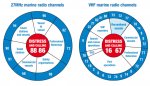
Is this relevant?

marine-radio-channels.jpg

The emergency frequencies used to be 2182, 4125 and 6215. But I don't think they monitor all three anymore.
"HF marine distress frequencies are monitored by Coast Radio Adelaide and also by some of the volunteer marine radio stations. This station maintains a 24 watch on channels: 4125, 6215 and 8291 kHz also VHF Ch 16. The HF frequencies should be be reliable for up to 200nm offshore. The distress frequencies are: 4125, 6215, 8291 kHz. 2182 kHz is no longer monitored by Coast Radio stations but may still be monitored by some volunteer stations
 
Last edited:
Not on board tonight but if you're around for a few days we could try a scheduled contact. We're near Falmouth at present. Are you an amateur as well or only the have the LRC (makes a difference which frequencies to choose). PM me if you like.

That'd be ace, I'm on the boat during the day most days. We'd be well placed to get you on 4meg which would be useful as that's the band we use most often.
I've got the GOC, but my experience beyond the course is limited to occasional radio skeds when racing offshore..!
 
Is this relevant?

View attachment 78486

The emergency frequencies used to be 2182, 4125 and 6215. But I don't think they monitor all three anymore.
"HF marine distress frequencies are monitored by Coast Radio Adelaide and also by some of the volunteer marine radio stations. This station maintains a 24 watch on channels: 4125, 6215 and 8291 kHz also VHF Ch 16. The HF frequencies should be be reliable for up to 200nm offshore. The distress frequencies are: 4125, 6215, 8291 kHz. 2182 kHz is no longer monitored by Coast Radio stations but may still be monitored by some volunteer stations

Hi Clive Firstly you can pretty much ignore reference to 27meg marine since DofT decided 27meg marine was not adequate to meet the requirements to carry a radio if beyond 3NM of shore. So while they monitor ch88 I don't expect it will be for much longer. VHF of course is not in the question. However we note in Oz volunteer rescue groups MAY monitor HF frequencies as listed. So for your boat if you go HF SSB then best get a set with the DSC and get it licenced for marine communication. However you might choose to use VHF repeaters certainly work down the coast and perhaps a sat phone. ol'will
 
So for your boat if you go HF SSB then best get a set with the DSC and get it licenced for marine communication. However you might choose to use VHF repeaters certainly work down the coast and perhaps a sat phone. ol'will

Thanks for that ol'will

That is something exercising my mind: communication on an ocean going yacht.
Sat phone vs HF SSB? (Of course I will have an EPIRB). Sat phones Inmarsat Vs Iridium ....

A lot more work to do......

Clive
 
Top