
Terrible news from Clipper

It's not about 'comparing'. It is about using technology and knowledge that is already available to improve safety.

When you're thinking in terms of 'fall arrest' in sailing , you've already got it seriously wrong.
Industrial fall prevention is not anything like climbing either.
 
When you're thinking in terms of 'fall arrest' in sailing , you've already got it seriously wrong.
Industrial fall prevention is not anything like climbing either.

No, I'm talking static falls on static material (lanyards), potentially with knots tied in which weaken them further. Im talking open gate clips that have very low residual strength in the gate open position, I'm talking cross loaded clips which also have very little strength in that position.

I am not talking about fall arrest whatsoever.

All these situations are common place on a boat in my experience.
 
going to keep this as concise as can be to stop going off topic........

in the climbing world, the main climbing rope is dynamic so stretches to absorb energy. Even then if you have cross loaded or open gate carabiners/clips they can snap so you fall down until your rope catches the next one.

These 'climbing' carabiner/clips are far stronger than their maritime equivalent and some have gate locking mechanisms etc that are used in certain key positions.

In the sailing world we do not use stretchy dynamic ropes, we use static / low stretch ropes.

When you fall on a tether, there is no energy absorbtion because it is static material and doesn't stretch. Either your body absorbs it if the gear holds, or the gear snaps if clips are cross loaded or the gate is open.

Google fall factors in climbing belays.

Now if someone goes up the mast on a static rope with someone grinding the winch and another person tailing and people are not concentrating and that person drops 4 metres on a static line before stopping.................either the connections (lanyard, harness tether) break or the body breaks (internal organs) whilst the tailer looks at his burning hands.

These tests have been done years ago just not in the sailing world.
 
Last edited:
When you're thinking in terms of 'fall arrest' in sailing , you've already got it seriously wrong.
Industrial fall prevention is not anything like climbing either.
Let's remember that the failure we are talking about took place at ~ 300 pounds. That isn't a big fall, that's just a wee bump by a big guy.

Let me repeat that. The carabiner will bend and fail at about 300 pounds. All you have to do is get it crooked. These failures are very rare, not because the carabiners and tether are good, but because, ass many have correctly pointed out, sailors try hard not to fall and the data base is tiny. But as a percent of falls (which includes hard slips and knock-downs--fall is just the chosen a word for getting caught by the tether), the failure rate is orders of magnitude higher than other applications.

The second statement--"Industrial fall prevention is not anything like climbing either"--is offered without engineering basis unless you are prepared to provide some. I say that if the people are the same size and they fall over a rail, the physics is the physics. Engineers and scientists understand the math showing that horizontal impacts, falls, getting hit by a wave (Clipper), and slopes are all related and can create equivalent impacts. In support, I can document three formally investigated failures of tethers at 1000-3500 pounds--these are discussed in a follow-up article. By comparison, a rock climber seldom sees a force of over 700 pounds, as witnessed by the fact that we can untie the knots after a fall--strong prima facia evidence. How is this possible, after a 40-foor whipper? The rope is designed to stretch.

For most sailing, tethers are relatively low priority and will never really be tested. But the people that really need these have a right to believe they will function safely. We're not there yet, but we can be.

In fact, the stronger clips are not more expensive. How about that. Why are we up set about something that is better, cheaper, and already on the market? What am I missing? That is a serious question. If there is something better and cheaper, tell me and I will help spread the word.
 
Let's remember that the failure we are talking about took place at ~ 300 pounds. That isn't a big fall, that's just a wee bump by a big guy.

Let me repeat that. The carabiner will bend and fail at about 300 pounds. All you have to do is get it crooked. These failures are very rare, not because the carabiners and tether are good, but because, ass many have correctly pointed out, sailors try hard not to fall and the data base is tiny. But as a percent of falls (which includes hard slips and knock-downs--fall is just the chosen a word for getting caught by the tether), the failure rate is orders of magnitude higher than other applications.

The second statement--"Industrial fall prevention is not anything like climbing either"--is offered without engineering basis unless you are prepared to provide some. I say that if the people are the same size and they fall over a rail, the physics is the physics. Engineers and scientists understand the math showing that horizontal impacts, falls, getting hit by a wave (Clipper), and slopes are all related and can create equivalent impacts. In support, I can document three formally investigated failures of tethers at 1000-3500 pounds--these are discussed in a follow-up article. By comparison, a rock climber seldom sees a force of over 700 pounds, as witnessed by the fact that we can untie the knots after a fall--strong prima facia evidence. How is this possible, after a 40-foor whipper? The rope is designed to stretch.

For most sailing, tethers are relatively low priority and will never really be tested. But the people that really need these have a right to believe they will function safely. We're not there yet, but we can be.

In fact, the stronger clips are not more expensive. How about that. Why are we up set about something that is better, cheaper, and already on the market? What am I missing? That is a serious question. If there is something better and cheaper, tell me and I will help spread the word.

your not missing anything
 
in fact some kind of maritime Via Ferrata tether is a new business opportunity! Lightbulb moment

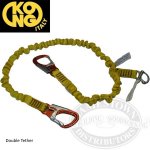
These and a similar offering from West Marine have been common in the US for a decade. There are UK makers of the components, but not the whole rig.

kong_double_harness_tether.jpg

https://www.jamestowndistributors.com/userportal/show_product.do?pid=63677#

http://www.iscwales.com/Products/Snaphooks/SH901-Double-Action-Snaphook/3379/

And look what Spinlock just came out with (I think it has been no more than a week). I think they felt the pressure. Those look like Kong clips to me. How about that. And for suggesting this I was called... sanct......?

https://www.spinlock.co.uk/en/categories/safety-lines/product_groups/performance-safety-lines
 
Last edited:
A point is;

A man died - possibly because he was using inadequate kit for which there are replacements on the shelves today.

2 equations - why was he using that clip? why are 'we' not more aware of the better clips. The fact that Clipper appear to have been using inadequate clips suggest the better clips are not well known in some sailing circles (mine included)

Finally - why the argument - unless some people work for Spinlock why are we not damning the ancient technology and being a bit more supportive of the only work, I know, underlining the inadequacies. I use(d) these clips, I will not be using them now. I'll invest in clips that appear to be more reliable - until such times another report shows even better clips. I know the MAIB will report, maybe in 12 months time - and they hopefully will have more background to the indecent than us and test rigorously - but I'm not prepared to wait 12 months before I go offshore again - and I have a responsibility to my crew.

Jonathan
 
The climbing world already has:
superbly strong but lightweight dynamicshock-absorbing ropes
superbly strong double- and triple- action locking connectors (carabiners) in a wide variety of shapes and mechnaisms to suit almost any situation
a whole range of devices which could be used to create fully adjustable length lanyards, operable one handed, which could prevent your tether ever being long enough to go over the lifelines

It has these because, in climbing, falling is an everyday part of the sport, so over the decades, and particularly recently huge amounts of research, ingenuity and testing have gone into developing products that work to keep climbers safe both in extreme situations and on local crags and indoor walls.

I don't understand the apparent reluctance from some in the sailing world to embrace the application of these to sailing...is it just some kind of unwillingness to accept that others not in the sailing world have come up with better solutions?

Whatever, I'm making my own tethers from climbing components until I see a decent sailing-specific product that betters them.
 
The climbing world already has:
superbly strong but lightweight dynamicshock-absorbing ropes
superbly strong double- and triple- action locking connectors (carabiners) in a wide variety of shapes and mechnaisms to suit almost any situation
a whole range of devices which could be used to create fully adjustable length lanyards, operable one handed, which could prevent your tether ever being long enough to go over the lifelines

It has these because, in climbing, falling is an everyday part of the sport, so over the decades, and particularly recently huge amounts of research, ingenuity and testing have gone into developing products that work to keep climbers safe both in extreme situations and on local crags and indoor walls.

I don't understand the apparent reluctance from some in the sailing world to embrace the application of these to sailing...is it just some kind of unwillingness to accept that others not in the sailing world have come up with better solutions?

Whatever, I'm making my own tethers from climbing components until I see a decent sailing-specific product that betters them.

Very well said. It's all there already. There is no excuse really, now how we design a maritime version of the via ferrata tether? or has it already been done? we just need to add 50% to the cost and label it as the 'Marine' version.
 
Most of us on here reduce the risks to life and limb, by employing sail handling methods which don't involve as much exposure to danger, as some of the methods used by Clipper etc. But I suppose they have to use old fashioned labour intensive methods, so that they can justify having lots of paying crew. :rolleyes:
 
Most of us on here reduce the risks to life and limb, by employing sail handling methods which don't involve as much exposure to danger, as some of the methods used by Clipper etc. But I suppose they have to use old fashioned labour intensive methods, so that they can justify having lots of paying crew. :rolleyes:

I think I'll just sit back and listen on this one.:cool:
 
I'm completely in accord with 'thinwater', 'steveej', and 'neeves' on this. In fact, I have been for way more than 10 years. It was obvious to me before the turn of the century that the personal tether products, accepted as OK by the sailing community and by those in it paid to have a higher awareness of standards, were inadequate. That was informed by having a background in climbing ( albeit limited compared with others ) where awareness of the limits and constraints of the gear was important.

I saw - I still see - on others' boats and on chandlers' shelves personal tethers with old Stubai-style climbing snaplinks outlawed as wholly inadequate 40 or more years ago. Complacency, for sure. That caused me to construct, way more than 10 years ago, my own p'tethers from readily-available products to reflect the 'Via Ferrata' products then available.


25579497878_18e08fcb8b_z.jpg


The sharp-eyed will note the old-style Gibb industrial snaplink ( best in test? ) and a climbers' woven sling - freely available almost everywhere. The cost to me was about one-third of the comparable 'yottie' products at the time. I suggest that setup will still cope with rather more than 300lbs.....

Certainly, the passage of time and recent events indicates these now be updated with better - but I shall still self-select from the best quality products around.
How many readers of this thread will be changing their own inadequate tethers before the sailing season starts.. .?
 
In answer to Zoidberg - I'm not going to change for a month, or so - because I understand that Practical Sailor have a follow up article next month and I don't want to change now and then need to modify in 4 weeks time. In the interim, we use Gibb style hooks, we will use two tether per person as we carry a set of eight and seldom sail offshore with more than 2 of us. However I will review our hard points and I will install spare tethers at appropriate fixed points.

We will then retire all the existing tether and clips and will replace with something more appropriate.

My reasoning for reticence is that I think there may be better ideas for the tether itself and I am happy to wait a few weeks to see if they are forthcoming. I note Zoidbergs tethers - of which I approve (though my approval is of little value as I am a neophyte) and I may use a couple of slings in the meantime, or make up a couple of tethers from dynamic climbing rope (with the eyes sewn with dyneema - another area in which Thinwater shines).

Personally I find this whole 'area' under reported and under investigated and its comforting to see Thinwater, Zoidberg and steveej happy to stick their necks out a bit in the face of some unsubstantiated criticism of Thinwater's efforts.

All credit to Thinwater - an accident happened, he set to, did some work QUICKLY and has come up with what looks like a sensible answer. It might need tweaking, next months issue? but I wonder when other independent results will be available.

Jonathan
 
i am totally behind Thinwater's efforts too, informed by his experience of both sailing and climbing
 
Top