Terrible news from Clipper

For decent protection they shouldn't be underfoot, inboard and waist height would be much better.

A freind has a Contessa which has the jack line along the handrails, at the top of the cabinside. Looks a good idea for that design, but my wheelhouse would get in the way a bit. Waist high would be completely impractical. What would keep it waist high? Would you have to climb over it to get to the mast, then climb over it again, to get back to the side deck?
Sounds dangerous!
I have had no problem in over 40 years with it underfoot, except a bit more wear on the deck paint, minimal in over 40 years.
 
The previous MAIB report on a Clipper mishap recommended they completely envelope the stanchions/lifelines with net. This is now the case on all Clipper yachts. it is laced along the top lifeline and they seem to have drilled the wood toerail and laced to it as well. The netting is a quite wide mesh and on the yachts has suffered some, very minor, damage - but it looks as if it will easily hold a man, or sails on the foredeck. I am not aware that the same requirement is imposed on racing yachts. They also have substantial stanchions, pulpit and pushpit, or more substantial than you see on most production yachts, there did not appear to be any damage, bent stanchions (though I did not look at every yacht, some were still at sea).
(Quote)
-------------------------------------------------------------------------------------------------------------------------------------------------------
I see more and more cruising boats using netting. It also catches a lot more flying fish. Black blocks visibility less than white. Black is also more UV resistant.
Sch 40 stainless pipe makes much better stanchions , lifelines, pushpits and pulpits, than the thin walled ,"Extruded tinfoil" used on most stock boats. It also can be bent and straightened, without the wall collapsing, and with no special equipment, anywhere.

Roller furling eliminates a lot of foredeck work , or the need to leave the cockpit, a major safty factor. With it ,you only need to go foreward to rig down wind gear, a much smoother and safer working situation than going to windward. The $80 furler rig I have been using for the last 35 years has fewer moving parts than a set of sail hanks, by a wide margin.
 
Last edited:
The previous MAIB report on a Clipper mishap recommended they completely envelope the stanchions/lifelines with net. This is now the case on all Clipper yachts. it is laced along the top lifeline and they seem to have drilled the wood toerail and laced to it as well. The netting is a quite wide mesh and on the yachts has suffered some, very minor, damage - but it looks as if it will easily hold a man, or sails on the foredeck. I am not aware that the same requirement is imposed on racing yachts. They also have substantial stanchions, pulpit and pushpit, or more substantial than you see on most production yachts, there did not appear to be any damage, bent stanchions (though I did not look at every yacht, some were still at sea).
(Quote)
-------------------------------------------------------------------------------------------------------------------------------------------------------
I see more and more cruising boats using netting. It also catches a lot more flying fish. Black blocks visibility less than white. Black is also more UV resistant.
Sch 40 stainless pipe makes much better stanchions , lifelines, pushpits and pulpits, than the thin walled ,"Extruded tinfoil" used on most stock boats. It also can be bent and straightened, without the wall collapsing, and with no special equipment, anywhere.

Roller furling eliminates a lot of foredeck work , or the need to leave the cockpit, a major safty factor. With it ,you only need to go foreward to rig down wind gear, a much smoother and safer working situation than going to windward. The $80 furler rig I have been using for the last 35 years has fewer moving parts than a set of sail hanks, by a wide margin.

Maybe true, I rather doubt it given ball bearing races; I hope you notice I'm a proponent of the Clipper boats using roller reefing headsails, but as far as moving parts go hanks win hands down, the most required being a bit of lube and occasional functioning during winter with a pair of pliers.

When headsail roller systems with a sense of humour go wrong one may well be stuck in a good Youtube situation with the sail stuck out in a gale, when part rolled you can't lower the sail unless there's some sort of fanciful knife on a halliard etc, motoring in circles doesn't work in waves, I've tried it - I've been on other people's boats where roller jams full out in a gale happened more than once, but I bet you and I, if suddenly beamed by a passing starship into control of a boat in the Southern Ocean, would be quite keen on a well sorted, top of the range roller set-up ! :)
 
Last edited:
Excellent information, often overlooked. However, I could not find the US Sailing reference regarding harnesses for 5'6" and shorter. Could you guide me?

This 'bear of little brain' ( cultural reference ) has done some delving and found the requested stuff within the Cruising Club of America's 'SASMoments' section of their website....

https://www.cruisingclub.org/safety-sea#sasmoments

....and within the several excellent documents list-linked therein. I'm certain that the nominated officer Ron Trossbach or his successor would be pleased to amplify, on request. I have been unable to trace a UK supplier/agent for Kong. The nearest seems to be in Belgium, and for several reasons I/we are not on best terms with The Bluddy Belgians at present..... However, Petzl is well supported hereabouts.

As for 'the camera never lies'.... that may be true of the devices and filmstock but, as someone who once-upon-a-time operated up to 9 cameras simultaneously, the photographer sure as hell does. :rolleyes:
 
This 'bear of little brain' ( cultural reference ) has done some delving and found the requested stuff within the Cruising Club of America's 'SASMoments' section of their website....

https://www.cruisingclub.org/safety-sea#sasmoments

....and within the several excellent documents list-linked therein. I'm certain that the nominated officer Ron Trossbach or his successor would be pleased to amplify, on request. I have been unable to trace a UK supplier/agent for Kong. The nearest seems to be in Belgium, and for several reasons I/we are not on best terms with The Bluddy Belgians at present..... However, Petzl is well supported hereabouts.

As for 'the camera never lies'.... that may be true of the devices and filmstock but, as someone who once-upon-a-time operated up to 9 cameras simultaneously, the photographer sure as hell does. :rolleyes:

Which was my point, you and I have worked on similar ( important no BS ) systems, but otherwise I delight in making things and or people look as good or bad as seems fit, the much later photoshop is just too easy it doesn't seem fair.

Anyway I prefer webbing jackstays, but I do think they require a thorough washing off with fresh water regularly to try to remove salt crystals, and while I don't know Clipper's routine on this, I'd suggest replacing all webbing annualy - of course I don't think anyone was suggesting unrestrained jackstays the length of a 70' boat.
 
Last edited:
....I have been unable to trace a UK supplier/agent for Kong. The nearest seems to be in Belgium, and for several reasons I/we are not on best terms with The Bluddy Belgians at present..... However, Petzl is well supported hereabouts.

Try Olympia Triumph Manufacturing. Item 5740-RH-21 CE in the catalog looks a lot like a Kong hook. Additionally, they are listed on the Kong web site as a retailer.
 
Anyway I prefer webbing jackstays, but I do think they require a thorough washing off with fresh water regularly to try to remove salt crystals, and while I don't know Clipper's routine on this, I'd suggest replacing all webbing annualy - of course I don't think anyone was suggesting unrestrained jackstays the length of a 70' boat.

My guess is the the Clipper yachts are thoroughly hosed down with fresh water at every stopover, though whether they pay particular attention to jackstays? The race takes 11 months and I would have thought, based on no reasoning (except common sense) that the jacklines are replaced at the end of the race and then renewed, again, before the next race (these yachts might do a 'few' more World races).

We only install our tape jackstays when we go 'offshore' we take them off, wash and dry them till the next 'cruise'.

And I agree - state of the art, top of the range, proven, furling system - for the primary headsail, I'd be quite happy with hanked on smaller headsails, No3, No4 , on an inner forestay and storm jib on a 'more' inner stay. + a furling and droppable Code Zero off the Bowsprit.

Jonathan
 
Try Olympia Triumph Manufacturing. Item 5740-RH-21 CE in the catalog looks a lot like a Kong hook. Additionally, they are listed on the Kong web site as a retailer.

Quite right, 'tw'. I've tracked that given lead to a subsidiary company at Wareham, UK. Their 'phone is continuously engaged....

I note from the catalog(ue) that they seem to offer a 'catch-free' hook....

[URL="]


Edit: I note again today - 9 Jan 2018 - that the above phone is again 'continuously engaged', suggesting something adrift with that business. Or British Telecom.....
 
Last edited:
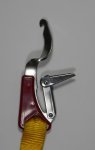
If the load is in the basket (crook, as you say), the gate is fully latched, and the carabiner is NOT loaded from the side, the Spinlock carabiner tests very strong, well over 2 tons. Same with the Gibb (the test results were nearly identical).

If the load is from the side (even fully latched) or on the nose (there are several very valid theories floating around, none fully proven that I am aware of, since apparently no one saw exactly how it was hooked) the hook can begin to distort at about 300 pounds. At that point, even if the webbing did not start near the nose, it can easily slide to the nose and become caught on the pin groove in the nose. Then, as the force builds, the carbabiner will stretch out as you see.

This is a subtle failure to diagnose, and there is more than one way it could have begun. However, it seems probable that it ended with the nose hooked on something; that is the only way to duplicate the distortion.

Hi TW
I can appreciate that the rate of deformation will happen at a much lower loading when the fabric of the 'jackstay' is caught on the nose of the hook. What is load for deformation when this happens on the Kong type carabiners? I know the 'open' gate test for such a carabiner is about 8kN but the loading from the nose would surely vastly reduce this? If the Gibb / Spinlock move at around 300lb, what do the Kongs move at?
I'm not sure that I see a benefit in the 'no snag' hook nose as for any fabric to be caught on the nose of the hook it means that the gate isn't closed and therefore the fabric has the potential to 'fall' out of the carabiner. Once inside the carabiner with the gate closed then the risk of 'snagging' is removed.
 
How is that ' catch free ' ? From the inset pic with a weaker almost sacrificial bit inside the hook it looks the opposite, I must be missing something ?

Snag free is what was meant. It is far less likely to snag on webbing when clipping on unclipping, as compared to the nose latch pin groove on a gibb-style cabariner

34a.%u00252Bgibb%u00252Bnose%u00252Bhooked.jpg


It is also not a Kong Tango. This is (the image didn't want to link).
http://theopsdeck.com/img.prod.CTC/PROD - Kong Tango Safety Snap.open.jpg

The nose is not sacrificial and is in fact not the failure point when pulled to failure in any test. Most of the load is along the spine. This is true of every D-shaped carabiner I have ever tested, including the Gibb.
 
Hi TW
I can appreciate that the rate of deformation will happen at a much lower loading when the fabric of the 'jackstay' is caught on the nose of the hook. What is load for deformation when this happens on the Kong type carabiners? I know the 'open' gate test for such a carabiner is about 8kN but the loading from the nose would surely vastly reduce this? If the Gibb / Spinlock move at around 300lb, what do the Kongs move at?
I'm not sure that I see a benefit in the 'no snag' hook nose as for any fabric to be caught on the nose of the hook it means that the gate isn't closed and therefore the fabric has the potential to 'fall' out of the carabiner. Once inside the carabiner with the gate closed then the risk of 'snagging' is removed.
Open gate is different from nose hooking (open gate only means that the gate is not latched, but that the load is still in the basket). Gibb-style hooks are pretty strong open gate. However, the marine code (ISO 12401) does not require strength testing, including open gate, which is why the value is not posted. Climbing carabiners are required to have the results stamped on the spine.

Regarding full test results, you will need to subscribe to Practical Sailor and get the report in about one month. However, climbing carabiners are many times stronger nose hooked or side loaded. It's not very close. Ask a climber if they would use a Gibb style hook and be prepared for laughter. There are several design features that classify them as toy carabiners.

The advantages of snag-free nose designs are two-fold:
1. They are much faster and easier to use. Like 3-5 times. You never fight getting the hook on or off the webbing.
2. It is less likely that the carabiner will be improperly closed with just a little bit of webbing caught in the gate. But this latter reason is secondary. Reason 1 is enough.

Nearly all locking climbing carabiners have gone to what is now called key lock noses. Nobody wants the pin deign anymore because it is simply obsolete. There are hold-outs, but they are dwindling. Also climbers are clipping rope, not webbing, which is much less snag prone, the ONLY reason pin gates still exist. Finally, without getting into fine details, climbers clip the rope into the carabiner in the reverse direction of most sailors when leading a route; from the nose down wards, not sliding up the gate, in part because the rope snags less this way. Clipping a free hanging carabiner to a free rope with one hand is an art.

Marine carabiners can be re-engnieered to meet modern standards. Let's encourage them. I still have climbing carabiners from the 60s. I don't use them, not because of deterioration, but because they are not as functional and robust as new designs. Times change.
 
Last edited:
Maybe true, I rather doubt it given ball bearing races; I hope you notice I'm a proponent of the Clipper boats using roller reefing headsails, but as far as moving parts go hanks win hands down, the most required being a bit of lube and occasional functioning during winter with a pair of pliers.

When headsail roller systems with a sense of humour go wrong one may well be stuck in a good Youtube situation with the sail stuck out in a gale, when part rolled you can't lower the sail unless there's some sort of fanciful knife on a halliard etc, motoring in circles doesn't work in waves, I've tried it - I've been on other people's boats where roller jams full out in a gale happened more than once, but I bet you and I, if suddenly beamed by a passing starship into control of a boat in the Southern Ocean, would be quite keen on a well sorted, top of the range roller set-up ! :)[/QUOTE

The solution? Keep it simple!
There is no way my 5/8th ID sch 40 aluminium pipe is going to jam on a 5/16th stay, nor are plastic bushings with a 3/8th inch hole going to jam on a 5/16th stay.
Reminds me of the time my "high tech" ball bearings on one of my bike pedals froze. They had, as I am told by bike mechanics, all bikes do, opposite threads ,one right hand and on left hand, each on the wrong side, which made sure that when the bearings froze, the pedals would unscrew themselves every 50 feet.
I replaced them with a piece of poly plastic with a hole in ,riding on a welded on half inch stainless rod (super low tech). No way is poly going to bind or freeze onto that rod . Been riding them for several years now, and no sign of wear. Will last my lifetime, at that rate.

No, more complexity doesn't mean quality, nor "Top of the range." Often, it just means "salesmanship!"
"Simplicity is the true genius." Albert Einstien.
I believe reliability, often thru simplicity, is "Top of the range" in real, practrical terms.
If I won millions in the lottery, I wouldn't change my very simple furler.
A friend on Cortes Island had a rig like mine,which he had made up and used for decades, on his 38 footer.Then he bought a very expensive and complex commercially made one, which he has used for several years now.
When I asked him what the diffence in benefits of the new one were, he said "None whatsoever!"
When I first sailed in to New Zealand in 1973, the Kiwis had been using extrusion type furlers for years ,of the extremely simple type I have been using for 35 years, with no problems. Some had done many trips to the islands ( Fiji ,Cooks, Tahiti, etc) and back with, no problems.
They cost about $100.
When I got back to BC, I couldnt believe how complex they had made the same simple idea, and how they used that to grossly increase the price, and deter cruisers from building their own.
I wote an article in Pacific Yachthing to describe how to build one's own ,and quickly saw a lot of what I had described, on more boats, with very happy owners.
 
Last edited:
I keep It Simple - and more efficient to windward which you don't seem to mention - by using hanked sails on my A22.

If you have a world beating roller system which will stand the lateral loads of a big headsail, why aren't you a zillionaire with it on the market already ?
 
I keep It Simple - and more efficient to windward which you don't seem to mention - by using hanked sails on my A22.

If you have a world beating roller system which will stand the lateral loads of a big headsail, why aren't you a zillionaire with it on the market already ?
Because it cant be patented, and anyone can build one, for very little money.
I have all the money I need , and no need to persue more.
Sch 40 pipe is much stronger, and more able to take loads than most extrusions made for furlers .Mine have never had that problem in 35 years, many ocean crossings, and several circumnavigations.
 
I'd like a bit more detail about your system please, and who did these ocean and RTW trips, are there any crew available to comment or verifiable photo's / logs?

I don't want it appear I don't believe you.

it's just that I don't believe you without evidence. :)
 
Last edited:
Virtually every yacht I see now at boat shows has a furling headsail and many now furling mains. Appreciating that some of these yachts never seem to use their sails at all and others only sail in good conditions - but if modern furling systems were unreliable then there would be a significant hue and cry - led by the major yacht builders. Furling systems can go wrong but constant checking of the various components has meant that our headsail furler has been trouble free for almost 20 years (and we have a fair number of miles under our belt). We have had furling rope jamming due to uneven leads - but that is easily sorted through trial and error. I'd agree that a well made hanked on headsail offers better performance - but I'd rather the convenience of the furler. If we do anticipate character building winds and we will be sailing to windward - we take the 150% genoa off the furler and replace it with a 100% self tacker (which I find is quite possible single handed - though folding the 150% (35m^2) certainly keeps me busy!)

Jonathan
 
Virtually every yacht I see now at boat shows has a furling headsail and many now furling mains. Appreciating that some of these yachts never seem to use their sails at all and others only sail in good conditions - but if modern furling systems were unreliable then there would be a significant hue and cry - led by the major yacht builders. Furling systems can go wrong but constant checking of the various components has meant that our headsail furler has been trouble free for almost 20 years (and we have a fair number of miles under our belt). We have had furling rope jamming due to uneven leads - but that is easily sorted through trial and error. I'd agree that a well made hanked on headsail offers better performance - but I'd rather the convenience of the furler. If we do anticipate character building winds and we will be sailing to windward - we take the 150% genoa off the furler and replace it with a 100% self tacker (which I find is quite possible single handed - though folding the 150% (35m^2) certainly keeps me busy!)

Jonathan

Yes, but you're not selling expensive holiday berths to dozens of people, and finding something for them to do. :rolleyes:
 
Top