Tepid hot water - what to check...

gregcope

Well-Known Member
Joined
21 Aug 2004
Messages
1,634
Visit site
Any gotchas/clues as to why our domestic hot water is no longer hot. Barely tepid?

For various reasons Spindrift has had a long time out of the water; So work included replacing the perished clarifier feed hoses, changed the engine coolant as well as replacing the taps.

The taps work as in water comes out when hot is selected.

Engine has been run multiple times for around 30mins each, and there is no hot water. I have topped up the coolant a few times since replacement.

The engine feed hoses get vhot to the touch (both feed and supply) at the clarifier end, which suggests there is enough coolant and no airlock.

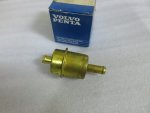
Their is a mangy old thermostatic valve on what i assume is the engine feed side.

I am pretty sure before (it was a while ago) even a short motor would produce piping hot water.

Any thoughts / things to check?

thanks!
 
When dealing with a car engine, you would have the coolant being heated within the cooling galleries of the engine block, then being pumped out through the hose to the radiator, where the airflow cools it. It then continues through another hose, back into the block. On first starting up a cold engine, the coolant is diverted through a bypass by a thermostat, usually in a housing at the front end of the cylinder head and rated to open at approximately 90° C, so that it does not go to the radiator, but is only allowed to circulate within the engine itself. If the thermostat fails to open, the engine will overheat and you will notice that your heater is not delivering any heat.
When you transpose this to a 'marinised' engine, the radiator is replaced by the heat exchanger, which uses cold seawater to cool the coolant, and your calorifier replaces the heater matrix.
In short, the symptoms you describe point to the thermostat staying closed , preventing hot coolant reaching the calorifier. The standard test for a thermostat is/used to be to take it out and put it in a pot of water on the stove, heat the water and use a thermometer to ascertain at what temperature it opens. If it doesn't open it obviously needs to be replaced.
If it does open the answer lies elswhere; you mention that you changed the coolant, which entails draining the system, perhaps you introduced an airlock. I'm not familiar with calorifiers, but logically they must have a bleed screw to remedy such an event.
 
Hoses to clarifier are hot as is heat exchanger so thermstat is working okay.

I suspect the thermostatic control valve too...

As to working, logically you need a few things;

no leaks in the clarifier (doubt it as coolant would leak out as its under higher pressure; decent hot coolant; sufficient flow.
 
You might have an airlock in the calorifier coil. Run the engine up to temperature and slacker the higher coil connection to the engine system to let air out. If coolant comes out then no airlock.
 
You might have an airlock in the calorifier coil. Run the engine up to temperature and slacker the higher coil connection to the engine system to let air out. If coolant comes out then no airlock.

I'm not sure I understand the concept of an "airlock". If hot water is flowing in to the calorifier, how does an "airlock" suddenly stop it?
 
Being airlock is a good call.

With older vehicles I remove the highest hose then fill the matrix through the hose.
All done cold then you do not scald yourself.
 
Is 30 minutes long enough?

I don't think it is on my boat. The domestic hot water will be scalding if I run the engine for several hours, but not for 30 or 40 minutes - I think that'll raise it to barely above tepid.
 
Last edited:
As KompetentKrew says.. When you say you've run the engine a few times for about half an hour - Was that actually motoring at sea or just running whilst still tied up in a marina? If still tied up then I'd say the engine has not worked hard enough to really heat up the water.
 
As PVB has repeatedly stated, if both the input hose to the calorifier and the output hose to the calorifier are at engine operating temperature, there cannot be an airlock. If there is any airlock or blockage or any kind the output hose will be much cooler that the input hose.

Provided that the engine has been run for long enough, the problem must be in the output from the calorifier to the domestic hot water supply. The most likely culprit is a stuck thermostatic valve or a partial blockage/semi-closed valve/airlock somewhere in the hot water feed side. The latter would usually show itself as a lower water pressure in the hot water supply rather than lower temperature but this might not be obvious with mixer taps.

Richard
 
Last edited:
Is 30 minutes long enough?

I don't think it is on my boat. The domestic hot water will be scalding if I run the engine for several hours, but not for 30 or 40 minutes - I think that'll raise it to barely above tepid.
I think several hours is more than necessary, but the water may have started at a far lower temperature than in the summer and the OP may have under-estimated the amount of motoring that would be needed, notwithstanding the possibility of a plumbing disorder.
 
Running engine has been in gear, lowish revs (1500 odd).

trip to locker semi successful... i could not undo the plumbing fittings due to corrosion so I have applied plus gass.

Interestingly the coolant feed pipe was already hot after only 10mins of engine running which makes me wonder which side of the volvo penta 2030B thermostat its on.
 
It could be the cold temperatures this time of year as well as a rose tinted view of how quickly it heated up in the past
 
My raw water cooled Bukh would heat the calorifier to over comfortable hand temperature in 15 minutes of motoring and impossible to touch in 20 minutes. My indirectly cooled Yanmar heats it even faster. In 5 minutes fast tick-over at the pontoon there is enough hot water to prove it is all working well.
 
Any gotchas/clues as to why our domestic hot water is no longer hot. Barely tepid?

For various reasons Spindrift has had a long time out of the water; So work included replacing the perished clarifier feed hoses, changed the engine coolant as well as replacing the taps.

The taps work as in water comes out when hot is selected.

Engine has been run multiple times for around 30mins each, and there is no hot water. I have topped up the coolant a few times since replacement.

The engine feed hoses get vhot to the touch (both feed and supply) at the clarifier end, which suggests there is enough coolant and no airlock.

Their is a mangy old thermostatic valve on what i assume is the engine feed side.

I am pretty sure before (it was a while ago) even a short motor would produce piping hot water.

Any thoughts / things to check?

thanks!
Although you can feel the hot water in the hoses between engine and calorifier you may still have air in the system. I have had the same problem where I have a loop of the hose going up then down again and some air gets trapped at the top of the loop. Not enough air to stop the flow yet not enough flow to carry the air bubble through the system. Took ages to heat the calorifer. I put a bleed valve at the top of the loop and despite there beeing hot water there, air did bleed out after which I got more/quicker hot water in the calorifier.

Also, you mentioned a manky thermostat in the supply hose. That sounds like the type Volvo Penta used to fit (long discontinued) that restricted flow, allowing the engine to warm up faster, before the thermostat opened and then let more hot coolant flow to the calorifier. Try removing it and link the two hose ends with a piece of copper tube. This is what this thermostat looks like
calorifier additiional thermostat 855844.jpg

Www.solocoastalsailing.co.uk
 
Last edited:
Top