
Techy Question - Using tank sender also as a high-limit / low-limit switch

sailorbenji

Well-Known Member
Joined
20 Oct 2011
Messages
205
Visit site
Hi, one for the incredible hive-mind here....

We have a watermaker on board, that can utilise two tank level switches (one at the bottom, one at the top) to both trigger water making and stop water making respectively.

The suggested tank level switches are this kind, simple volt-free contacts mounted in such a way that they are NO and close when 'triggered'.
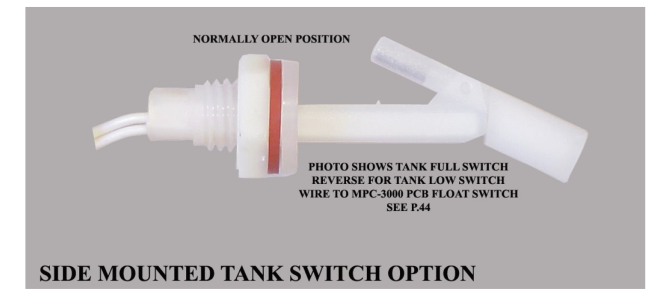
Screenshot 2025-04-24 at 12.27.27.png
My issue is I cannot get to the side of the tanks to install 2 additional switches like this, but we do have a fully functioning analogue tank gauge reading from a resistive type float sender, 0-180 ohm I believe.

I wondered, and appreciate this may mean delving into a bit of an electrickery project, if anyone could recommend some way that we could use the resistive sender to generate full and empty triggers, which we could wire into the water maker instead of these dedicated switches?

I have some experience with ESP devices etc, but am by no means a programmer.....

Any suggestions, or similar projects (or even products) that might do this, please point me in the direction...or of course any other solutions.

Thanks, Ben
 
Hi, one for the incredible hive-mind here....

We have a watermaker on board, that can utilise two tank level switches (one at the bottom, one at the top) to both trigger water making and stop water making respectively.

The suggested tank level switches are this kind, simple volt-free contacts mounted in such a way that they are NO and close when 'triggered'.
View attachment 192602
My issue is I cannot get to the side of the tanks to install 2 additional switches like this, but we do have a fully functioning analogue tank gauge reading from a resistive type float sender, 0-180 ohm I believe.

I wondered, and appreciate this may mean delving into a bit of an electrickery project, if anyone could recommend some way that we could use the resistive sender to generate full and empty triggers, which we could wire into the water maker instead of these dedicated switches?

I have some experience with ESP devices etc, but am by no means a programmer.....

Any suggestions, or similar projects (or even products) that might do this, please point me in the direction...or of course any other solutions.

Thanks, Ben
Certainly very easy using something like an Arduino Nano to read in resistance and then output some other on/off signal. Quite possibly there's other off the shelf items too that don't need any coding.
 
Certainly very easy using something like an Arduino Nano to read in resistance and then output some other on/off signal. Quite possibly there's other off the shelf items too that don't need any coding.
That's what I was thinking along the lines of....I've just not managed to find a pre-existing project I could jump on the back of...wiring is fine for me, but programming wise I'm basically a beginner.
 
That's what I was thinking along the lines of....I've just not managed to find a pre-existing project I could jump on the back of...wiring is fine for me, but programming wise I'm basically a beginner.
Reading the input resistance should be easy:
sensorValue = analogRead(A4);

With the testing tools you can see what values it reads for the top/bottom of your sensor and map accordingly.

If your water maker just wants a simple open/closed circuit then, very easy to simply open/close one of the digital outputs based on the input resistance value with something like
digitalWrite(3, HIGH); or digitalWrite(3, LOW);

The beauty of an Arduino is that having a play costs pennies!
 
The electronics could far simpler than invoking an arduino computer. All you need is 2 comparators. Something like a 741 Op amp with a stable voltage froma zener diode on one input and the voltage from the sender via an adjustable potentiometer to set trigger level. The output will toggle from high to low. Feed this toa transsitor switch to operate a relay. Build on a small circuit board fed from 12v supply. Find an electronics nutter for help and a circuit. ol'will
 
I have some experience with ESP devices etc, but am by no means a programmer.....
Seems like overkill (although might be just as easy).

However you should be able to do it with no programming / microcontrollers.

Probably the hardest part is making sure whatever you do doesn’t stop your 0-180 gauge working!

It seem you need two relays - one which closes at close to 180ohm and one which closes at some lower value (you might want to be able to
The electronics could far simpler than invoking an arduino computer. All you need is 2 comparators. Something like a 741 Op amp with a stable voltage froma zener diode on one input and the voltage from the sender via an adjustable potentiometer to set trigger level. The output will toggle from high to low. Feed this toa transsitor switch to operate a relay. Build on a small circuit board fed from 12v supply. Find an electronics nutter for help and a circuit. ol'will
Does either approach stop the original gauge working?
 
I've been using Raspberry Pi Picos for this sort of thing. They have a reasonably accurate analogue input and only cost a fiver.

If you ask nicely, Grok will help with the coding
 
my water maker has a 3 way divert valve to direct the Watermaker output to either tank or to a sink open tak so the quality of the Watermaker output can be checker before feeding fresh water to the storage tank to save contaminating the water tanks
 
Thanks all for the many thoughts and ideas on this. Lacking the programming knowledge, in the end I’m trying a semi-off-the-shelf solution as linked by William above. Seems to work, what I’m not sure is if this has any affect on the actual gauge read out…if I cut power to the two circuit board devices, the gauge needle doesn’t seem to move, so
I presume not?

Time to tidy it up and design/3D print a box for it all.

Still surprised there’s nothing like this out there as a product.

 
Last edited:
The additional connections to the gauge system should not affect the accuracy. This based omn the expectation that the gauge circuit will be low resistance while the comparator input will be quite high resistance ie no current drain. You tests seem to confirm that. ol'will
 
Thanks all for the many thoughts and ideas on this. Lacking the programming knowledge, in the end I’m trying a semi-off-the-shelf solution as linked by William above. Seems to work, what I’m not sure is if this has any affect on the actual gauge read out…if I cut power to the two circuit board devices, the gauge needle doesn’t seem to move, so
I presume not?

Time to tidy it up and design/3D print a box for it all.

Still surprised there’s nothing like this out there as a product.

Loads of units out there for tank level/pump etc. control. Most however need their own sensors. Have a look for "Tank level control" on Google.
 
Top