Teak Sealer That Leaves The 'Grey' Look?

So I have a quick update on the teak and its not all great news.
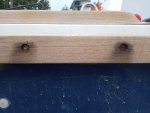
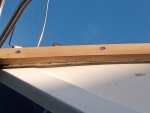
Unfortunately after a couple rains some of the dark seeping from the teak bolt plugs started to come back. Even on pieces that looked really nice before. I tried oxalic acid and while it lightens the whole area, those rings are pretty dark and won't budge. So it looks like I'll have to pull some plugs and clean all the black out, epoxy over the bolts, epoxy/fill the hole and add new teak plugs. Before of course three coats of woodskin. There are at least 40 plugs on the rubbing strake with dark black around, so this is going to be probably a few weekends job. And the teak is pretty quickly turning grey already so it will need to be sanded/and/or cleaned with oxalic. Again. Yeah.

So this job is not even close to done. But I've poured such a ridiculous amount of time in so far (8 days?!) that it would be a shame to not finish it properly at this point. I'm invested.

Good news is I ordered a few bags of teak caps so I don't have to make my own, and they should be in tomorrow :)

Sorry wish I had pics of how much black came back. Will do next time.
Onward and upward!
 
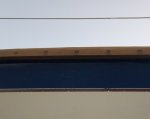
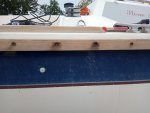
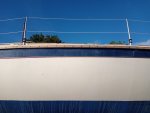
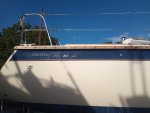
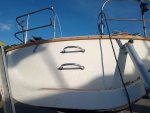
A quick update with a few photos of how the dreaded black circles are coming back (see below).
Also my Whitecap brand teak plugs arrived and they are very nice. Unfortunately most of the holes are so shallow that the plugs hit the bolt heads before being deep enough to really gain any grip. I have little confidence that they will hold once epoxied and hit with a chisel or when sawing off the tops. One cap that came out from the transom rub rail was literally less than 1mm thick!

So plan B?
Hmm well I can see at least a couple of options :

1. One option is to chisel the plugs down really thin (2-3mm), place them with epoxy, then sand down to size. And for the black holes, well they were cleaned up really nice before the last couple rains which brought the black back. Maybe if I sand/oxalic again, then woodskin really quick before the next rain, they will seal in. But I'm afraid the black might come back anyway. And I will have used my woodskin. And it will be more work to sand down and fix.

2. Drill/Dremel out the holes and clean out all black stain, seal bolts with epoxy, and then add a 5-7mm strip of teak over the top to make a new surface. Afraid to even ask how much that teak will cost! Though this might be the nicest looking solution. Also quite a pain to install without assistance as this is obviously at least a two person job.

3. Clean out and epoxy as above, but add a bronze or stainless rubbing strip. Might also be pretty spendy, but one guy said it could be done for 300 Euros which isn't too bad really. It's not thousands anyway.

4. Clean out and epoxy as above, but with wood colored epoxy filler. And do all the holes so it looks consistent. Though the color is unlikely to match exactly, at least the holes will all be the same color which should look pretty decent. Someone on the Westerly forums recommended this stuff below and his came out looking really good. He said it matches Westerly teak nicely. No idea how the woodskin will deal with the epoxied holes, but who knows maybe the woodskin will help to blend them in.

405 Filleting Blend

I'm leaning toward option 4 though I know this means drilling and cleaning out ALL holes. I have a few drill/Dremel attachments that should help with this work and at this point I don't mind the extra labor.
I've put so much time and work into this teak project that I really do want to get a good result.

As usual, any suggestions appreciated!


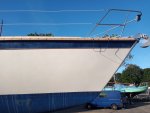
BTW yes, those old pinstripes are going to go!
The rubber eraser wheel drill attachment I used to debadge her of her old name worked surprisingly well. Will use again :)
Rails 1.jpgRails 2.jpg
 
So with no new 'surprise' quick easy solutions after my last post, I went ahead as planned with option 4. To remove the caps and clean the holes I tried several things then settled on the following procedure:
1. Drill small pilot hole 3mm.
2. Drill larger hole 7mm.
3. Pry out the cap with an awl while using a putty knife to hold down and to avoid removing any stuck on surrounding wood.
4. Use awl and hammer to gently chip out rest of plug material.
5. Clean out all black until good brown wood exposed with Dremel and small wire brush attachment.
6. Repeat 4-5 for any stubborn spots.
7. Clean and polish bolt head.

The hardest part by far was remaining patient and slow so as to not damage surrounding wood with chips or an off shaped hole.
Literally every hole was different and required a slightly unique solution.
3 full days work. 138 holes cleaned.
The most frustrating part- waiting, sometimes for days b/c rain season is here!
The most rewarding part- this part done! They all cleaned up pretty well. Looking forward to dry day epoxy :)
See results below:

An Early Attempt, Before Dremel, See Chips Around Edges, Solved Later By Putty Knife:
IMG_20220923_120009_226 (Large).jpg

After Dremel (Left Bolt):
IMG_20220923_120018_383 (Large).jpg

Finished Work:
IMG_20220924_174458_832 (Large).jpg
IMG_20220924_174524_116 (Large).jpg
IMG_20220924_174556_754 (Large).jpg
IMG_20220924_174618_880 (Large).jpg

Some are much thinner than others!
IMG_20220924_174634_288 (Large).jpg
 
I know now that this will never look perfect. But I'll be happy just to have made the effort to seal it up properly and preserve what teak is left.

Next Steps:
1. Wait for dry day.
2. Tighten down whatever bolts will tighten. Found at least one that was very loose. Care on this step as inside nuts are fiberglassed in, and the last thing I want is to break that seal and get leaks behind my cabinetry!
3. One final clean/light sand of outside black marks.
4. Do test batch of epoxy and West 405 colored filler on aft rail.
5. Settle on a ratio for filler/epoxy, then do the rest.
6. Woodskin.

Just having one coat of woodskin will be a major milestone in this project. Two more coats on dry days as opportunities arise.

Also good news: After several rains, none of the opened/cleaned holes bled any more black, not even inside.
This is great news as it means the black was probably accumulation from a long time, maybe many years.
Also only less than 1mm of opening up was required for most holes, so most of the wood is still good.
I feel like I'm on the downward part of the slope now, with this painstaking task over :)
 
Top