Teak decks on an affordable old sailing boat - avoid like the plague?

Simon F

Well-Known Member
Joined
1 Jan 2019
Messages
83
Visit site
Hello All,

I'm looking for a 30/32ft sailing boat in the £20,000/25,000 range and I'm considering fairly old ones as it seems to be a cost effective way to get a heavy long keeled, off-shore capable boat in that price range. How deterred should I be by teak decks? I gather that they need replacing periodically and the cost could buy the whole boat, but can they be removed cost effectively and replaced with something grippy and more durable at a cost that makes sense to a budget conscious cruising sailor? Or is it wisest to swerve teak decked boats altogether? I'm a d.i.y. sailor but I'm allergic to epoxy, so I wouldn't be able to do all of a job like that myself.

Thoughts and anecdotes are welcomed.

Simon.
 
Hello All,

I'm looking for a 30/32ft sailing boat in the £20,000/25,000 range and I'm considering fairly old ones as it seems to be a cost effective way to get a heavy long keeled, off-shore capable boat in that price range. How deterred should I be by teak decks? I gather that they need replacing periodically and the cost could buy the whole boat, but can they be removed cost effectively and replaced with something grippy and more durable at a cost that makes sense to a budget conscious cruising sailor? Or is it wisest to swerve teak decked boats altogether? I'm a d.i.y. sailor but I'm allergic to epoxy, so I wouldn't be able to do all of a job like that myself.

Thoughts and anecdotes are welcomed.

Simon.
Yes they can be removed and the holes and mess insured repaired and the deck painted the only problem I could foresee is if the teak deck had been compromised enough to allow water to get underneath it and into a cored deck would be a whole different prospect of repairing especially if the teak had been laid directly on a plywood deck.
 
Depends on first the boat and type of construction and second condition. Not all teak decks are the same and you have to treat every one on its merits. On balance though chances of finding the right goat with a good deck that has a few years' of life left in it at that price point are slim
 
In 1982 I bought a 1973 Nauticat 33, I found that when I opened the anchor locker the wood which was holding the teak deck up had gone soft as you could stick a knife in it. Perhaps there is a way of sealing it but then the boat was only 9 years old and also had been treated for osmosis.
 
...the right goat with a good deck ...
Like this? :)

goat-playing-wooden-deck-bellville-south-africa-137908886.jpg
 
I love a teak deck underfoot, and to look at, but at the age any will be now I would be extremely wary unless in truly excellent condition.

There's a huge amount of work in removing and making good, easily avoided by buying a different boat. Where once they fetched a premium I'd be expecting a discount nowadays.
 
Hello All,

I'm looking for a 30/32ft sailing boat in the £20,000/25,000 range and I'm considering fairly old ones as it seems to be a cost effective way to get a heavy long keeled, off-shore capable boat in that price range. How deterred should I be by teak decks? I gather that they need replacing periodically and the cost could buy the whole boat, but can they be removed cost effectively and replaced with something grippy and more durable at a cost that makes sense to a budget conscious cruising sailor? Or is it wisest to swerve teak decked boats altogether? I'm a d.i.y. sailor but I'm allergic to epoxy, so I wouldn't be able to do all of a job like that myself.

Thoughts and anecdotes are welcomed.

Simon.
Unless you get a very good survey saying it doesn’t need replacing or ripping up steer clear if you are allergic to epoxy or any of possible dust particles from sanding etc
 
I love a teak deck underfoot, and to look at, but at the age any will be now I would be extremely wary unless in truly excellent condition.

There's a huge amount of work in removing and making good, easily avoided by buying a different boat. Where once they fetched a premium I'd be expecting a discount nowadays.
Thanks, that's confirmed what I thought.
 
+1 for avoid.

I had teak side decks removed and a million screw holes filled fortunately with no core deterioration. Very laborious. It was only justifiable to me because the rest of the boat was good and hard to find. Only consider if the boat is special enough to justify.
 
+1 for avoid.

I had teak side decks removed and a million screw holes filled fortunately with no core deterioration. Very laborious. It was only justifiable to me because the rest of the boat was good and hard to find. Only consider if the boat is special enough to justify.
Not all teak decks are laid like that which is why you have to look at the individual boat. Some of that age (70s/80s) may well have had a new deck still with life in it. It is fairly easy to check if there is a problem. Visual inspection of caulking seams then soak the deck on a warm day and watch as it dries. Any localised spots that do not dry quickly are suspect.

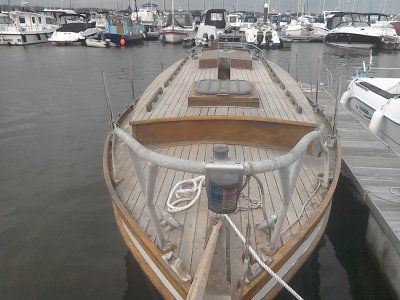
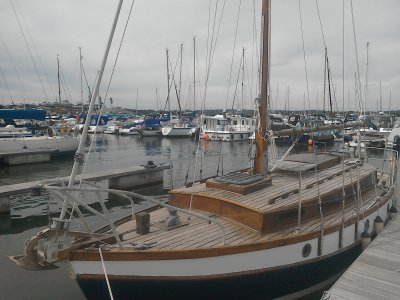
If you are lucky you might find a boat like the one in the photo which I glued a 5mm teak strip deck on. 7 years old when the photo was taken. No chance of leaks because no fastenings and would have expected at least 25 years or more if covered up every winter.
 

Attachments

  • IMG_20190709_180141.jpg
    IMG_20190709_180141.jpg
    931.2 KB · Views: 30
  • IMG_20190717_171933.jpg
    IMG_20190717_171933.jpg
    918.7 KB · Views: 30
When I bought Tiller Girl in 1991 she still had the original 1" teak deck from 1963. After a couple of years I found that repairing seams was unsuccessful - I found why the original screws were plain steel so in certain areas screws had failed and excessive seam movement meant reseaming was only really a temporary remedy. So I decided I had to lift the deck. I then tested how long it took me to draw one screw without damaging the the teak. Given that I was in full time work, I estimated it would take me several years to remove the deck. I decided that I had do it properly and remove it as quickly as possible. That took only a day or so. The 1" teak had been laid on 1/4 inch ply so the fresh water had travelled and caused damage. The net damage was some half beams, a section of the starboard beam shelf and I chose to replace the gunn'les. Not difficult, not expensive (in 1995). I decided not to relay teak. I choice an expensive high quality sapele marine ply protected with glass and resin. The product was a lovely taut boat with absolutely no leaks. One season's work (because I could only do it at weekends).

I only parted with TG on account of advanced arthritis and I still miss her.

Classic signs of fresh water leaking of the deck - pouting seams. blackened varnish (I am assuming there are no obvious leaks)
 
Last week was aboard a 1970-ish yacht with teak deck that was original but still in very good order. Very high quality build. Huge difference from the "teak deck" options on current mass production boats, which are thin, and not as good quality teak. I've owned a boat with elderly teak decks and in general would prefer to avoid them, but if genuinely in very good order not necessarily a deal breaker.
 
We have an old teak-decked boat. After 30 years there is still 10mm of teak deck left. That’s the thickness of todays’s new boats with teak decks. Yes, we need to re-caulk in places and remove screws and re-plug using low viscosity epoxy to seal and glue where the screws went. We also borocol the decks regularly. But at £30K+ to replace with synthetic teak I we think we’ll take the risk given the 10mm of teak left. It’s the thickness of teak that’s left that will determine whether the deck has any life left.
 
When I bought Tiller Girl in 1991 she still had the original 1" teak deck from 1963. After a couple of years I found that repairing seams was unsuccessful - I found why the original screws were plain steel so in certain areas screws had failed and excessive seam movement meant reseaming was only really a temporary remedy. So I decided I had to lift the deck. I then tested how long it took me to draw one screw without damaging the the teak. Given that I was in full time work, I estimated it would take me several years to remove the deck. I decided that I had do it properly and remove it as quickly as possible. That took only a day or so. The 1" teak had been laid on 1/4 inch ply so the fresh water had travelled and caused damage. The net damage was some half beams, a section of the starboard beam shelf and I chose to replace the gunn'les. Not difficult, not expensive (in 1995). I decided not to relay teak. I choice an expensive high quality sapele marine ply protected with glass and resin. The product was a lovely taut boat with absolutely no leaks. One season's work (because I could only do it at weekends).

I only parted with TG on account of advanced arthritis and I still miss her.

Classic signs of fresh water leaking of the deck - pouting seams. blackened varnish (I am assuming there are no obvious leaks)
Thanks Tillergirl.
 
Have a look at the teak decks on the Royal Yacht in Leith. I expect they will last for the foreseeable future. As others have said it’s all about the individual boat. Having said that wood is a daft option for anything other than decorative wood below decks IMHO.
 
Hello All,

I'm looking for a 30/32ft sailing boat in the £20,000/25,000 range and I'm considering fairly old ones as it seems to be a cost effective way to get a heavy long keeled, off-shore capable boat in that price range. How deterred should I be by teak decks? I gather that they need replacing periodically and the cost could buy the whole boat, but can they be removed cost effectively and replaced with something grippy and more durable at a cost that makes sense to a budget conscious cruising sailor? Or is it wisest to swerve teak decked boats altogether? I'm a d.i.y. sailor but I'm allergic to epoxy, so I wouldn't be able to do all of a job like that myself.

Thoughts and anecdotes are welcomed.

Simon.
Lots of good advice on the decks but why the long keel? Plenty of seaworthy moderate fin keel boats that track well, sail faster and handle under power MUCH better.

I’ve had both and sailed lots of boats with long keeks and lots of board with fins of various shapes and designs. Lightweight racy boats with high aspect fibs are a PITA on ocean crossings but plenty of moderate fin keeled boats look after you just as well as any long keeled boat.

I understand that long keels have a following but my theory is it’s because of a mistaken mythology promoted by a few. In reality boat design moved on for a reason. (Some of it to do with what is possible when you don’t build in a traditional way with wood!)

Apologies for drifting your thread. .
 
Lots of good advice on the decks but why the long keel? Plenty of seaworthy moderate fin keel boats that track well, sail faster and handle under power MUCH better.

I’ve had both and sailed lots of boats with long keeks and lots of board with fins of various shapes and designs. Lightweight racy boats with high aspect fibs are a PITA on ocean crossings but plenty of moderate fin keeled boats look after you just as well as any long keeled boat.

I understand that long keels have a following but my theory is it’s because of a mistaken mythology promoted by a few. In reality boat design moved on for a reason. (Some of it to do with what is possible when you don’t build in a traditional way with wood!)

Apologies for drifting your thread. .
+1

I know someone who has an utterly gorgeous Hans Christian long keeler. Loads of lovely woodwork, teak decks, the works. Absolutely the boat to take you anywhere - except into marinas, which terrify him because the boat has to be moving well for the rudder to bite the way you need it to in a tight spot, when stopping with all that momentum... and, as for reversing :eek:
 
Top